
Ethereum Witnesses Threefold Surge in Stablecoin 'Dust' Transactions Following Fusaka Update: Coin Metrics Report
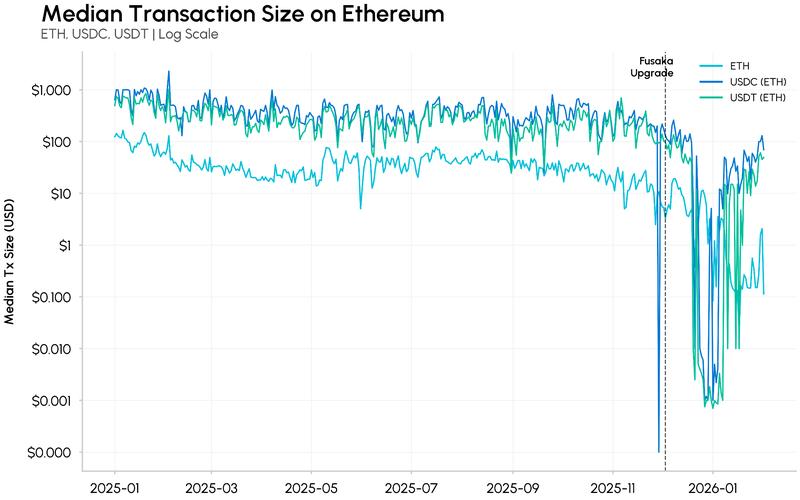
Coin Metrics' examination of 227 million balance updates for USDC and USDT revealed that dust transfers valued at less than $1 accounted for 43% of all transactions.

Following the implementation of the Fusaka upgrade, which reduced transaction costs on the network, stablecoin-driven dusting attacks now account for an estimated 11% of total Ethereum transactions and represent 26% of active addresses during a typical day, as reported by Coin Metrics.
The Ethereum network is currently processing over 2 million transactions daily on average, with numbers reaching nearly 2.9 million during the middle of January, alongside 1.4 million active addresses each day — representing a 60% rise compared to previous average figures.
Implemented in December, the Fusaka upgrade enhanced the network's affordability and accessibility by optimizing how onchain data is managed, specifically lowering the expenses associated with submitting information from layer-2 networks back to the Ethereum mainnet.
Digging through the dust on Ethereum
According to Coin Metrics, their analysis covered more than 227 million balance updates for USDC (USDC) and USDt (USDT) on the Ethereum network spanning from November 2025 to January 2026.
Their findings revealed that 43% of these updates were associated with transfers valued at less than $1, while 38% involved amounts below a single penny — "amounts with insignificant economic purpose other than wallet seeding."
"The number of addresses holding small 'dust' balances, greater than zero but less than 1 native unit, has grown sharply, consistent with millions of wallets receiving tiny poisoning deposits."
Before the Fusaka upgrade was implemented, stablecoin dust transactions comprised approximately 3 to 5% of all Ethereum transactions and represented 15 to 20% of active addresses, the report indicated.
"Post-Fusaka, these figures jumped to 10-15% of transactions and 25-35% of active addresses on a typical day, a 2-3x increase."
Nevertheless, the remaining 57% of balance updates were associated with transfers exceeding $1, "suggesting the majority of stablecoin activity remains organic," according to Coin Metrics' statement.
Users need to be wary of address poisoning
During January, Andrey Sergeenkov, a security researcher, highlighted a 170% surge in newly created wallet addresses during the week that began on Jan. 12, and similarly attributed this phenomenon to a surge in address poisoning attacks exploiting reduced gas fees.
Such "dusting" attacks generally involve bad actors transmitting fractions of a cent's worth of stablecoin from wallet addresses that closely mirror legitimate ones, tricking users into copying the incorrect address when executing a transaction.
According to Sergeenkov, $740,000 had already been stolen through address poisoning attacks. The most prolific attacker distributed nearly 3 million dust transfers while spending only $5,175 in stablecoin costs, as documented by Coin Metrics.
Dust does not represent genuine economic usage
Coin Metrics' report indicated that roughly 250,000 to 350,000 daily Ethereum addresses are participating in stablecoin dust activity, though the bulk of the network's expansion has been legitimate.
"The majority of post-Fusaka growth reflects genuine usage, though dust activity is a factor worth noting when interpreting headline metrics."