
BlackRock maintains lead as Morgan Stanley's Bitcoin ETF secures $30.6M debut
On its inaugural trading day, Morgan Stanley's Bitcoin ETF attracted $30.6 million in capital, securing the second position after BlackRock's IBIT amid overall net withdrawals from US spot Bitcoin ETFs on Wednesday.

On its first day of trading, the Morgan Stanley Bitcoin Trust (MSBT) attracted $30.6 million in capital inflows, marking the debut of the first spot Bitcoin exchange-traded fund (ETF) launched by a traditional US banking institution. While the performance represents a solid market entry for the Wall Street financial giant, it falls short of being characterized as a groundbreaking launch in the competitive spot Bitcoin ETF landscape.
Trading commenced for MSBT on the NYSE Arca platform on Wednesday, with the fund generating approximately $34 million in total trading volume throughout the day. This figure marginally exceeded the forecast made by Eric Balchunas, a Bloomberg ETF analyst, who had anticipated the inaugural day's volume would hit around $30 million.
According to data from April 8, MSBT's holdings consisted of 444.4 Bitcoin (BTC), representing a value of approximately $31.7 million. This amount constitutes roughly 0.03% of the total estimated 1.29 million BTC that US spot BTC ETFs hold collectively across all issuers.
Despite featuring the most competitive fee structure among comparable products, Morgan Stanley's ETF secured second place for the day, with only BlackRock's iShares Bitcoin Trust (IBIT) surpassing it by attracting $40 million in capital inflows. This dynamic underscores the intense competition within a marketplace that remains concentrated among several major issuers.
Rather than representing a direct competitive threat to BlackRock's market position, the launch serves as evidence that established traditional finance institutions continue to identify opportunities within the Bitcoin ETF sector. However, Morgan Stanley's entrance comes approximately two years after the initial wave of approvals, entering a marketplace where the 2024 cohort of launches established considerably more ambitious benchmarks for opening-day investor demand.
Total Bitcoin ETF flows negative amid outflows from FBTC and ARKB
The combined capital inflows to IBIT and MSBT proved insufficient to counterbalance the capital withdrawals experienced by competing funds. The Fidelity Wise Origin Bitcoin Fund (FBTC) experienced outflows totaling $79 million, while the ARK 21Shares Bitcoin ETF (ARKB) saw approximately $75 million in redemptions, based on data provided by Farside.
Contributing to the negative trend, the Grayscale Bitcoin Trust ETF (GBTC) registered an additional $11 million in investor redemptions. When aggregated, these movements resulted in total daily net outflows of $124.5 million across all US spot Bitcoin ETFs for the trading session.

These withdrawals represented the second straight trading day characterized by net selling activity. This followed Tuesday's session, which saw $159 million in total outflows, occurring immediately after Monday's substantial $471 million in aggregate inflows, which marked the most significant single-day capital influx since the latter part of February.
MSBT trails the 2024 launch wave
When compared to the January 2024 launch cohort that emerged following the Securities and Exchange Commission's greenlight for the initial wave of US spot Bitcoin ETFs, MSBT's market debut appears relatively modest in scale.
During their respective opening sessions, GBTC and IBIT processed $2.3 billion and $1 billion in trading volume. On its first trading day, IBIT attracted approximately $112 million in capital inflows, whereas GBTC experienced $95 million in net outflows.
Despite lagging behind those earlier benchmarks, the Morgan Stanley Bitcoin ETF remains positioned to rank among the most successful ETF product launches over the past twelve months, based on analysis from Bloomberg's Balchunas.
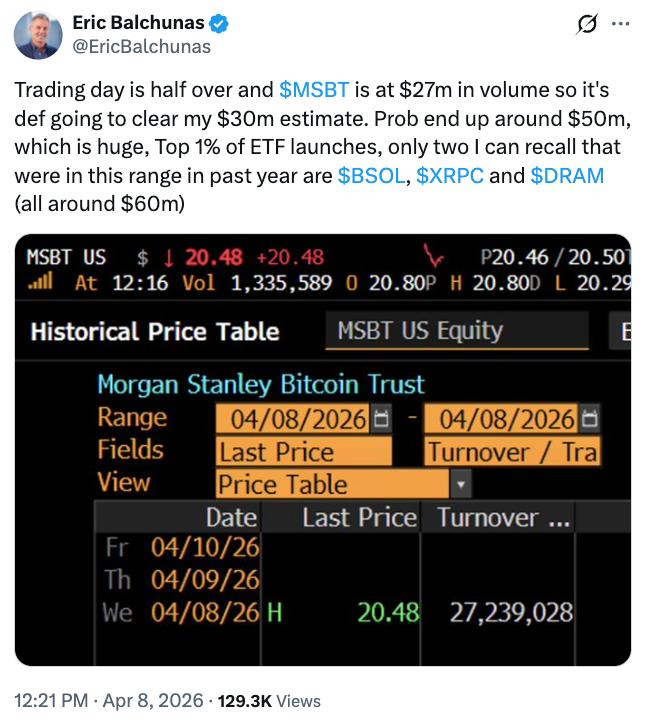
In his assessment, the ETF analyst made reference to various products including the Bitwise Solana Staking ETF (BSOL), the Canary XRP ETF (XRPC) and the Roundhill Memory ETF (DRAM), emphasizing a $60 million volume threshold as a relevant comparative benchmark for recent launches.