
Bank of Japan Policy Decision Looms as Yen Hits Four-Decade Weakness Against Dollar
Market observers sound alarm over potential recurrence of 2024's yen carry-trade reversal that impacted cryptocurrency markets, with Bank of Japan rate decision approaching.

The monetary authority of Japan has become the focal point for investors this week as it prepares for its upcoming interest-rate decision while the yen trades at levels not seen in four decades versus the United States dollar.
Key points:
- The currency of Japan is nearing fresh four-decade weakness levels versus the United States dollar, coming close to surpassing its most recent peak from the previous week.
- Japan's central banking institution will announce its interest-rate determination on July 31, with current rates standing at 1%, marking their peak level since September 1995.
- Market experts have been issuing warnings that the carry trade involving the yen might reverse once more, mirroring a significant cryptocurrency market obstacle from 2024.
Dollar-yen exchange rate approaches four-decade milestone
Information from TradingView demonstrated that the USD/JPY currency pair was moving toward the 164 level on Tuesday, sitting marginally beneath fresh four-decade peaks recorded during the prior week.
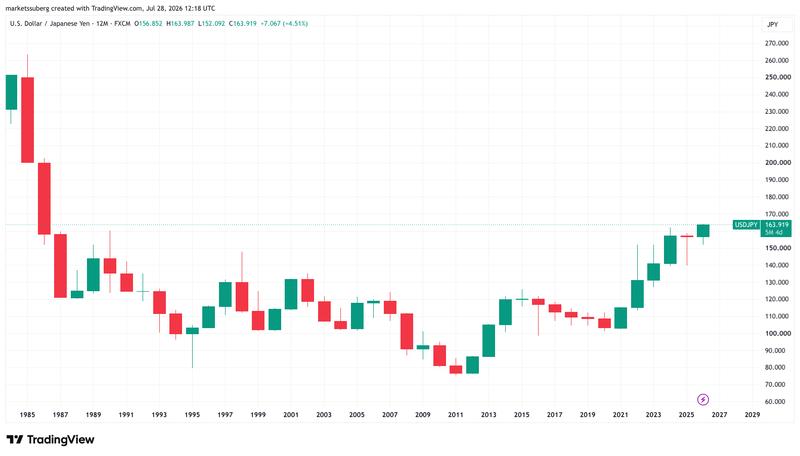
The Japanese yen's position as a currency used for funding purposes means the monetary policy decisions from the BoJ exert disproportionate influence across international markets. Currency markets in Japan are distinguished by their minimal restrictions on capital movement and unparalleled liquidity when compared to other non-dollar denominated currencies.
The persistent current account surpluses and trade surpluses that Japan accumulated during previous decades, combined with chronically low interest rate environments, have positioned the JPY as the world's most significant global funding currency. Nevertheless, following the uptick in Japanese inflation beginning in 2022, this situation has introduced the possibility of carry trade reversals accompanied by a crunch in available liquidity.
During Thursday and Friday of this week, the Bank of Japan (BoJ) will render its decision regarding potential adjustments to its benchmark interest rate, which currently stands at 1.0% and represents its highest level since 1995.
Financial markets anticipate rates will remain unchanged, with probabilities implied by the market suggesting a 98% likelihood of maintaining the current rate, considering that policymakers implemented their most recent increase in June. The prediction platform Polymarket calculates the chances of no modification at 99% as of Tuesday.
During that time, nonetheless, the BoJ indicated that additional increases would be implemented at a later date. In a synopsis from the June policy meeting, it made reference to inflationary patterns as measured by the Consumer Price Index (CPI), combined with the historically low rates that have been maintained over the past three decades, as justification for the adjustment.
As for the future conduct of monetary policy, given that underlying CPI inflation has been approaching 2% and financial conditions have been accommodative, it is appropriate for the Bank to continue to raise the policy interest rate and adjust the degree of monetary accommodation, in response to developments in economic activity and prices as well as financial conditions.
Bank of Japan
Following that decision, an additional challenge in the form of yen depreciation has intensified, maintaining its position above the crucial 160 threshold versus the dollar despite experiencing a temporary decline after the June rate increase.
The BoJ had previously highlighted the possibility that a weaker yen could exert pressure on CPI growth, limiting the purchasing power available to consumers.
Attention should also be paid to the point that, with firms' behavior shifting more toward raising wages and prices recently, exchange rate developments are, compared to the past, more likely to affect prices, and that such moves could affect underlying CPI inflation through changes in inflation expectations.
Bank of Japan's Outlook for Economic And Prices document
Reversal of yen carry trade poses international contagion risk
For participants in cryptocurrency trading, movements in the yen hold significant importance. The carry trade strategy utilizing the yen, which can serve as a source of liquidity for cryptocurrency markets, experiences heavy influence from BoJ interventions aimed at stabilizing the yen's valuation relative to the dollar. As previously documented by Cointelegraph, interventions that occurred in August 2024 triggered an abrupt "unwinding" of the carry trade strategy, resulting in an immediate negative impact on Bitcoin and alternative cryptocurrencies.
Currently, with the USD/JPY pair establishing new four-decade peak levels, apprehensions regarding a potential repetition are intensifying.
That trade only works if two conditions remain intact. Japanese interest rates remain exceptionally low. The yen remains broadly stable or continues depreciating.
Analyst Ricky Ho
Ho indicated that reversals of carry-trade positions are "rarely gradual" due to the substantial amounts of leverage utilized by market participants.
He issued a warning that any modifications to BoJ policy could therefore result in more extensive ramifications for a global economy that has already become accustomed to Japan's economic status quo.
Ultimately, we think investors remain too focused on whether the BOJ hikes in September, October or December. The more important issue is that the direction of policy has fundamentally changed.
Ricky Ho