
America's cryptocurrency regulations must withstand future political shifts
Ex-Governor Andrew Cuomo of New York contends that lawmakers need to enact robust, cross-party digital asset laws before electoral transitions disrupt the regulatory landscape.

Opinion by Andrew M. Cuomo, former governor of New York
The era of digital assets has arrived, fundamentally reshaping how our financial infrastructure operates.
The question of whether this evolution will persist is no longer on the table. It certainly will. What remains uncertain is whether America will put in place transparent, lasting regulations that allow this sector to flourish domestically.
At this moment, the response is negative.
The CLARITY Act was designed to address this challenge. It aimed to establish a nationwide regulatory structure for digital assets, define the responsibilities of federal regulatory bodies like the Securities and Exchange Commission (SEC) and the Commodity Futures Trading Commission (CFTC), and offer businesses, investors and consumers transparent guidelines on compliance requirements.
While the House approved the CLARITY Act in 2025, legislators have not yet delivered a final bill to the president's desk. The Senate's failure to move the Act forward in September has left many asking: where do we go from here?
Those identical federal regulators have stepped in rapidly with new regulations that substantially reshape the marketplace. The SEC and CFTC have both taken extremely assertive approaches to establishing new rules, occupying the regulatory vacuum created by congressional inaction, putting forward a novel federal structure for crypto trading venues and a customized regulatory system for specific crypto assets.
For the immediate future, this development is positive, and we're likely to witness numerous new market possibilities emerge. However, the truth is that these regulations have been implemented without a comprehensive market structure statute passed by Congress and depend on agencies' current statutory powers, missing the staying power of freshly enacted legislation.
Even more significantly from the perspective of Democrats, these rules were implemented despite resistance from legislators. This renders the regulations politically fragile right out of the gate.
And there's nothing quite like the wrath of a slighted Congress.
The next election could upend the rules
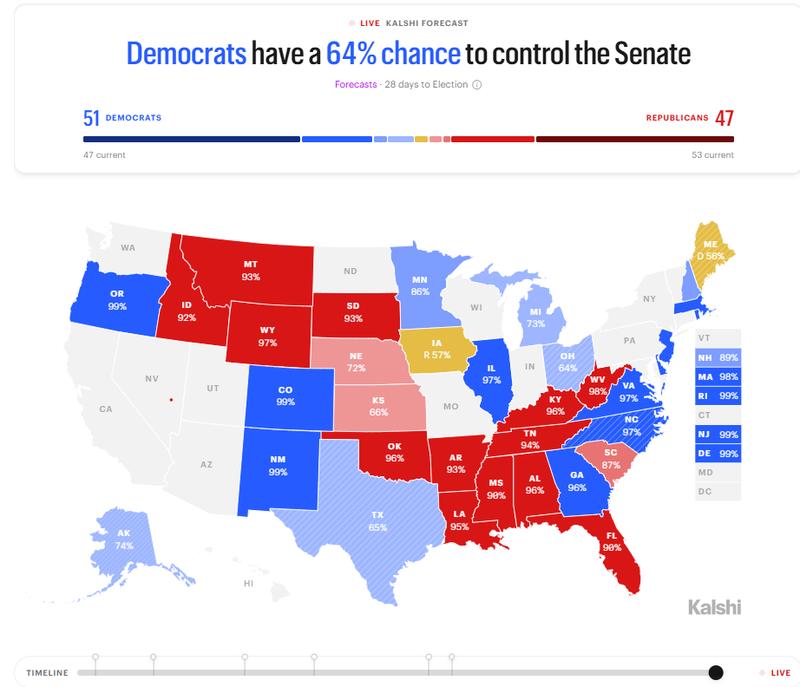
According to prediction markets and prevailing electoral patterns, Democrats are positioned to gain control of one chamber, potentially both chambers, of Congress following the midterm elections. And the capacity of Congress to obstruct and derail regulatory actions should never be taken lightly.
I witnessed this pattern firsthand during my tenure in the Clinton administration at the Department of Housing and Urban Development (HUD). When the 1994 midterm elections brought Republicans into control of both the House and Senate, the department's authority was significantly curtailed. Scrutiny became more intense, budget allocations turned into negotiating chips, and Congress deployed every available mechanism to question and restrict the administration. This is the standard congressional response when lawmakers believe executive agencies have overreached.
Democrats will seek to validate their assertions that the Trump administration operated corruptly and that regulatory decisions were crafted to personally enrich individuals and reward campaign contributors. Regardless of whether these accusations hold merit, they will shape the political landscape. And political considerations will determine the intensity of oversight.
The legislative branch possesses numerous instruments for intervention. Regulatory agencies are required to present new rules and regulations prior to implementation, creating opportunities for legislative input. Lawmakers can restrict budgetary allocations for agency initiatives, enact laws that supersede agency decisions, or utilize the Congressional Review Act to nullify specific regulations. Congress additionally wields investigative authority and subpoena power that can create substantial disruption when combined with public testimony hearings. One need only reference Anthony Fauci and Jack Smith for recent examples!
Congress must put politics aside
The fundamental challenge centers on harmonizing private sector technological advancement with thoughtful government oversight. Following the CLARITY Act's defeat, uncertainty became the norm. This outcome is detrimental for business interests, detrimental for investors, detrimental for consumers and detrimental for America.
Businesses shouldn't need to speculate about whether current regulations will remain intact after the next electoral cycle. They shouldn't have to make decisions about building and investing domestically based on which political party dominates Washington. They deserve clarity on what activities are permitted, what actions are forbidden, which agencies oversee what functions and how enforcement will proceed.
America warrants a regulatory system that fosters innovation while safeguarding consumers and investors. It warrants rules that deter illegal activities and preserve market integrity. It warrants a regulatory framework that businesses can depend upon when determining where to expand their workforce, allocate capital and establish operations.
Other nations comprehend this reality. They are building their own frameworks, such as Europe's Markets in Crypto Assets (MiCA) regulation or Singapore's Payment Services Act, delivering regulatory clarity and establishing benchmarks. The United States cannot permit political stalemate to dictate the trajectory of financial innovation.
It is critical that the incoming Congress makes it a top priority to set politics aside — if only temporarily — and enact bipartisan legislation authorizing digital asset activities, enabling companies to invest securely and strategically in the US.
About the author: Andrew M. Cuomo served as governor of New York from 2011 to 2021 and previously served as New York attorney general and US secretary of Housing and Urban Development. He currently serves on the board of OKX and co-chairs OKXICE, a joint venture between OKX and Intercontinental Exchange focused on tokenized and digitally native financial products.