
2026 Hardware Wallet Comparison: Which Crypto Security Device is Right for You?
An in-depth comparison of top cryptocurrency hardware wallets examining security features, connection methods, blockchain support, backup solutions, and ease of use to help you select the ideal device.
Hardware wallets are specialized devices engineered to safeguard the private keys required for authorizing cryptocurrency transactions. Put simply, while your digital assets remain stored on the blockchain itself, the hardware wallet secures the cryptographic keys that grant you control over those assets.
Key distinctions among various wallet models include which digital currencies they accommodate, the methods by which they interface with your smartphone or personal computer, and the processes through which you review and authorize transactions. This comprehensive guide breaks down these variations and clarifies their significance in the wallet selection process.
Our wallet evaluation methodology
For this analysis, Cointelegraph conducted hands-on testing of the Trezor Safe 7, Ledger Stax, Flex, Nano Gen5, Nano X, Nano S Plus, and Coinkite's Opendime. The testing process utilized both smartphones and computers operating on Linux and macOS platforms, employing a combination of manufacturer-provided software and third-party applications. While the Opendime was evaluated for cold storage purposes, the remaining models underwent testing for both straightforward transaction processing and interactions with decentralized applications. For all other wallet models discussed in this article, our analysis relied exclusively on information available in the public domain.
The hardware units used for evaluation were provided at no cost to the article's author by Ledger, Trezor, and Coinkite following our request to facilitate comprehensive device testing. None of these manufacturers provided financial compensation or received any guarantees regarding favorable editorial coverage.
The security provided by hardware wallets
Hardware wallets maintain transaction signing operations isolated from your smartphone or personal computer. This isolation significantly reduces the possibility that malicious software on connected devices could compromise your keys, thereby preventing cybercriminals from gaining unauthorized access to your cryptocurrency holdings.
The majority of hardware wallets incorporate a built-in display, enabling you to confirm transaction details directly on the wallet device. This safeguard ensures that even if the connected smartphone or computer presents false information in an attempt to deceive you into authorizing a fraudulent transaction, you retain the ability to identify the discrepancy prior to completing the signature process.
Nevertheless, this protective capability has inherent limitations. The wallet's screen must present sufficient detail for you to comprehend exactly what action you're authorizing. You remain vulnerable to fund loss through approving fraudulent transactions, compromising your recovery backup phrase, or utilizing wallet software with security vulnerabilities.
Your recovery backup phrase requires equally stringent protection. Anyone who gains possession of this backup may successfully restore your wallet configuration and gain complete access to the associated funds.
Multi-cryptocurrency hardware wallet options
For users holding diverse cryptocurrency portfolios, the initial step involves verifying whether a particular wallet accommodates your specific coins and the blockchain networks you utilize. Additionally, determine which functionalities operate through the manufacturer's proprietary application versus those requiring alternative software solutions.
The following table presents multi-asset wallet models, with all technical specifications sourced directly from manufacturer documentation.
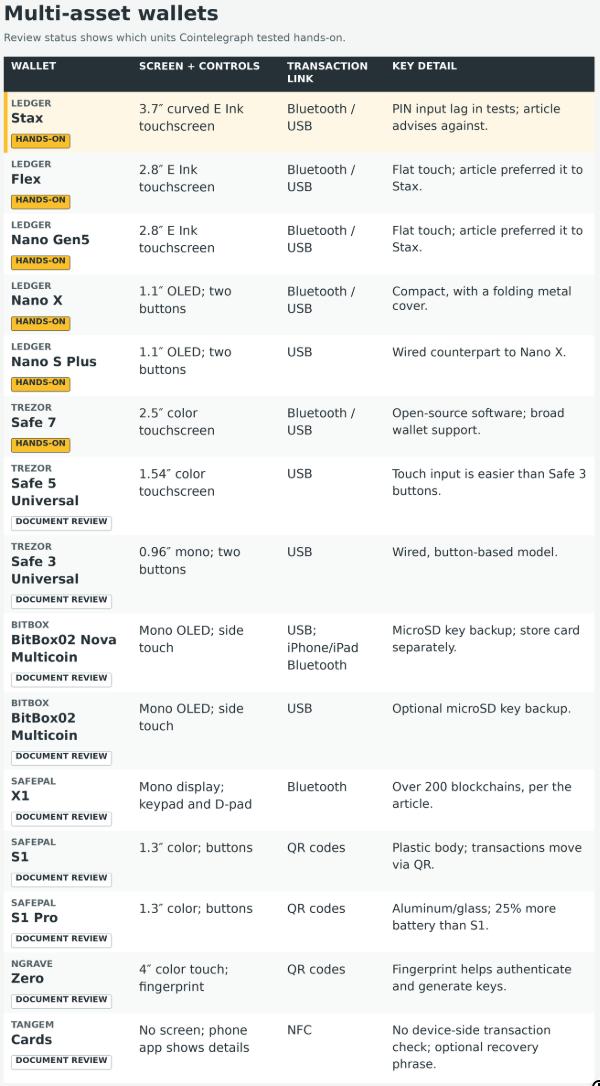
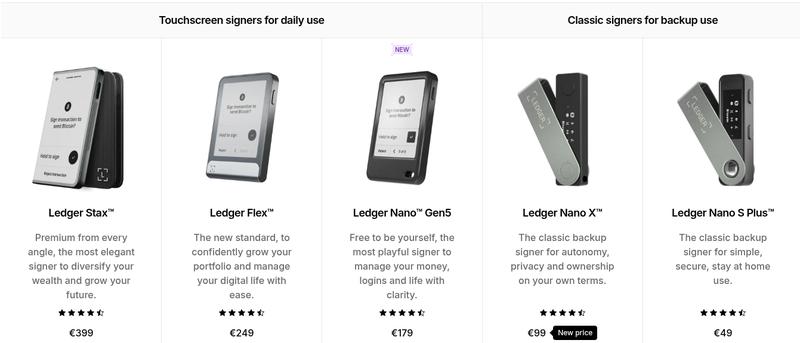
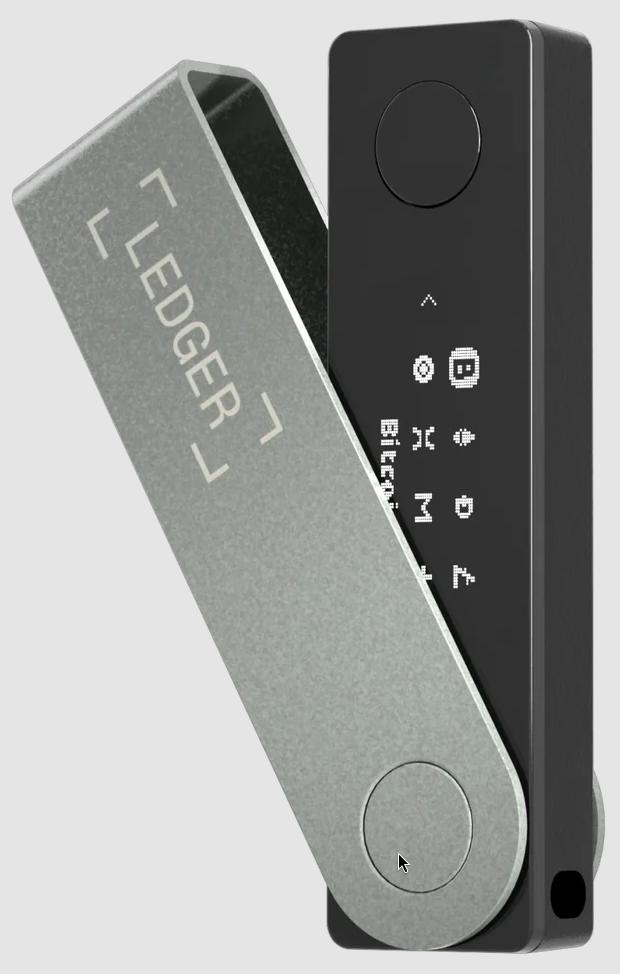
The Stax, Flex, Nano Gen5, and Nano X models from Ledger offer connectivity via both Bluetooth wireless and USB wired connections.
The Stax model features a 3.7-inch E Ink touchscreen display that wraps around both the front surface and one edge of the device. Meanwhile, the Flex and Nano Gen5 incorporate flat, rectangular E Ink touchscreens measuring 2.8 inches diagonally.
In contrast, the Nano X utilizes a more compact 1.1-inch OLED display paired with two physical navigation buttons. Its protective metal cover folds to create a profile resembling a standard USB flash drive.
Throughout Cointelegraph's evaluation of the Ledger product line, testing revealed that the Stax — representing the premium-priced option in the range — exhibits noticeable responsiveness problems, which the manufacturer acknowledged stem from the curved wraparound screen design implemented in the device.
Users experienced this issue as delayed input response, leading to frequent incorrect PIN entries and necessitating significantly slower number input compared to other devices in the lineup. Based on this finding, we recommend avoiding this particular model, as our testing determined that the more affordable touchscreen alternatives deliver substantially superior user experiences.
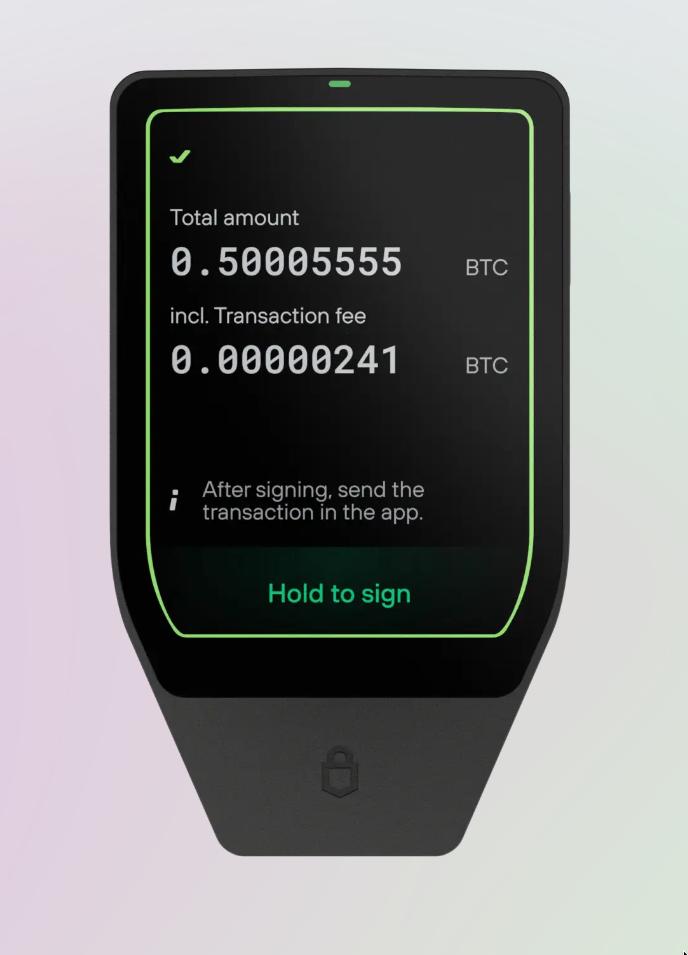
The Trezor Safe 7 represents a color touchscreen hardware wallet featuring completely open-source software architecture, contrasting with Ledger's approach of utilizing certified secure element chips that impose legal restrictions preventing Ledger from making portions of its codebase open-source.
From a functional standpoint, their feature sets are largely equivalent, both offering extensive third-party software compatibility, support for thousands of cryptocurrency assets, and dedicated management applications for desktop and mobile platforms.
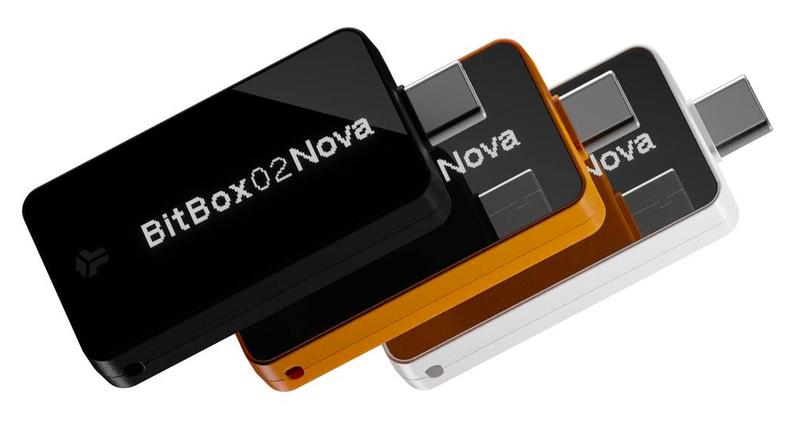
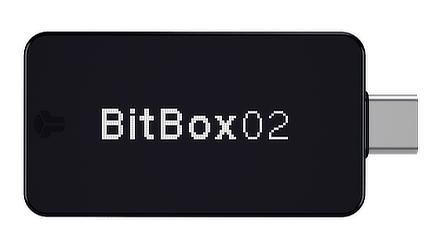
The BitBox02 Nova Multicoin serves as a Bluetooth-enabled multi-purpose hardware wallet featuring capacitive touch controls positioned over an OLED screen, offering compatibility across all major operating system platforms. This device distinguishes itself as the first model we examine that enables users to create backup copies of private keys on a microSD card. This storage card requires secure storage in a location separate from the wallet device itself.
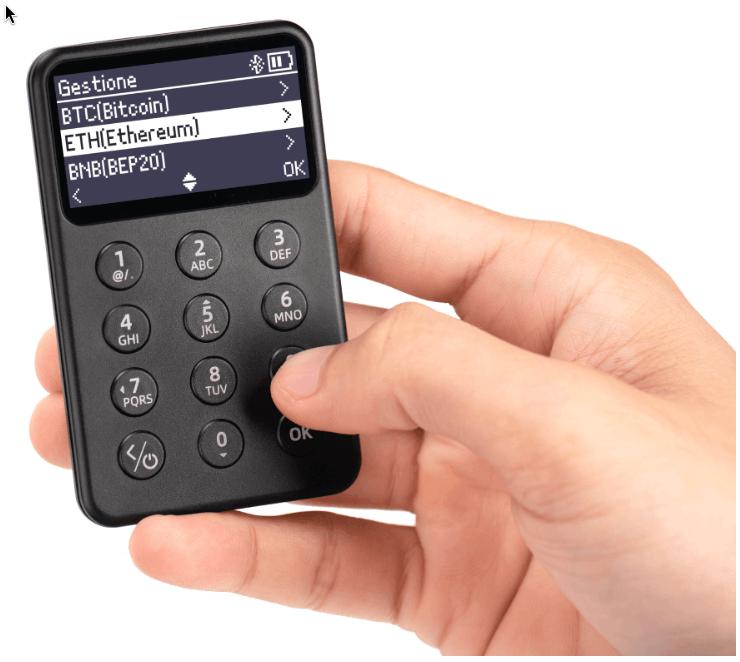
The SafePal X1 differentiates itself from the previously discussed options through its complete numeric keypad, straightforward monochrome user interface, and budget-friendly Bluetooth wireless capability. This hardware wallet provides wireless connectivity at an exceptionally competitive price point while maintaining support for over 200 distinct blockchain networks. Typically retailing around $70, this device is presently offered through Changelly's wallet marketplace for $29.99, representing approximately 57% savings below its standard pricing.
Following these are the USB-connected multi-purpose hardware wallet options. This category encompasses Ledger's Nano S Plus, Trezor's Safe 5 Universal and Safe 3 Universal models, alongside the BitBox02 Multicoin, all of which establish connections with compatible computers and mobile devices via USB cable. The Nano S Plus shares virtually identical specifications with the Nano X, differing primarily in its exclusive support for wired communication protocols.
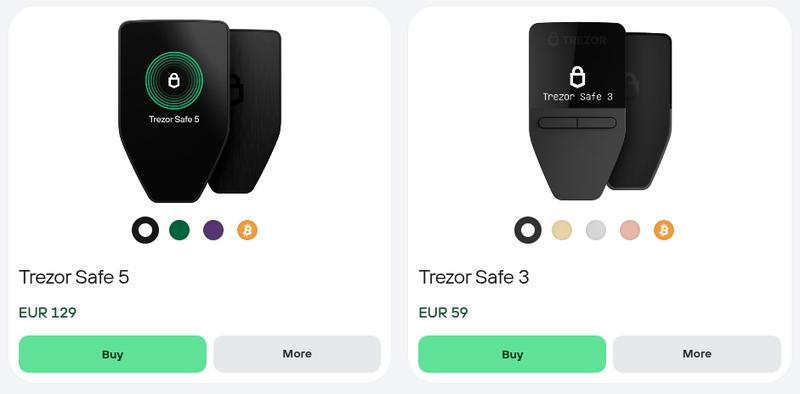
Trezor's Safe 5 Universal and Safe 3 Universal represent USB-connected hardware wallet solutions, with the Safe 5 incorporating a full-color touchscreen interface while the Safe 3 employs a monochromatic screen with dual physical buttons. Both models offer comparable feature sets, though the Safe 5 Universal provides considerably more streamlined data input and output experiences.
Finally, the BitBox02 Multicoin represents the Swiss manufacturer's USB-connected monochrome touchscreen hardware wallet solution. Similar to its wireless counterpart, the BitBox02 Nova Multicoin, this wired version also supports private key backup functionality using a microSD card.
QR code-based wallet devices
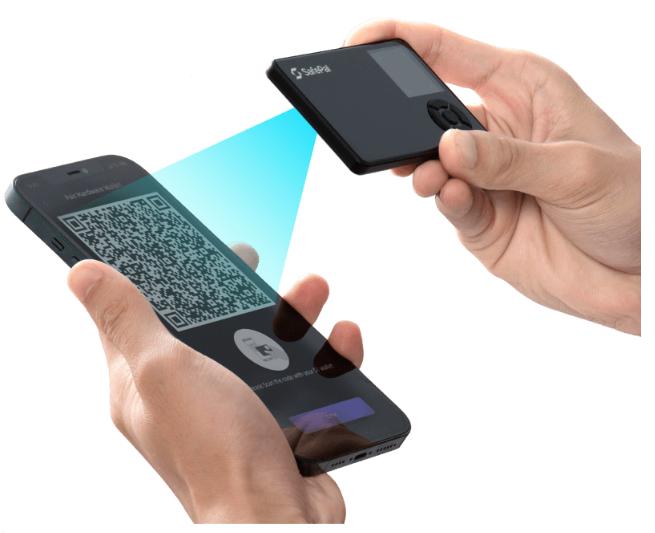
The SafePal S1, S1 Pro, and Ngrave Zero models facilitate transaction data transfer through QR codes displayed on their integrated screens and captured by device cameras. This mechanism enables users to authorize transactions without establishing USB or Bluetooth data connections. These devices continue to require USB connectivity for battery charging and firmware update procedures. Users must still carefully review transaction details before approval — QR code technology alone does not ensure transaction security.
The SafePal S1 and S1 Pro are fundamentally identical devices: QR code-based hardware wallets sharing the same color display technology, with the Pro variant constructed from aluminum and glass materials while the standard model utilizes plastic housing. The Pro version incorporates 25% additional battery capacity, though this represents the primary practical distinction between the two devices.
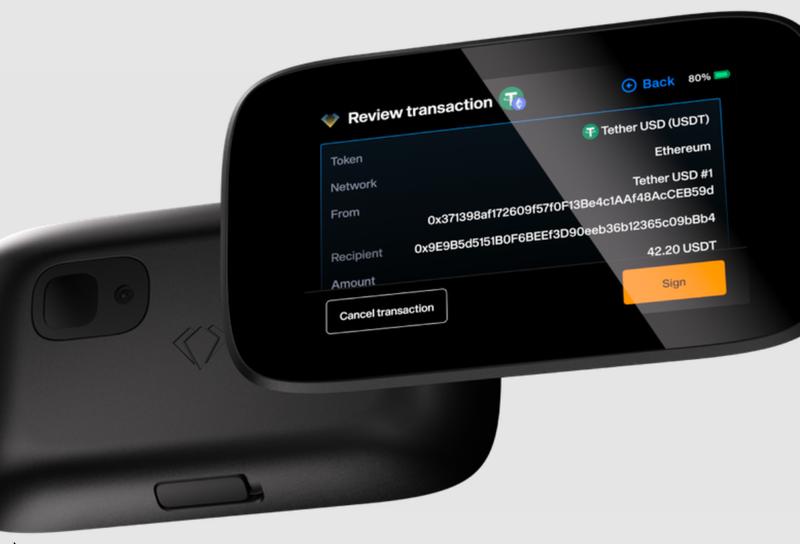
The Ngrave Zero functions as a smartphone-inspired air-gapped hardware wallet equipped with a color touchscreen and a user interface design reminiscent of contemporary mobile applications. This device incorporates an integrated fingerprint sensor serving dual purposes: user authentication and as an additional entropy source during cryptographic key generation, working in conjunction with its dedicated random number generator and ambient light sensor data.
Wallet cards using NFC technology
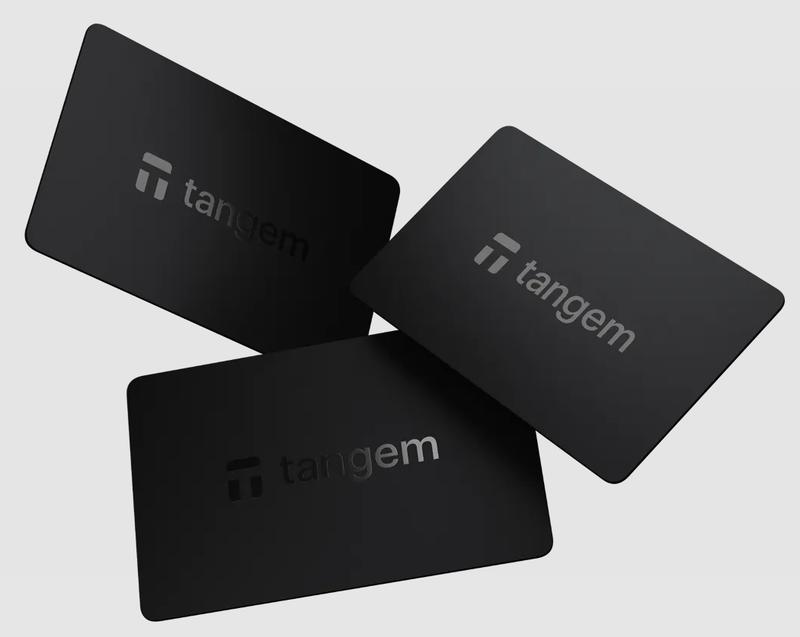
Finally, Tangem wallet cards utilize near-field communication (NFC) technology as hardware wallets operating without dedicated display screens, which means these wallets cannot independently alert you if your connected device has been compromised and is attempting to deceive you into signing a transaction displaying different information on screen than what you're actually authorizing. Users initiate wallet interactions by tapping the card against their smartphone.
Tangem provides setup options both with and without recovery phrase generation. Wallets created without recovery phrases generate cryptographic keys internally within the card itself. When establishing a wallet using a recovery phrase, the mobile application generates the phrase and subsequently transfers the resulting keys to the card.
Hardware wallets exclusively for Bitcoin
For users exclusively transacting in Bitcoin, both Trezor and BitBox manufacture Bitcoin-specific versions of several wallets previously discussed. These specialized versions omit compatibility with alternative cryptocurrencies. Purchasers must still evaluate transaction verification methods, backup protection strategies, and device software maintenance procedures.
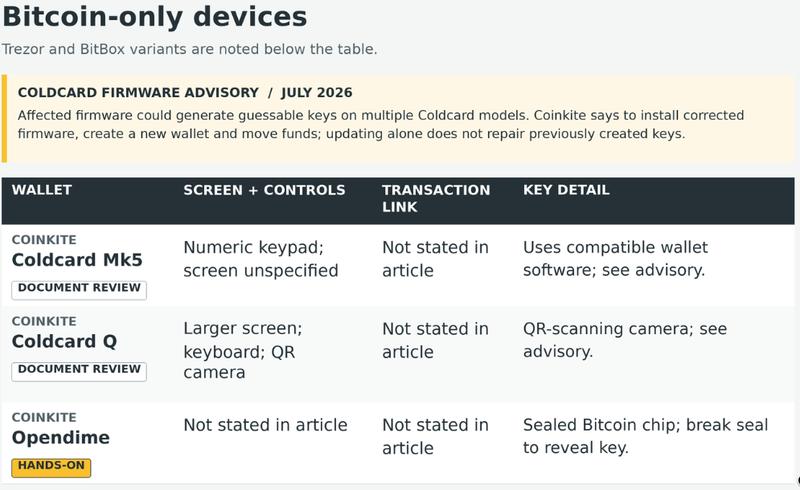
Coinkite's Coldcard Mk5 functions as a hardware wallet featuring a numeric keypad interface, while the Coldcard Q expands upon this foundation with a larger display screen, complete alphanumeric keyboard, and integrated camera for QR code scanning. Both devices operate with compatible wallet software applications, such as Sparrow, for transaction preparation.
During July 2026, Coinkite issued a security warning that specific Coldcard firmware versions could generate wallet keys with reduced cryptographic strength, making them more susceptible to attacker brute-force attempts. This vulnerability affected multiple device models across various software versions.
In an Aug. 24 update, Galaxy Research's Alex Thorn attributed the unauthorized transfer of approximately 1,789 BTC from 8,865 distinct addresses to this security flaw. The stolen Bitcoin held a value of about $114.7 million at the time these thefts occurred.
Coinkite directed affected users to install corrected firmware versions, generate new wallet configurations, and migrate their Bitcoin holdings. Installing updated firmware does not remediate keys previously generated with the flawed software. Users should consult the company's official security advisory for information on affected versions, specific exceptions, and detailed migration procedures.
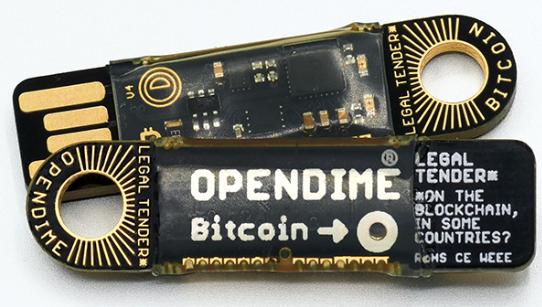
Coinkite's product range includes the Opendime Bitcoin credit chips and button-operated hardware wallets Coldcard and Coldcard Q, all exclusively supporting Bitcoin. The Opendime realizes the cyberpunk vision of physical credit chips by enabling Bitcoin storage until the device seal is physically broken — analogous to accessing funds from a digital piggy bank — thereby revealing the private key that permits users to spend the stored assets.
Selecting the appropriate wallet for your requirements
Begin by identifying the cryptocurrencies in your portfolio and the smartphone or computer you intend to use. Subsequently, consider your preferences for transaction verification and access recovery procedures should the device be lost or damaged. After developing a shortlist of candidates, the Changelly hardware wallet marketplace provides tools to compare cold wallet options side by side and purchase them at promotional prices unavailable through standard retail channels.
A display-free NFC wallet card could, for example, serve effectively as an affordable option for one key in a multisignature security arrangement alongside other keys with more robust verification mechanisms, while a Bitcoin-exclusive device will minimize potential attack vectors by eliminating support for cryptocurrencies that certain users never utilize, though proving unsuitable for others with different needs.
Furthermore, premium pricing may provide enhanced display quality, superior construction materials, or additional convenience features, but does not inherently guarantee stronger security protection. An essential aspect of hardware wallet ownership involves developing practices to safeguard your backup phrases, thoroughly verify transaction details, and maintain awareness of security updates to ensure ongoing protection — understanding that hardware wallets function as risk mitigation tools that cannot provide absolute guarantees against potential loss.