
White House Economic Report: Stablecoin Interest Poses No Threat to Banking Sector
Economic advisers to the White House have determined that prohibiting interest payments on stablecoins would generate negligible increases in bank lending activity while simultaneously imposing approximately $800 million in yearly costs on consumers, as regulatory debates surrounding cryptocurrency intensify.

Economic advisers to the White House have concluded that prohibiting yield payments on stablecoins would result in minimal effects on banking sector lending activity while simultaneously producing evident economic disadvantages.
The Council of Economic Advisers, a three-person organization operating within the Executive Office of the President responsible for providing economic guidance to the president, determined that transferring capital from stablecoins to traditional bank deposits would fail to generate meaningful increases in new lending activity. In the baseline projection, overall bank lending would grow by approximately $2.1 billion, representing roughly 0.02% of the total $12 trillion lending market.
The analysis, released on Wednesday, indicates that smaller community banking institutions would experience even more limited benefits. These institutions would see lending volumes increase by approximately $500 million, representing about 0.026% growth.
These conclusions emerge during a continuing dispute between traditional banking institutions and the cryptocurrency sector regarding stablecoin yield offerings. Traditional banking organizations, such as the Independent Community Bankers of America, have cautioned that allowing stablecoin yields could substantially diminish bank lending volumes, whereas cryptocurrency advocacy groups have disputed this assertion.
Stablecoin lending ban could cost $800 million per year
In contrast, implementing a prohibition on stablecoin rewards might impose greater economic burdens. The analysis projects a net economic welfare reduction of approximately $800 million annually, primarily attributable to users being denied access to yield opportunities on stablecoins. The calculated cost-benefit ratio stands at about 6.6, indicating that the economic disadvantages would substantially outweigh any potential increases in lending activity.
Producing lending effects in the hundreds of billions requires simultaneously assuming the stablecoin share sextuples, all reserves shift into segregated deposits, and the Federal Reserve abandons its ample-reserves framework.
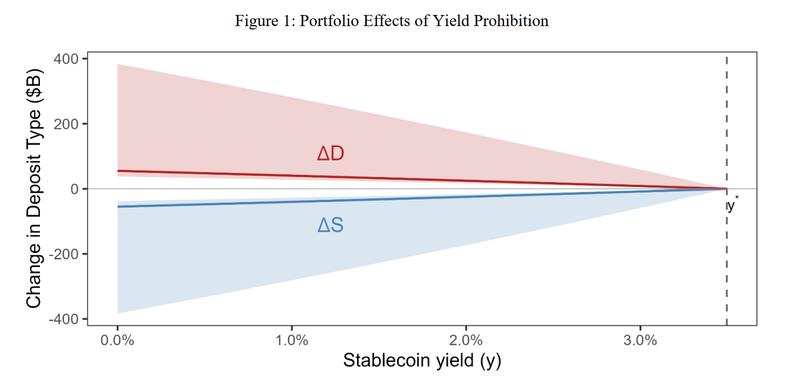
During July 2025, President Donald Trump enacted the GENIUS Act into federal law. This legislation bars stablecoin issuers from distributing interest or yield payments to token holders, though third-party service providers (such as cryptocurrency exchanges) retain the ability to provide yield offerings on stablecoins. The proposed Digital Asset Market Clarity Act may address this regulatory gap by establishing clear guidelines on whether yield restrictions should apply universally or be permitted under specific circumstances.
CLARITY Act nearing Senate markup hearing
The United States House of Representatives approved the CLARITY Act on July 17, 2025. During January, Senate Banking Committee Chair Tim Scott postponed a scheduled markup session, which remains unscheduled at this time.
During the previous week, Coinbase chief legal officer Paul Grewal indicated the CLARITY Act may be approaching a markup hearing within the US Senate Banking Committee, suggesting lawmakers are nearing consensus on critical provisions. He emphasized that forward movement depends on successfully resolving ongoing disagreements concerning stablecoin yield regulations.