
US Risks Ceding Financial Leadership to China Without CLARITY Act, Warns Senator Lummis
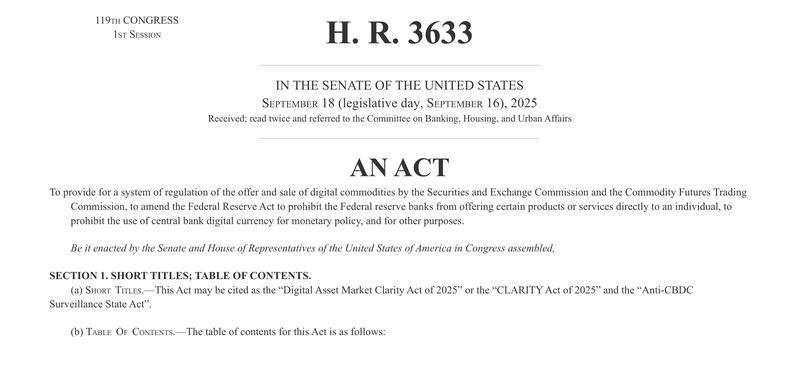
Following the Senate Banking Committee's May vote to move the CLARITY Act forward, the legislation now faces the challenge of passing through both the House and Senate before reaching the president for signature.

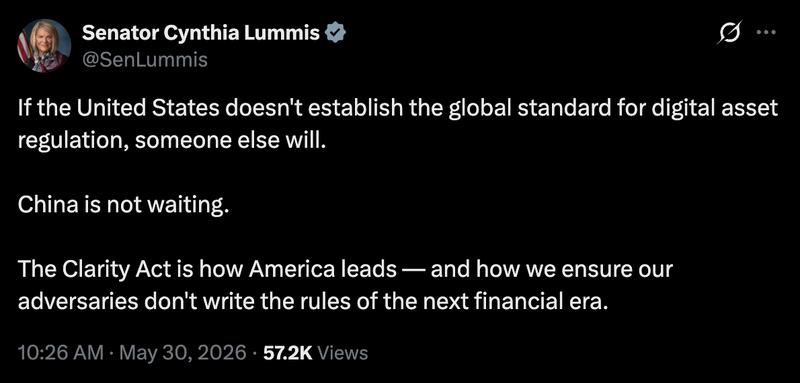
Wyoming Senator Cynthia Lummis has warned that failure to pass the Digital Asset Market Clarity Act (CLARITY), a bill designed to establish crypto market structure, will result in the United States surrendering its dominant position in the cryptocurrency sector to rival nations, particularly China.
According to Lummis, the passage of a thorough regulatory framework for cryptocurrencies would guarantee that competing nations cannot establish the regulatory standards for the emerging financial landscape. In an additional statement posted on X, she emphasized:
"America built the dollar-dominated financial system that has anchored global stability for a century. The Clarity Act ensures we build the next one. The time to act is now, before Beijing decides it will."
Following months of legislative inaction, the Senate Banking Committee voted in May to move the CLARITY Act forward, reigniting optimism within the cryptocurrency industry that the bill could become law during 2026.
Despite being among the most crucial pieces of cryptocurrency legislation in the United States, the market structure bill's path to becoming law in 2026 remains uncertain, primarily due to resistance from banking industry lobbyists and the approaching US midterm elections.
JPMorgan CEO says banks will oppose CLARITY, as the window to pass it narrows
During remarks made on Friday, JPMorgan CEO Jamie Dimon indicated that the banking sector will mount opposition against the bill's current version, citing its continued allowance for cryptocurrency firms to offer interest payments on customer deposits.
Dimon further noted that the present form of the CLARITY Act fails to enforce identical anti-money laundering (AML) regulations and capital reserve mandates on cryptocurrency companies that traditional banks are required to comply with.
Dimon stated that "The banks will not accept it that way," further commenting that banking institutions would maintain their opposition to the legislation. The JPMorgan chief executive was particularly critical of cryptocurrency exchange Coinbase and the lobbying efforts of its CEO Brian Armstrong regarding the bill's passage.
"No one is going to bow down to this guy or that company," Dimon said. Simultaneously, the opportunity to enact the CLARITY Act is becoming increasingly limited as the nation approaches the midterm election cycle.
Senator Lummis has cautioned that failure to enact the bill into law during 2026 could mean the next viable opportunity for passing such legislation might not emerge until 2030.