
Michigan's legal fight over Coinbase prediction markets to see Detroit intervention
Detroit plans to submit an amicus brief supporting Michigan in its legal dispute with Coinbase, a case the crypto exchange initiated before rolling out prediction market services.

Legal counsel for Detroit, a major US city, intends to submit an amicus brief in the ongoing legal dispute between Coinbase and Michigan, a case centered on whether federal authorities or individual states should regulate prediction market oversight.
According to a Thursday court document submitted to the US District Court for the Eastern District of Michigan concerning state officials' request for a preliminary injunction, District Judge Shalina Kumar granted approval for an order permitting Detroit to submit a brief backing state authorities in their legal action against Coinbase. The judge set April 3 as the deadline for Detroit's legal team to submit their filing while the case proceeds.
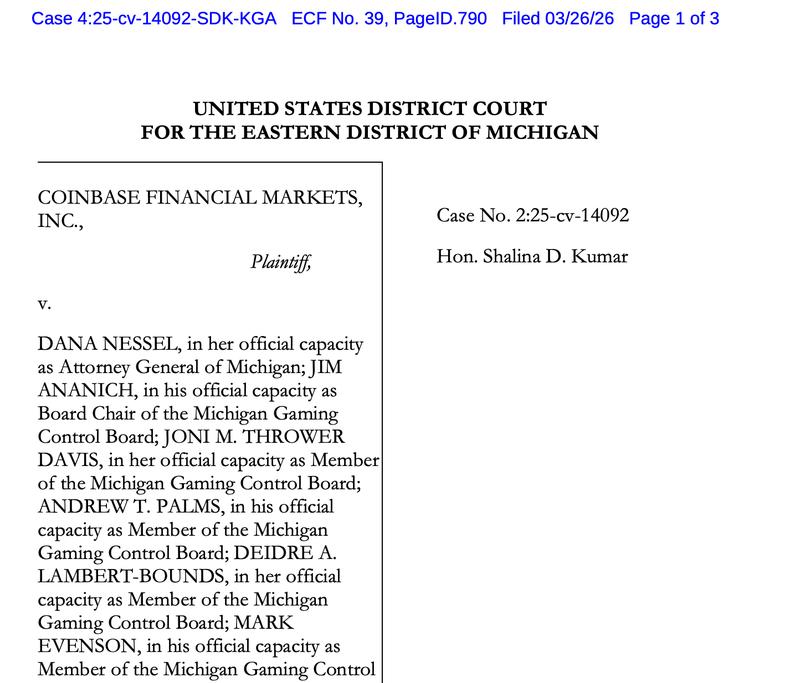
Coinbase initiated its legal action against Michigan in December, along with gaming regulators in Connecticut and Illinois, over a month prior to the cryptocurrency exchange revealing the rollout of its prediction market offerings on the platform.
The crypto firm's legal position rests on assertions that prediction markets should be regulated by the US Commodity Futures Trading Commission (CFTC) instead of state-level gambling authorities, disputing Michigan's regulatory enforcement actions.
Businesses providing event contract wagering on prediction markets such as Coinbase, Kalshi and Polymarket are currently confronting state-level legal challenges across various jurisdictions. Despite backing from CFTC Chair Michael Selig, who put forward new regulatory rules for the commission, uncertainty remained as of Friday regarding how the jurisdictional dispute between state regulators and federal authorities would be resolved.
Where will the chips fall for platforms dealing with state and federal authorities?
"The more the CFTC can do in this space [prediction markets] to put a comprehensive regulatory regime around it, the more likely it is for courts who are looking at the issue to say 'actually, yes, this is a CFTC jurisdiction issue — this really is not just an end run around sports gambling bans in particular states,'"
Stephen Piepgrass, partner at international law firm Troutman Pepper Locke
Piepgrass suggests the legal matters may eventually reach the US Supreme Court, considering its 2018 ruling in Murphy v. National Collegiate Athletic Association. That particular decision granted individual US states regulatory power over sports gambling, overturning a federal statute that had sought to ban such activities.
Individual US states have predominantly resisted legal challenges concerning prediction markets, though judicial rulings have favored the platforms in certain instances.
Earlier this month, a court ordered Kalshi to cease operations temporarily in Nevada, while the platform confronts criminal allegations in Arizona related to purported illegal gambling activities on sports and elections. Conversely, a Tennessee judge prevented state regulators from applying gambling statutes against the platform in February.
According to the Michigan Gaming Control Board, Detroit-based casinos produced over $200 million in revenue during January and February, contributing more than $24 million in tax revenue to the US state.