
How a Fraudulent Domain Sparked Legal Action in the CoinDCX Fraud Investigation
An elaborate impersonation scheme involving a counterfeit CoinDCX domain resulted in a 7.16 million rupee fraud and subsequent arrests. Discover how brand impersonation, not the legitimate exchange, was behind this incident.
Key takeaways
Simple yet remarkably effective impersonation schemes employ fraudulent websites that convincingly replicate legitimate cryptocurrency exchanges to trick unsuspecting users.
The CoinDCX situation demonstrates how a fraud complaint involving 7.16 million rupees led to legal proceedings before investigators recognized it as brand impersonation.
Fraudsters utilized the counterfeit domain coindcx.pro, rather than the authentic platform, to trick the victim and execute the scheme.
Criminals constructed an elaborate fraudulent infrastructure utilizing websites, Telegram communication channels and social platforms to establish apparent legitimacy.
When examining the cryptocurrency sector, attention typically centers on market fluctuations, vulnerabilities in smart contracts and evolving regulatory frameworks, yet some significant risks are surprisingly simple in their execution. Fraud frequently appears in recognizable forms. A counterfeit website that flawlessly replicates a legitimate trading platform can inflict both monetary losses and harm to reputation.
The incident involving CoinDCX impersonation serves as a clear example of this phenomenon. What initially started as a fraud complaint worth 7.16 million rupees ($77,000) subsequently grew into police action targeting the exchange's executive leadership. Nevertheless, judicial intervention eventually redirected accountability away from the genuine platform, exposing that the perpetrator was an elaborate digital impersonation orchestrated by fraudsters.
A fake CoinDCX, but a real complaint
The situation began with a complaint submitted by a 42-year-old insurance consultant residing in Mumbra, a suburban area located in the Thane district of the Mumbai metropolitan area. The person filing the complaint stated that he had lost approximately 7.16 million rupees to fraud. Throughout the deception, he was convinced that his interactions were with CoinDCX, which he believed was offering him investment opportunities.
The proposition reportedly featured guarantees of 10% to 12% returns each month and mentioned a franchise-style crypto investment model associated with the platform. These components, specifically the guarantee of substantial returns and the seeming authenticity of the brand, constituted the foundation of the purported fraud.
What distinguishes this situation is the subsequent developments. Rather than being recognized as an impersonation scheme, the complaint progressed into legal proceedings that resulted in the detention of the company's co-founders, Sumit Gupta and Neeraj Khandelwal.

The role of coindcx.pro in this case
At the heart of the incident was a fraudulent website, coindcx.pro, which became the victim's point of interaction rather than the authentic CoinDCX website, coindcx.com.
These fake domains represent a typical technique in brand impersonation schemes. They look visually authentic, convey trustworthiness and intentionally leverage the brand's existing credibility.
Based on declarations released by CoinDCX, no funds related to this incident were handled through its exchange infrastructure. The fraudulent scheme did not have its origins within the platform's operations. Rather, third-party actors purportedly utilized its name and established reputation as a lure.
Did you know? Domain impersonation scams often use subtle tricks, such as replacing letters, for example "o" with "0," or adding extra words, to make fake websites nearly indistinguishable from real ones at a glance.
How the fraudsters built a fake ecosystem
The brand impersonation purportedly went far beyond just a single domain. The fraudsters additionally created supporting infrastructure, including Telegram channels and social media profiles, to strengthen the appearance of authenticity. This pattern aligns with a wider trend in cryptocurrency fraud today, where criminals no longer depend on a single deceptive component but instead construct an entire parallel infrastructure.
From the victim's perspective, this arrangement produced a smooth and coherent experience: a website, a related community and representatives, all apparently tied to a well-known brand.
How the case escalated
The formal complaint was lodged at the Mumbra police station in Thane on March 16, 2026. As law enforcement pursued the investigation, CoinDCX's co-founders were apprehended in Bengaluru.
This sequence of events underscores a significant challenge in impersonation situations. When complainants reference a well-known company in a filing, it may require time to differentiate actual involvement from unauthorized use of the brand identity. In rapidly developing investigations, this ambiguity can occasionally result in measures against legitimate businesses before complete facts are determined.
The situation reached a pivotal moment when it appeared before a Thane magistrate court. The court approved bail for CoinDCX's co-founders and indicated that no prima facie case had been made against them. It determined that the complainant had been tricked by individuals posing as the company's promoters, rather than by the company's actual leadership. The victim also acknowledged having had no direct interaction with the company's co-founders.
Did you know? Cybercriminals often buy expired or similar-looking domains in bulk, enabling them to launch multiple fake versions of a popular crypto platform within hours once a scam template proves effective.
A wider pattern of fake domains
The CoinDCX situation is far from unique.
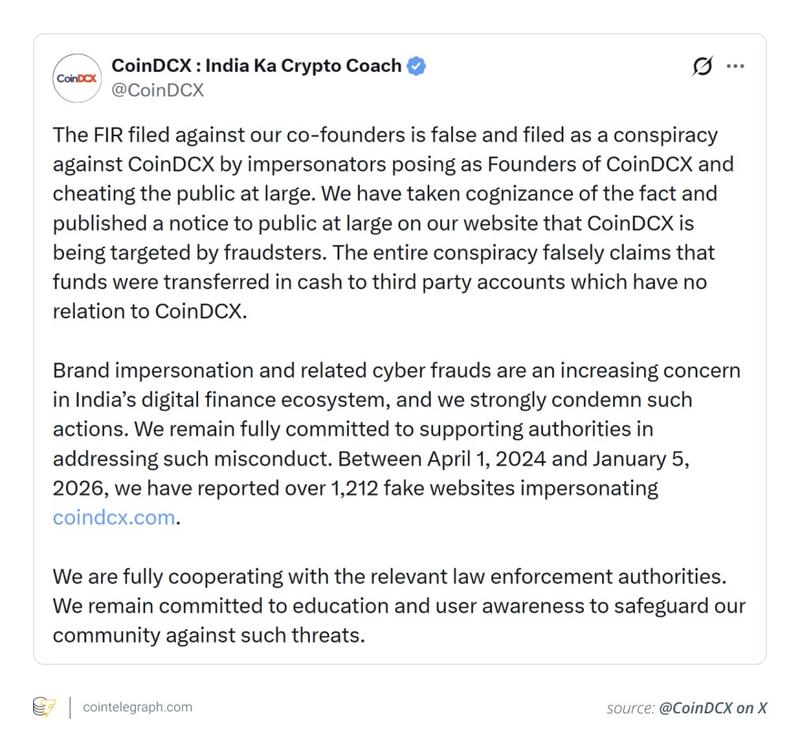
Based on the company's information, it filed reports on more than 1,200 counterfeit websites posing as its platform during the period from April 2024 to January 2026. This indicates that, for criminals, impersonation represents not an occasional tactic but a repeatable strategy.
CoinDCX further claimed that the first information report (FIR) submitted against its co-founders was fraudulent.
Establishing a domain that closely resembles a popular platform requires relatively minimal investment. When paired with messaging applications and social networks, it enables fraud operations to reproduce an impression of credibility at significant scale.
Why high monthly returns remain a key trigger
A defining characteristic of the purported scam was the guarantee of 10% to 12% returns every month.
These types of assertions are a frequent component in financial deception. Within the cryptocurrency domain, they are regularly combined with urgency, exclusivity or an affiliation with a respected platform.
From a behavioral standpoint, these guarantees fulfill two essential functions:
They attract interest in a crowded marketplace.
They diminish doubt by framing the opportunity as organized or affiliated with an institution.
In numerous instances, the apparent trustworthiness of the brand helps eliminate concerns that might otherwise emerge from the exceptionally high returns.
Did you know? Many impersonation scams reuse the same scripts and layouts across different brands, allowing a fake site built for one exchange to be repurposed for another within days.
Legal and reputational fallout of the CoinDCX incident
Despite the court determining there was no case against CoinDCX's co-founders, the situation illustrates the broader implications of impersonation schemes.
For businesses and their executives, these incidents can lead to:
Temporary legal exposure
Reputational damage
Heightened scrutiny from both users and regulators
For customers of any exchange, observing it connected with negative publicity can be disturbing. Those who have made investments through the platform may worry about monetary loss. Even when a recovery mechanism is available, few would desire to become engaged in a challenging and frequently protracted process.
The situation also presents significant questions regarding how law enforcement addresses digital impersonation, where identities can be duplicated much more rapidly than they can be authenticated.
CoinDCX's response
Following the incident, CoinDCX revealed a 100 crore rupee ($10.76 million) program called the Digital Suraksha Network (DSN), dedicated to fraud prevention and user education.
The announced initiatives include:
An AI-driven WhatsApp helpline
APIs for sharing fraud-related data
Collaboration with law enforcement for training and improved response
Although these initiatives cannot entirely remove the threat of impersonation, they demonstrate a shift toward more proactive defense and enhanced coordination throughout the ecosystem.
What users should take away
The CoinDCX impersonation situation provides several actionable insights:
Verify domains carefully. Even minor variations can indicate a fraudulent site.
Be cautious of promises of fixed or unusually high monthly returns.
Treat Telegram groups and social media handles as unverified unless they are officially confirmed.
Ensure that all transactions are conducted only through official platforms.
In most instances, the distinction between a genuine service and a fraudulent scheme is not sophisticated technology but diligent verification.