
Federal Banking Authorities Confirm Tokenized Assets Face Identical Capital Requirements
Federal banking authorities, including the Federal Reserve, have issued guidance confirming that tokenized securities will be treated identically to conventional assets regarding capital requirements.

Federal banking authorities in the United States have issued guidance stating that tokenized securities will be subject to identical capital treatment as conventional securities, emphasizing that regulatory frameworks remain "technology neutral."
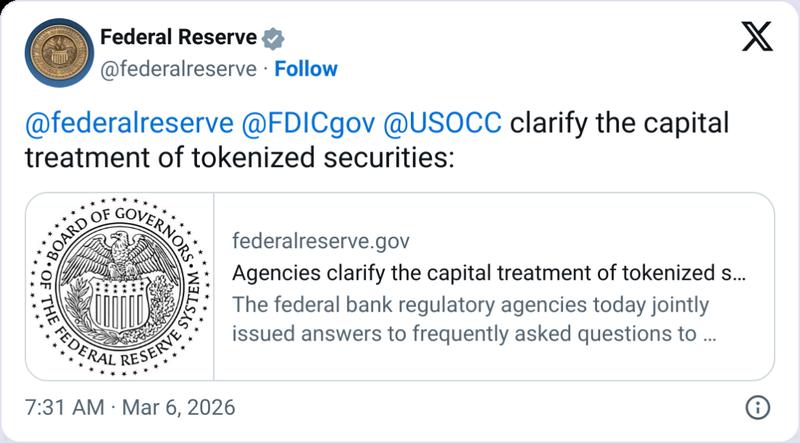
On Thursday, the Federal Reserve, alongside the Federal Deposit Insurance Corporation and the Office of the Comptroller of the Currency, announced they would apply uniform treatment to both conventional and tokenized securities in matters concerning capital requirements for banking institutions.
The technologies used to issue and transact in a security do not generally impact its capital treatment.
An eligible tokenized security should be treated in the same manner as the non-tokenized form of the security would be treated under the capital rule.
According to the new guidance, banking institutions will not be required to over-collateralize their holdings of tokenized securities on balance sheets, a requirement typically reserved for volatile and unproven asset classes.
The regulators noted that a growing number of traditional finance institutions have shown heightened interest in tokenization technology, which served as the impetus for releasing this clarifying guidance.
According to the regulatory agencies, derivatives that reference an "eligible tokenized security" must likewise receive the same capital treatment as derivatives referencing the conventional, non-tokenized version of that security.
The banking regulators further clarified that tokenized securities maintain their eligibility to be classified as financial collateral from a legal standpoint, provided they meet liquidity requirements and are legally owned or controlled by the institution in a manner that permits their sale should the borrower default under the terms of a collateral arrangement.
An eligible tokenized security that satisfies the definition of 'financial collateral' would qualify as financial collateral for purposes of the capital rule and may be recognized by the banking organization as a credit risk mitigant if all the other relevant requirements in the capital rule are met.
Tokenization of assets has emerged as a significant area of focus for traditional financial institutions, with numerous industry giants including JPMorgan, BlackRock and Franklin Templeton entering the market through various investments or infrastructure initiatives.
Among the primary advantages driving interest in this sector is the capability to conduct transactions around the clock via blockchain technology, contrasting sharply with the limited trading hours characteristic of conventional financial markets.