
DeSantis to Review Florida Stablecoin Legislation After Senate Approval
A comprehensive regulatory structure for payment stablecoins receives approval from Florida's legislature, establishing licensing requirements, consumer safeguards and regulatory oversight protocols.

A regulatory framework governing payment stablecoins at the state level has received approval from Florida's legislature, with the bill now awaiting Governor Ron DeSantis' final signature to become law.
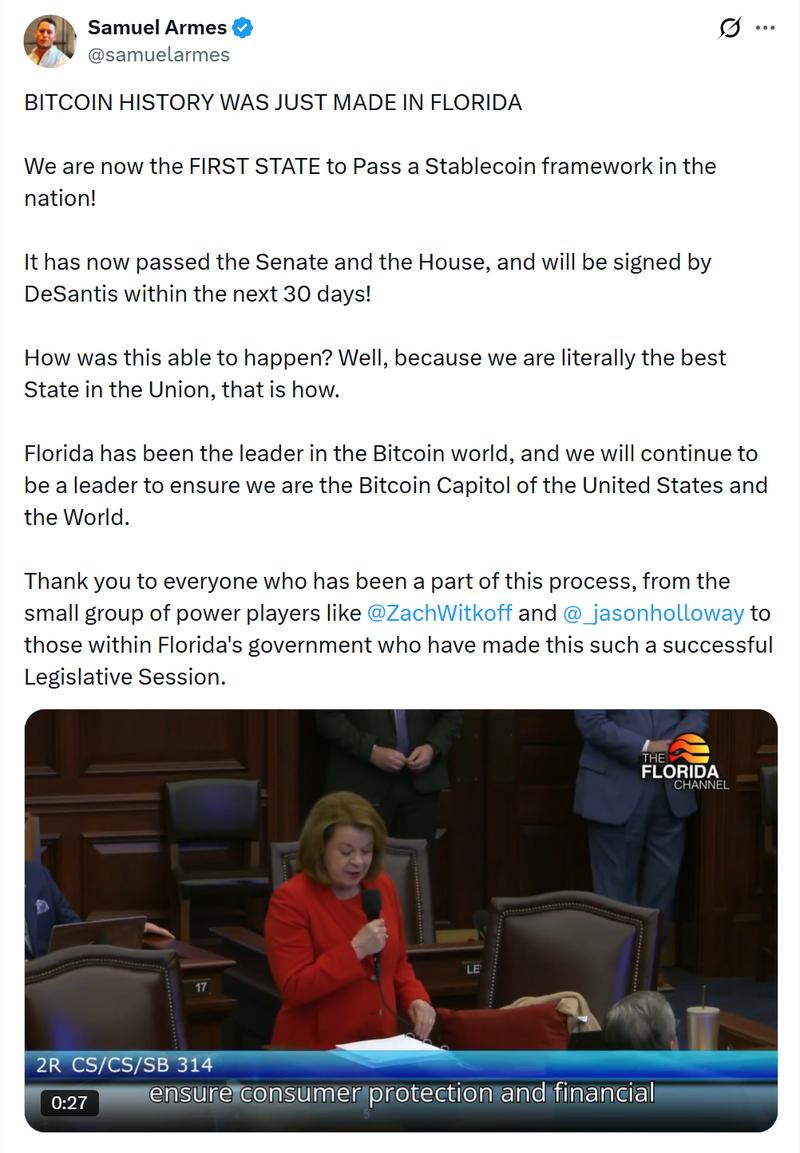
Samuel Armes, who founded the Florida Blockchain Business Association, shared on Friday via X that Senate Bill 314 received unanimous passage through the Florida Senate. According to Armes, the governor is anticipated to sign the legislation into law within the coming month.
"It has now passed the Senate and the House, and will be signed by DeSantis within the next 30 days!" he wrote on X.
The legislation creates regulatory parameters for issuers of payment stablecoins conducting operations in Florida. Operating in conjunction with House Bill 175, the framework implements consumer protection measures and financial oversight protocols that align with the federal GENIUS Act, which received presidential signature in July.
Florida bill amends money laundering law to include stablecoins
Through SB 314, amendments will be made to Florida's Control of Money Laundering in Money Services Business Act to expressly incorporate stablecoins. The modification mandates that stablecoin issuers adhere to current financial regulations while prohibiting issuance without proper licensing within state borders. The bill further establishes that specific payment stablecoins will not fall under securities classification.
Stablecoin issuers headquartered outside Florida's boundaries must provide notification to the state's Office of Financial Regulation (OFR) prior to commencing operations. The nature of oversight will vary based on the issuer's organizational structure. Certain stablecoin operators will answer solely to the OFR, whereas others will experience dual supervision in coordination with the Office of the Comptroller of the Currency.
The legislation additionally addresses potential hazards associated with stablecoin incentive mechanisms. Qualified issuers will face restrictions preventing them from distributing interest or yield to token holders in cases where federal regulations prohibit such distributions.
Florida revisits state crypto investment bill
During October of last year, Florida's lawmakers renewed initiatives to incorporate cryptocurrencies into the state's investment framework. The Florida House Bill 183, introduced by Republican Representative Webster Barnaby, would permit the state and designated public entities to invest up to 10% of their capital into digital assets. The updated proposal extends beyond Bitcoin (BTC) to encompass crypto exchange-traded products, crypto securities, non-fungible tokens and additional blockchain-based assets.
HB 183 represents a revised iteration of HB 487, which was pulled in June following its failure to progress in a House operations subcommittee.