
City Officials Push Back Against Vancouver's Bitcoin Reserve Plan
Municipal administrators in Vancouver have determined that Bitcoin holdings violate the Vancouver Charter, urging council members to reject Mayor Ken Sim's 2024 reserve initiative before the scheduled March 10 vote.

Municipal administrators in Vancouver have declared that holding Bitcoin in city reserves is not permissible and have urged council members to abandon the initiative aimed at establishing a Bitcoin reserve fund.
According to a motions update report with a March 2 date, city administrators under the leadership of Colin Knight, who serves as general manager of Finance and Supply Chain Management, reached a "conclusive determination" that Bitcoin (BTC) does not qualify as a permissible investment vehicle for municipal funds under the provisions of the Vancouver Charter.
The administrative team has put forward a recommendation to consolidate this motion with additional related initiatives as a means of reallocating resources more effectively, with the ultimate determination awaiting a council vote scheduled for the March 10 meeting.

Mayor Ken Sim first brought forward the initiative to establish a Bitcoin reserve for Vancouver during the latter part of 2024, presenting it as a motion entitled "Preserving the City's Purchasing Power Through Diversification of Financial Reserves — Becoming a Bitcoin-Friendly City."
When it came to a vote, the council approved the motion by a margin of six votes supporting it and two in opposition. Nevertheless, these recent administrative developments have the potential to completely halt the proposal's progress.
Bitcoin's inflation hedge argument fades amid bear market
When Mayor Sim presented the proposal during 2024, he indicated that one of the primary objectives behind the motion was to provide the city with a mechanism to protect against inflation through Bitcoin investments, a cryptocurrency frequently characterized as "digital gold" due to its finite supply limited to 21 million coins.
"As an open, decentralized, and secure digital asset, Bitcoin has been recognized by many financial experts and analysts as a potential hedge against inflation and currency debasement,"
the motion reads.
The case for Bitcoin serving as a protection against inflation has lost strength in recent times as the digital currency's valuation has experienced a dramatic decline. Bitcoin's value has decreased approximately 50% from its October 2025 high point exceeding $126,000, falling back to price levels last seen in late-2024 and momentarily dropping to lows around the $60,000 mark.
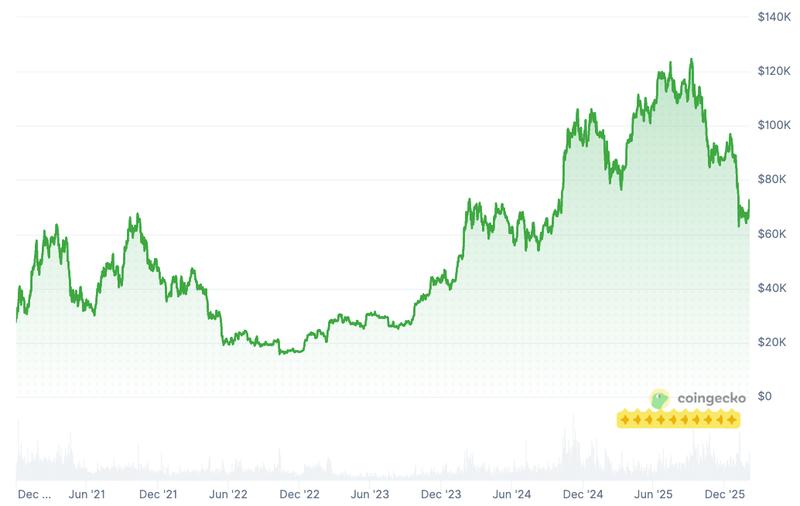
While skepticism persists among certain analysts who contend that Bitcoin's behavior does not mirror that of digital gold, macroeconomic experts such as Lyn Alden continue to maintain an optimistic outlook on the digital asset when compared to gold in the short-term horizon.
"If I had to bet Bitcoin versus gold over the next two to three years, I would bet Bitcoin,"
Alden said on the New Era Finance podcast on Wednesday.