
Circle Blocks $12.6M in USDC Connected to Zama Privacy Network
Circle, the company behind the USDC stablecoin, has blocked access to $12.6 million in tokens associated with the Zama privacy network, drawing sharp criticism from blockchain investigator ZachXBT.
The company responsible for issuing the USDC stablecoin, Circle, has blocked $12.6 million worth of its dollar-backed tokens connected to the Zama privacy protocol's confidential USDC smart contract this past Saturday, as reported by blockchain detective ZachXBT.
According to ZachXBT, the smart contract in question is "publicly labeled" across various block explorers as well as within the privacy protocol's technical documentation.
ZachXBT noted that the precise rationale behind the freezing action remains "unclear," while pointing out that addresses associated with the Overnight Finance decentralized finance (DeFi) platform deposited approximately $12.4 million into the Zama protocol on May 11, 2026. He stated:
"Overnight Finance held a governance vote recently to distribute treasury funds after holders alleged the team was rug-pulling. Regardless, it's precedent-setting to unilaterally freeze the contracts or addresses of a protocol where funds have been commingled with Zama users."

"From my understanding, the Zama team does not appear to have been notified of the Circle freeze prior," he stated. Cointelegraph made attempts to contact Circle for comment but had not received any reply at the time this article was published.
The stablecoin issuer has faced criticism on multiple fronts for its inconsistent approach to freezing funds, both for neglecting to freeze assets following significant cryptocurrency platform breaches, and for blocking wallets belonging to legitimate cryptocurrency projects and protocols without providing those projects with advance warning.
Circle comes under fire for freezing legitimate user funds, but not stolen crypto
Back in March, blockchain investigator ZachXBT leveled accusations against Circle for "wrongfully" blocking 16 stablecoin addresses connected to online gambling platforms and legitimate cryptocurrency trading platforms.
The addresses in question were frozen in relation to active civil litigation proceedings in the United States; nevertheless, the affected businesses and their associated wallets "do not appear related at all," according to his findings.
ZachXBT subsequently revealed that Circle had neglected to freeze approximately $420 million across 15 different incidents involving fraudulent transfers or assets stolen via cryptocurrency exploits dating back to 2022.
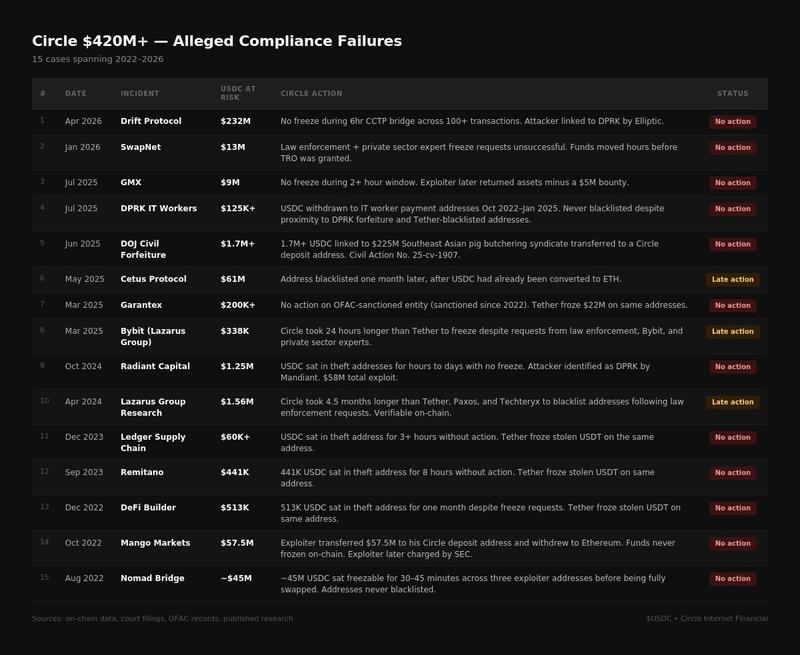
Among these cases was Circle's failure to block $232 million in compromised user assets from the April 2026 Drift Protocol security breach, despite being presented with a six-hour timeframe during which action could have been taken, according to his analysis.
In the aftermath of this incident, affected users initiated a class action legal proceeding against Circle for its failure to freeze the compromised funds, which had moved through Circle's Cross-Chain Transfer Protocol (CCTP), a bridging infrastructure that enables the transfer of digital assets across different blockchain networks.