
Bitcoin Network Requires 72% Subsea Cable Collapse Before Experiencing Disruption, Research Reveals
The cryptocurrency maintains robust defenses against accidental undersea internet cable disruptions, yet remains exposed to deliberate, coordinated attacks, a Cambridge University study reveals using over a decade of network analysis.

A minimum of approximately three-quarters of the world's submarine fibre optic internet infrastructure (responsible for transmitting roughly 99% of cross-border internet communications) would require simultaneous failure before Bitcoin experiences meaningful operational disruption, new research published this year indicates.
According to research initially made public in February with final revisions completed on March 12, Cambridge Centre for Alternative Finance investigators Wenbin Wu and Alexander Neumueller utilized peer-to-peer network information spanning from 2014 through 2025, alongside 68 confirmed cable malfunction incidents, implementing a country-level cascade framework to assess Bitcoin's physical infrastructure robustness.
The authors characterize this work as the inaugural long-term investigation into Bitcoin's capacity to withstand submarine cable disruptions, providing crucial insights into the persistent question surrounding Bitcoin's operational continuity during widespread internet infrastructure breakdowns.
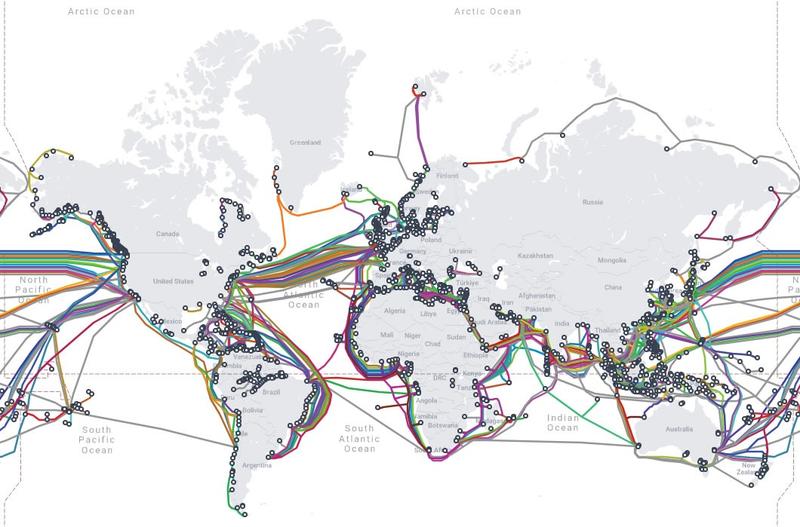
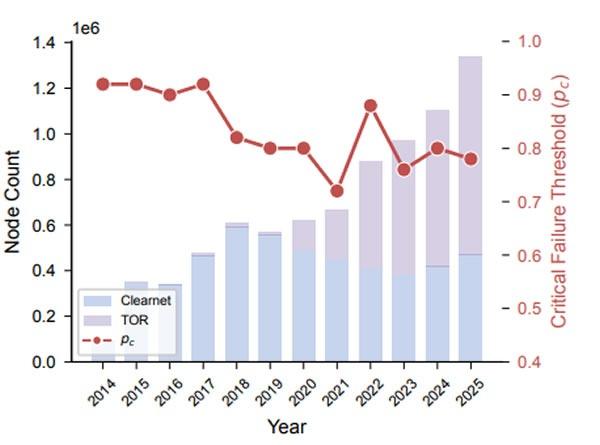
Wu and Neumueller's analysis determined that the critical breakdown point for arbitrary cable elimination ranges from 0.72 to 0.92, indicating that between 72% and 92% of all cross-border submarine communications cables must experience simultaneous failure prior to exceeding a 10% network node disconnection rate.
Nevertheless, the Bitcoin infrastructure demonstrated heightened susceptibility to deliberate assaults on specific submarine cable bottlenecks, with the research team describing such targeted disruption as "order of magnitude more effective," exhibiting a critical breakdown point ranging from 0.05 to 0.20.
Tor routing provides greater resilience
The investigation additionally determined that Tor (The Onion Router) "creates a compound barrier to disruption," particularly considering the present-day geographic distribution of relay nodes predominantly situated in highly-connected European nations.
Tor functions comparably to VPNs (virtual private networks), redirecting internet communications through a network of volunteer-operated servers distributed globally, encasing each connection segment within encryption layers for anonymity, resembling the multiple layers characteristic of an onion.
The Bitcoin infrastructure leverages Tor technology to mask node identities, effectively concealing their geographical positions. The research paper disclosed that 64% of Bitcoin network nodes remain effectively "invisible" to academic investigators.
"Tor adoption increases resilience under current relay geography rather than introducing hidden fragility," it stated.
The enhanced protection stems from Tor relay infrastructure being predominantly positioned in Germany, France, and the Netherlands — nations possessing comprehensive and duplicative submarine cable networks — resulting in cable disruptions infrequently compromising relay operational capacity.
Near-zero correlation between cable events and BTC price
Wu and Neumueller's findings established that 87% of the 68 documented historical submarine cable disruption incidents generated less than 5% node disruption, while cable malfunction occurrences demonstrated virtually zero statistical relationship with Bitcoin (BTC) market valuations, reflected in a statistically negligible correlation coefficient measurement of −0.02.