
Bitcoin Network Faces Scrutiny as AI Data Centers Lure Miners Away
Ran Neuner, a cryptocurrency trader, warns that Bitcoin's security may be at risk as AI companies attract miners from the network, though many experts dispute this concern.

A fresh discussion has emerged regarding whether the ongoing shift of Bitcoin miners toward artificial intelligence operations could potentially affect Bitcoin's security infrastructure and its standing as a reliable store of value.
Some voices contend that an exodus of miners from the network could render it more vulnerable to what's known as a "51% attack," while others maintain that this will merely activate the Bitcoin network's built-in rebalancing mechanisms as originally intended, ultimately making mining attractive once more.
"AI has killed Bitcoin forever," declared crypto trader Ran Neuner this past Sunday, contending that artificial intelligence has emerged as Bitcoin mining's most formidable rival due to both sectors vying for the same electrical resources.
"AI is willing to pay much more for it," he continued, noting that Bitcoin (BTC) mining generates revenue per megawatt ranging from approximately $57 to $129, whereas AI data center operations yield revenue per megawatt that's up to eight times greater at $200 to $500 for identical electricity consumption, which explains why mining operations are beginning to shift their focus.
At the beginning of this month, Core Scientific obtained up to $1 billion in financing for AI hosting operations, MARA Holdings submitted recent SEC filings indicating plans to liquidate portions of its BTC holdings as part of an AI strategy shift, and Hut 8 executed a $7 billion AI infrastructure deal with Google this past December, Neuner pointed out.
In the meantime, Cipher Mining reduced its hashrate in order to concentrate on AI computing capabilities, and Bitmain cofounder Jihan Wu has ceased mining operations and redirected efforts toward AI, he further noted.
So if I were a miner, it wouldn't be a tough decision. And that's why every day more and more miners are leaving the network.
The scenario appears dire for Bitcoin on the surface, but consensus is far from universal.
Bitcoin pioneer and cryptographer Adam Back contended that difficulty adjustments would simply eliminate the least efficient mining operations, while profitability metrics would see improvement.
What happens to Bitcoin is simple: tick tock, next block! Difficult adjusts downwards, the least efficient and AI switchers move out, and Bitcoin mining profitability converges to AI profitability. QED.
"If AI outbids miners for electricity, miners just turn off until the difficulty adjusts and it's profitable again, that's literally how Bitcoin works," added investor Fred Krueger.
Bitcoin energy demand is variable
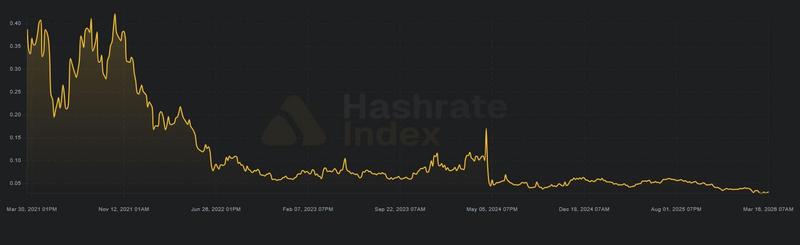
Neuner countered, however, that declining hashrates, which have fallen 14.5% from their peak in October, indicate that fewer miners are available to maintain network security, creating elevated risk for 51% attacks.
Similar patterns have occurred previously during bear market cycles, and the network's automatic difficulty adjustment mechanisms typically address the issue, "but this time is different because we don't have the energy," he stated.
Daniel Batten, a Bitcoin ESG specialist, offered a contrasting perspective and suggested the relationship was actually inverted, stating "the evidence tells us that AI is dependent upon Bitcoin for its expansion."
The situation extends beyond just high demand and costly power sources, as Bitcoin mining operations can leverage stranded energy resources, function as flexible load balancing mechanisms for electrical grids, and utilize legacy equipment with access to more affordable energy, he contended.
One green candle to prevent AI competition doomsday
Neuner indicated that one potential pathway to prevent AI from eclipsing Bitcoin would hinge on whether BTC valuations experience upward movement.
What I hope is that Bitcoin has one green candle. Maybe because of the war, maybe because of the regulation, who knows? But ultimately, if it has one green candle.
"If you're watching the Bitcoin price action during this war, that's exactly what's happening," he remarked, noting that the alternative scenario, in which Bitcoin prices persist in declining, represents "pretty much a Bitcoin doomsday."
Bitcoin has experienced five consecutive monthly red candles, a streak that hasn't occurred since the bear market of 2018. Nevertheless, March is presently trending green with the digital asset posting gains of 8% month-to-date, based on data from CoinGlass.