
AI revenues surge at TeraWulf as company reports $427M Q1 loss amid Bitcoin mining slump
In Q1 2026, TeraWulf generated $34 million in total revenue with artificial intelligence computing representing 60% of income, though the company recorded a $427 million net loss following a 50% year-over-year decline in Bitcoin mining earnings.

Cryptocurrency mining company TeraWulf recorded a $427 million net loss during the first quarter of 2026, representing a significant increase from the $61.4 million loss the company reported during the corresponding period in the previous year.
The company's overall revenue for the first quarter reached $34 million, with high-performance computing (HPC) lease income contributing $21 million, representing approximately 60% of total earnings and marking a 117% increase compared to the previous quarter, based on an announcement made Friday. Meanwhile, revenue from Bitcoin mining operations declined by 50% to approximately $13 million.
The revenue generated from HPC operations stemmed from 60 megawatts of active critical IT capacity at the Lake Mariner facility, recognized as one of the largest HPC campuses across North America, which is leased to Core42. Additionally, TeraWulf is collaborating on infrastructure deployment with both Fluidstack and Google, with supplementary capacity construction facilities scheduled for completion throughout 2026. At the conclusion of the quarter, the company held approximately $3.1 billion in cash reserves.
Our capital structure is designed to align long-term financing with contracted cash flows, supporting disciplined growth while maintaining financial flexibility.
Patrick Fleury, Chief Financial Officer
TeraWulf accelerates AI transition
Last October, TeraWulf unveiled a 25-year lease agreement with Fluidstack, which has backing from Google, valued at approximately $9.5 billion in contracted revenue streams, representing an expansion from a previous 10-year commitment. The mining company is simultaneously developing a nationwide portfolio of power-advantaged locations, which includes a recently purchased 480 MW facility in Hawesville, Kentucky, a 300 MW development in Lansing, New York, and a 210 MW location in Morgantown, Maryland, with the capacity to expand to 1 gigawatt.
We are building a power-advantaged platform that we believe is increasingly differentiated in a market constrained by access to power.
Paul Prager, CEO
Chief Executive Officer Prager emphasized that the company's Abernathy joint venture, a 168 MW HPC development operating under a 25-year lease agreement, continues to progress according to schedule for completion during the fourth quarter of 2026.
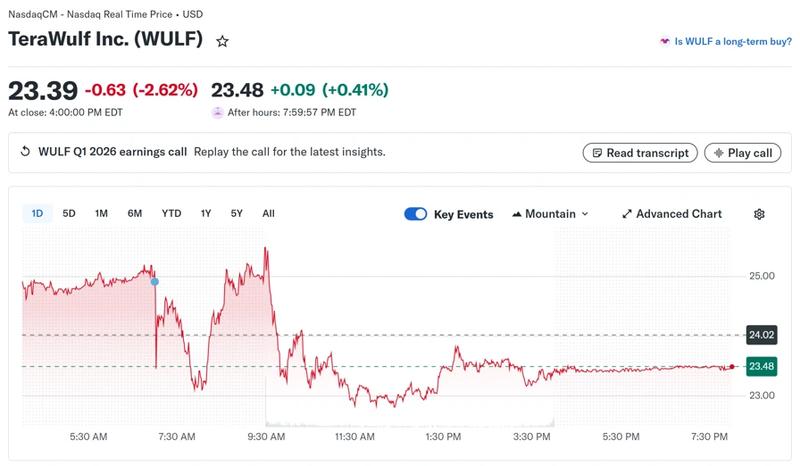
WULF shares concluded the trading session with a 2.6% decline, although the stock has experienced gains exceeding 105% from the beginning of the year and has risen more than 30% over the previous month.
Riot's data center business generates $33 million in revenue
According to Cointelegraph's coverage, Riot Platforms reported $167.2 million in first-quarter revenue for 2026, with its recently introduced data center division generating $33.2 million, which helped compensate for a reduction in Bitcoin mining income, which decreased to $111.9 million from $142.9 million during the same period one year prior.
Cryptocurrency mining companies are shifting their focus toward AI infrastructure development as diminishing profit margins drive the sector in the direction of more stable and predictable income sources, with companies including Core Scientific, MARA Holdings, Hive, Hut 8 and Iren transforming mining operations into data center facilities or purchasing AI computing infrastructure assets.