
Seoul Advocates for Lower Thresholds in Crypto Travel Rule Enforcement
During recent FATF discussions, South Korea's Financial Intelligence Unit proposed stricter reporting standards for cryptocurrency transactions, pointing to offshore platform vulnerabilities and inconsistent international AML compliance.

Authorities overseeing financial regulation in South Korea are advocating for more comprehensive reporting obligations on cryptocurrency transactions as part of efforts to enhance alignment with international Anti-Money Laundering frameworks for digital currencies.
During a plenary session held in Paris last week, South Korea's Financial Intelligence Unit (FIU) presented recommendations to broaden the Financial Action Task Force's (FATF) Travel Rule mandate to cover smaller cryptocurrency transactions, as disclosed in a Monday statement.
The Travel Rule for cryptocurrencies represents an international AML framework requiring digital currency exchanges to transmit information about senders and recipients for transactions exceeding specific thresholds. The regulation aims to enhance the ability to trace funds as they move across different platforms.
Current regulations in South Korea enforce Travel Rule compliance for cryptocurrency transactions exceeding 1 million won ($650), with the new recommendation seeking to expand these requirements to encompass smaller-value transactions.
Ongoing gaps in global oversight and DeFi risks
According to the FIU, Travel Rule responsibilities should be implemented for both the initiating and receiving crypto asset service providers (CASPs) in order to eliminate deficiencies in international transfers.
The FIU additionally advocated for more robust measures targeting offshore and unlicensed cryptocurrency platforms, pointing to their growing involvement in illegal financial activities and the dangers of regulatory arbitrage.

In addition to deliberations on the Travel Rule, FATF members gave approval to a newly compiled report analyzing threats connected to decentralized finance (DeFi), the FIU confirmed.
Commissioner Lee Hyung Ju of the FIU expressed support for the acceptance of the DeFi-focused report during the FATF deliberations. Nevertheless, he noted that regulatory arbitrage between different jurisdictions primarily results from variations in licensing requirements, supervisory practices and offshore regulatory oversight.
Seven years after FATF extended Travel Rule scope to crypto
The recommendation formed part of wider conversations regarding the execution of FATF Recommendation 15, the global standard that was modified in 2019 to incorporate AML protocols for digital assets and CASPs.
Despite seven years having passed since FATF broadened its AML structure to include digital assets, worldwide adoption of Recommendation 15 continues to show significant variation, as indicated in a focused update released by FATF in 2025.
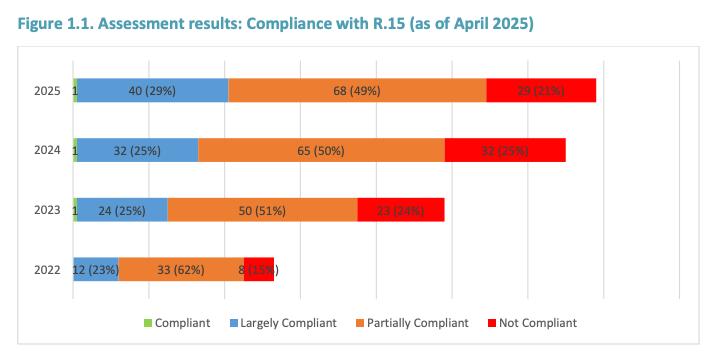
The evaluation conducted by FATF revealed that 49% of jurisdictions achieved only partial compliance with CASP-related requirements, whereas 21% continued to be non-compliant as of April 2025, resulting in merely about 29% of jurisdictions receiving ratings of largely compliant or compliant.