
Senate Approves Housing Legislation Blocking Federal Reserve CBDC Development Through 2030
In an 85-5 vote, the Senate has approved sweeping housing affordability legislation that prohibits the Federal Reserve from developing a central bank digital currency through 2030.

Housing legislation that prohibits the Federal Reserve from developing or pursuing a central bank digital currency (CBDC) through 2030 has cleared the US Senate and is anticipated to receive swift approval from the House of Representatives.
In a Monday session, the Senate approved the 21st Century Road to Housing Act by a margin of 85-5, legislation designed to expand housing availability following an agreement reached by bipartisan leadership from both chambers last week to advance the measure.
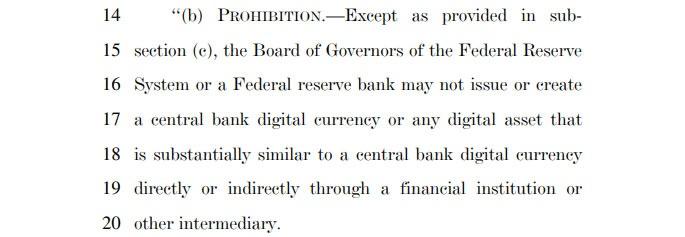
The CBDC prohibition has been part of the legislation since the Senate initially approved an earlier version in March, stipulating that the Fed cannot, through direct or indirect means, "issue or create a central bank digital currency or any digital asset that is substantially similar to a central bank digital currency."
Those advocating for cryptocurrency have consistently opposed CBDCs, viewing them as governmental efforts to establish central bank authority over digital currencies, making this bill a significant victory for Republican lawmakers who have pursued CBDC prohibition for several years.
Following its Senate passage, the bill will proceed to the House of Representatives for consideration, where swift passage is anticipated given the agreement reached among House leadership last week, after which it will advance to the president for final signature into law.
The inclusion of the CBDC provision within the housing package served as a political incentive to obtain backing from House Republicans and the administration to expedite the legislative process.
The prohibition includes an exception for stablecoins, specifically any "dollar-denominated currency that is open, permissionless, and private," and specifies that following the expiration of the CBDC ban in 2030, the Fed would still require explicit congressional authorization before pursuing any CBDC initiative.
In contrast, numerous other countries are actively advancing their CBDC initiatives.
On June 16, Reuters reported that China had enlisted 26 financial institutions to participate in its digital yuan (e-CNY) cross-border payment platform.
According to data from the Atlantic Council think tank, three countries have formally launched a CBDC, while 41 nations are currently conducting pilot programs, 33 are actively developing their systems, and 40 remain in the research stage.