
Maple Finance Sets Sights on $10-15B AUM Target Through 2027
CEO Sidney Powell has set an ambitious goal of achieving $15 billion in assets under management within the next three years, with plans to diversify into tokenized asset lending and forge partnerships with traditional financial institutions.

Sidney Powell, CEO of onchain asset manager Maple Finance, has revealed the company's ambitious plans to expand its assets under management (AUM) to a range of $10 billion to $15 billion before 2027 comes to a close, with a strategic focus on drawing in more traditional financial (TradFi) institutions.
During an exclusive conversation with Cointelegraph conducted on Monday, Powell disclosed that the firm is simultaneously pursuing a loan book target ranging from $4.5 billion to $5 billion.
These strategic objectives emerge as Maple seeks to diversify beyond its current lending operations that are predominantly secured by cryptocurrencies like Bitcoin (BTC), with Powell anticipating that tokenized assets alongside stablecoins will serve as crucial drivers of the company's expansion trajectory.
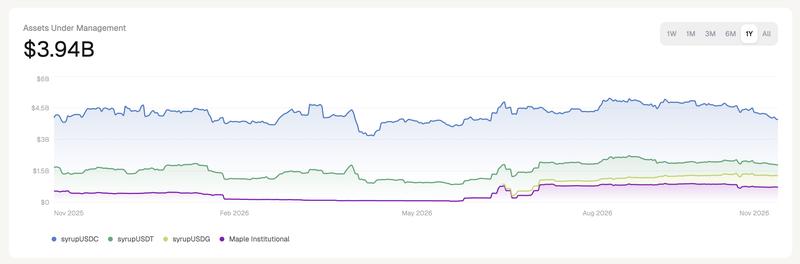
The company disclosed $4.7 billion in AUM as of the conclusion of the third quarter, representing an 18% increase compared to the prior year. Maple's dashboard, however, displayed approximately $3.9 billion in AUM as of Tuesday.
The volume of outstanding loans climbed 12% year-over-year to reach $1.7 billion, with quarterly revenue experiencing a 5% uptick to $4.4 million, translating to annualized revenue of $17.6 million. Nevertheless, outstanding loans decreased 9% from the preceding quarter, with quarterly revenue showing no change.
Tokenized assets represent digital equivalents of conventional assets, including stocks and bonds, which can be maintained and exchanged on a blockchain. In a separate category, stablecoins are digital tokens engineered to preserve a stable value in relation to a reference asset, typically a currency like the US dollar.
The tokenized real-world assets market has experienced substantial expansion throughout the past year, with their aggregate value on public blockchains climbing to approximately $39.9 billion as of Nov. 11, marking a 52% year-over-year increase, based on data from RWA.xyz. The valuation of tokenized stocks specifically surged from roughly $678 million in January to nearly $3.9 billion by November.
TradFi partnerships central to Maple's expansion strategy
Powell forecasts that tokenized stocks will experience growth of five to ten times their current size during 2027, potentially enabling Maple to extend loans collateralized by tokenized shares instead of depending primarily on cryptocurrency backing.
"I think tokenized equities are going to be really big," he said. "You'll start to see more tokenized equity lending."
This approach would enable borrowers to leverage tokenized stocks as collateral for obtaining loans while avoiding the need to liquidate their investments, mirroring the current mechanics of Bitcoin-backed lending.
"Ultimately, that's really positive for the space because it gives you tokenized assets to lend against that are not correlated with Bitcoin," Powell said. Bitcoin maintains its position as the largest cryptocurrency with a market capitalization exceeding $1.28 trillion as of Nov. 17.
Powell revealed that Maple is currently engaged in discussions regarding credit facilities whereby banks would provide financing for its Bitcoin-backed lending operations.
"At the moment, we're looking at a first deal where we're speaking with banks about warehouse facilities for the Bitcoin-backed lending, so they would be a funder to us," Powell said.
The company currently supplies financing for a warehouse facility that supports Kraken's crypto-backed lending program, a partnership that was publicly announced in June. The bank arrangements under consideration would instead channel funding directly into Maple's lending operations.
Powell further indicated that Maple might pursue additional agreements with US banks and lending institutions involving loans initially originated by TradFi entities and later migrated onto blockchain networks. "I think that's going to be a big market for 2027," he said.
In September, Maple revealed plans to offer lending against portfolios consisting of asset-backed and mortgage-backed securities while also financing loans originated by fintech companies. The company stated at that time that each new strategy would be subject to an initial cap of 5% of its total deposit base.
Expanding collaborations with financial technology companies and digital banks seeking to provide customers with opportunities to generate interest on their stablecoin holdings represents another key priority. Powell indicated that Maple is presently engaged in talks with multiple large firms regarding potential product offerings, with announcements potentially coming in the first quarter of 2027.
"My view is that's the kind of path Maple has to go down in order to grow, and we have to focus more on these larger institutional allocators," Powell said. "That's ultimately where most of the balance sheet is in traditional finance."
This expansion methodology stands at the core of the leadership disagreement, based on Powell's account.
Executive departures occur during expansion phase
These growth initiatives are unfolding against the backdrop of a leadership transition following last week's announcement by co-founder and executive chairman Joe Flanagan and chief operating officer Ryan O'Shea that they plan to depart due to disagreements concerning the company's strategic direction.
Flanagan indicated his differences with Powell revolved around matters of strategy and leadership, whereas O'Shea stated he had arrived at an alternative vision regarding Maple's appropriate direction.
According to Powell, the disagreements were primarily focused on the optimal approach to business expansion, especially as TradFi institutions increase their participation in crypto lending.
"We had a difference of opinion on the best way to scale things," he told Cointelegraph. "This year, I think, more than ever, we started to see that real convergence with traditional finance, fintechs and neobanks. And my view is that that is kind of the right path for us to scale."
The announced departures triggered inquiries from Maple's investors, partners and clients, with some reaching out to Powell to request clarification. Powell emphasized that the departures bore no connection to issues with Maple's loan book or the overall health of the business.
"The important thing is conveying to them and reassuring them that this wasn't to do with any issues in Maple's loan book or any issues with the business," Powell said. "It is just a difference on what is the best pathway to scale Maple from here."
As of 6:50 pm UTC on Tuesday, Maple Finance's native token, SYRUP is trading at $0.103, with a market capitalization standing at $123 million, based on CoinMarketCap data. The token has declined approximately 46% throughout the past 30 days and 74% over the previous year.