
Gemini sees 42% revenue surge driven by financial services diversification
The cryptocurrency exchange's credit card business experienced explosive growth of nearly 300% in the first quarter, reaching $14.7 million as the platform's user numbers expanded substantially.


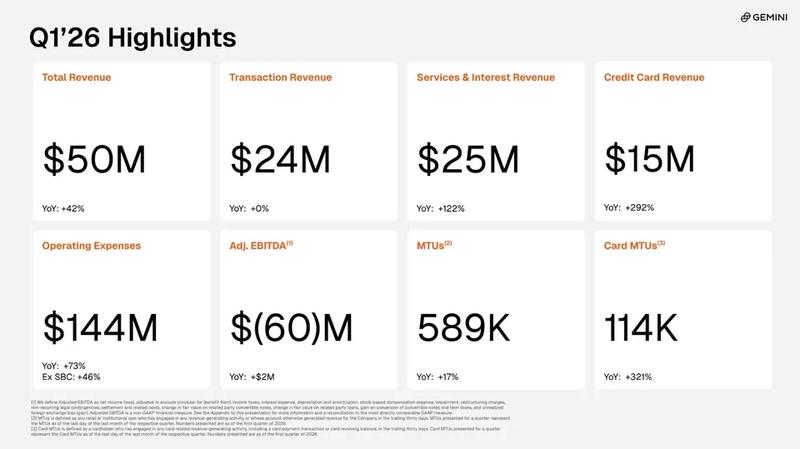
Digital currency platform Gemini announced a 42% year-over-year revenue surge for Q1 2026, marking continued progress in its transformation from a cryptocurrency-only exchange into a comprehensive financial services provider.
The company owned by the Winklevoss twins saw overall revenue climb 42% compared to the previous year, reaching $50.3 million during the first quarter, with transaction revenue holding steady at $24 million, according to Thursday's report.
By contrast, revenue from its cryptocurrency exchange operations fell 27% year-over-year to $17.2 million, "reflecting lower spot trading activity and a moderation in crypto market volumes," as total trading volume dropped to $6.3 billion compared to $13.5 billion during Q1 2025.
The most substantial gains came from credit card revenue, which skyrocketed nearly 300% to reach $14.7 million, fueled by substantial expansion in the Gemini Credit Card user base, according to the company's statement.
The strategic shift from cryptocurrency-focused operations into comprehensive financial services kicked off in early 2021, coinciding with the company's launch of consumer finance products including credit cards. Half a decade later, services and interest income, primarily powered by credit card offerings, now account for nearly half of overall revenue, demonstrating the critical importance of this strategic expansion.
As Gemini continues to evolve, we expect that the momentum we have built in diversifying our revenue will only accelerate.
Cameron Winklevoss, Gemini president
Various cryptocurrency exchanges have been exploring business opportunities beyond digital assets, Coinbase has been vigorously expanding into stock and ETF trading with ambitions to transform into an "everything exchange," while Kraken has completed recent acquisitions that enable expansion into regulated derivatives markets.
Total operating expenses increased
Along with revenue expansion, Gemini also disclosed a 73% rise in total operating expenses reaching $144.5 million during the quarter. This spike was primarily attributed to "compensation, marketing and credit card-related costs associated with the significant business expansion," according to the company's statement.
Gemini reported an adjusted EBITDA loss of just under $60 million.
Gemini also revealed Thursday that it secured a $100 million strategic investment from Winklevoss Capital in return for 7.1 million shares of common stock, with the investment funded in Bitcoin.
Path to becoming a full-stack, end-to-end marketplace
During April, the company obtained a Derivatives Clearing Organization license from the US Commodity Futures Trading Commission, positioning Gemini as one of just a select few crypto-native platforms in the country holding both a Designated Contract Market and a DCO license in-house.
This all represents the next step towards Gemini becoming a full-stack, end-to-end marketplace for crypto trading, predictions, futures, options, and more.
Gemini's stock (GEMI) climbed 6.9% on Thursday reaching $4.92 during after-hours trading; nevertheless, it remains down 47% year-to-date, according to Google Finance.
The previous week, Coinbase disclosed $1.41 billion in total Q1 revenue, declining 31% year over year, though it recorded a net loss of $394 million. It operates at a much larger scale than Gemini and similarly experienced robust diversification into derivatives, prediction markets, and stablecoins, which helped mitigate the decline.