
Federal Reserve Research Reveals Cryptocurrency Buyers Influenced by Expectations and Historical Performance
Research from the Federal Reserve Bank of Cleveland reveals that cryptocurrency investors maintain vastly different perspectives on potential gains and risk factors, with data showing that knowledge of Bitcoin's historical performance can boost both intended investment levels and real purchasing activity.

A recently published working paper from the Federal Reserve Bank of Cleveland presents a compelling theory for cryptocurrency's distinct behavior compared to conventional financial instruments: US citizens who invest in digital currencies don't merely possess different demographic profiles or tolerance for risk—they maintain fundamentally divergent convictions about the prospective returns of these digital assets.
This discovery may shed light on both the enduring price swings characteristic of cryptocurrency markets and the manner in which price rallies can draw fresh capital, establishing a potential cyclical pattern where escalating valuations strengthen optimistic projections and attract additional market participants.
Through sequential surveys encompassing up to 25,000 American households in each survey wave, researchers Michael Weber, Bernardo Candia, Olivier Coibion and Yuriy Gorodnichenko discovered that projections regarding cryptocurrency returns account for a greater portion of the variability in cryptocurrency ownership than an extensive array of demographic factors.
The research document, bearing the title "Do You Even Crypto, Bro? Cryptocurrencies in Household Finance," additionally employs a randomized information-based experiment demonstrating that merely providing individuals with data regarding Bitcoin's (BTC) latest performance metrics can enhance both their preferred cryptocurrency allocation and their actual buying behavior afterward.
According to the researchers, these findings indicate a possible driver of speculative market bubbles: historical performance gains have the capacity to lure new market entrants, whose buying activity drives valuations upward and may draw even more participants into the market.
Positive returns attract new participants, which raises the price further
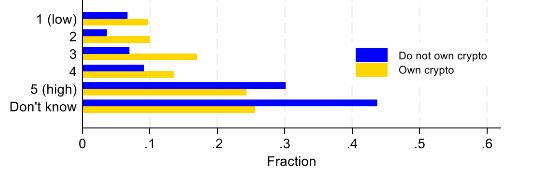
This pattern proves especially notable given that a substantial segment of the population maintains limited understanding of cryptocurrency. Within the researchers' 2021 survey data, 87% of individuals without crypto holdings reported uncertainty about anticipated returns over the subsequent twelve months. Even among cryptocurrency holders, this percentage remained at 54%.
Ownership linked to double-digit returns expectations
Among those prepared to offer projections, the disparity proved substantial. Cryptocurrency holders anticipated an average annual return of 22% over the coming year, in contrast to merely 7% among those without holdings. Holders similarly perceived cryptocurrency as carrying less risk compared to the perceptions of non-holders.
The research team identified that anticipated returns demonstrated exceptional influence in predicting ownership patterns. An increase of one percentage point in a person's projected crypto return correlated with a 0.8-percentage-point rise in the likelihood of cryptocurrency ownership. Combined expectations concerning returns and risk accounted for substantially greater variation in crypto ownership compared to observable traits including age, income level and gender.
This pattern positions crypto as an anomaly when compared with stocks, bonds and gold. For conventional assets, demographic and financial attributes typically possess far greater predictive capacity than variations in anticipated returns. Cryptocurrency inverts this dynamic.
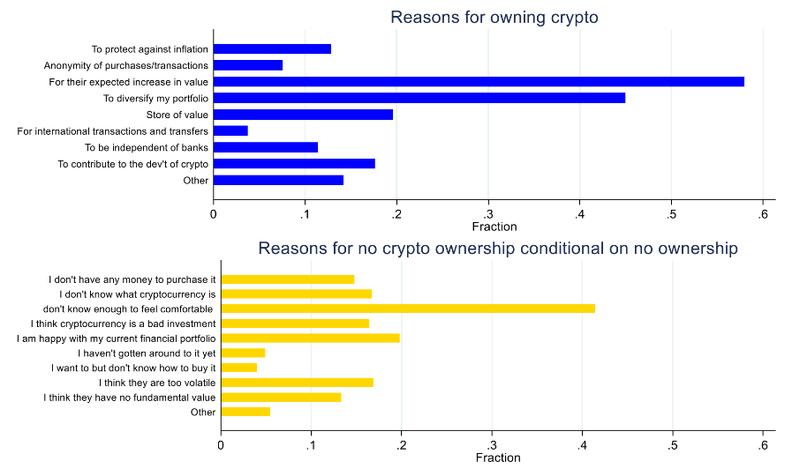
The demographic composition of cryptocurrency investors nonetheless displays distinct characteristics. Individuals younger than 40 demonstrated 13 percentage points higher probability of owning cryptocurrency relative to those exceeding 60 years of age, even when accounting for additional characteristics. Male participants showed approximately 4 percentage points greater likelihood than female participants to hold crypto, while households with elevated income and wealth levels also exhibited increased participation rates.
The experimental component delivers what may be the paper's most significant discovery for cryptocurrency markets.
During 2025, the research team randomly distributed households into groups receiving information concerning BTC, stocks, GameStop or inflation. Survey participants presented with Bitcoin's preceding 12-month performance increased their preferred crypto portfolio share by approximately 2 percentage points, representing roughly a 47% elevation compared to the 4.3% desired allocation observed in the control group. Real subsequent cryptocurrency acquisitions similarly increased by approximately 2.5 percentage points.
The researchers characterize this outcome as "providing information about recent Bitcoin returns induces some households to start buying cryptocurrency."
The impact concentrated primarily among individuals who indicated they abstained from crypto ownership due to insufficient information. Those who already maintained beliefs that crypto represented an unfavorable investment largely showed no response to the information treatment.
The research paper additionally determines that cryptocurrency wealth can influence household consumption patterns. A price doubling in BTC rendered a household with complete financial portfolio concentration in crypto 1.4 percentage points more inclined to acquire a durable good, representing approximately a 7% increase relative to the baseline probability of such transactions. However, this effect failed to extend to routine expenditures.
This observation prompted the researchers to draw a striking parallel: cryptocurrency gains seem to receive treatment more comparable to "gambling income" or lottery proceeds rather than a lasting wealth increase.
The wider significance suggests that cryptocurrency's price volatility may stem partially from divergent opinions and information acquisition rather than exclusively from market fundamentals. The researchers conclude that cryptocurrency distinguishes itself through limited understanding, sharply contrasting investor perspectives regarding its potential, and the capacity of fresh information about historical returns to modify both expectations and actions.
The absence of common information and beliefs about crypto across investors suggests that price volatility will continue to be one of the most defining characteristics of this new asset for the foreseeable future.
For cryptocurrency markets, this implies a potentially troubling inference: the subsequent surge of retail investor demand may hinge not solely on Bitcoin's current valuation, but on the information investors receive about its previous price trajectory.