
EU and New York financial authorities forge partnership to regulate stablecoins
In an effort to bolster transatlantic regulatory oversight, the European Banking Authority has partnered with New York's Department of Financial Services through a formal agreement targeting cross-border stablecoin operations.

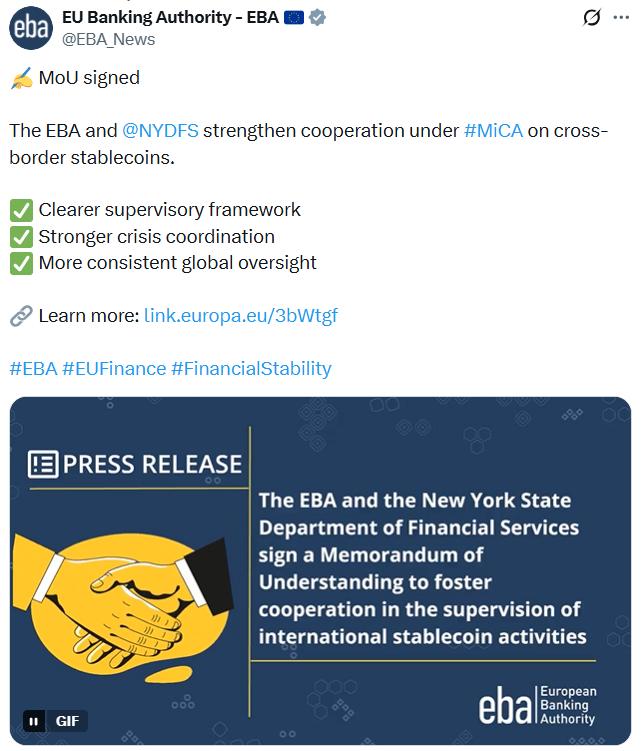
A memorandum of understanding has been executed between the European Banking Authority and the New York State Department of Financial Services (NYDFS) aimed at monitoring stablecoin activities that span international borders.
According to a Tuesday announcement from the EBA, this agreement fulfills obligations outlined in the Markets in Crypto-Assets (MiCA) Regulation and establishes foundational principles and operational procedures for information sharing and coordinating oversight of stablecoin activities, emerging market developments, and potential risks across the European Union and New York.
According to NYDFS, the partnership will "enhance the supervision of entities engaged in stablecoin activities, identify market trends and risks, and promote the integrity of the stablecoin market."
Major financial institutions and banks across the United States and Europe have been experimenting with stablecoin utilization for payment systems, driven by regulatory frameworks governing these digital tokens in both jurisdictions. As of Wednesday, the worldwide stablecoin market has expanded to exceed $319 billion, based on data from DefiLlama.
Among the data points that will be exchanged between the two regulatory bodies are details about the stablecoin being issued, aggregate circulation volume, holder counts, findings from both external and internal audit processes, and the compliance status of particular products and services.
Additionally, the MOU establishes a collaborative structure enabling both regulators to provide mutual support and synchronize their responses when facing crises or emergency situations. It's important to note that oversight will be limited to stablecoin-related operations of supervised entities, rather than encompassing all business activities these companies may undertake.
In July, US President Donald Trump enacted stablecoin regulations into federal law, whereas the European Union's Markets in Crypto-Assets framework became operational in late 2024. Stablecoins pegged to the US dollar presently dominate the sector's activity, with Tether's USDT and Circle's USDC representing the two largest offerings by market capitalization.
In January, Jimmy Xue, co-founder of quantitative yield protocol Axis, told Cointelegraph that the global stablecoin market has largely plateaued after rapid expansion, entering a consolidation phase as new regulation, liquidity constraints, and higher real-world yields weigh on new issuance.
According to Xue, a cautious macroeconomic environment, combined with competitive Treasury yields, further reduced appetite for rapid stablecoin expansion.