
EDX Markets pursues national trust bank charter from OCC for crypto custody operations
The institutional cryptocurrency exchange is pursuing authorization from the Office of the Comptroller of the Currency to establish a separate custody infrastructure from its trading operations and broaden its service offerings within a federally regulated banking structure.

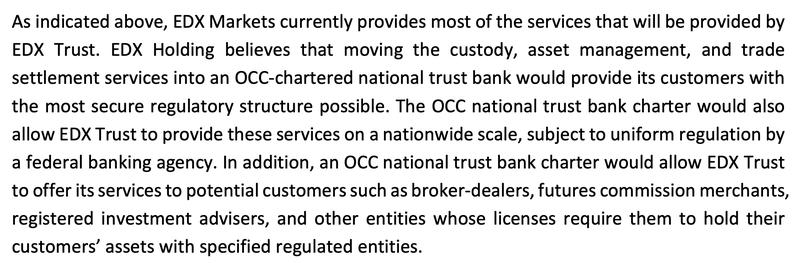
An institutional cryptocurrency exchange known as EDX Markets has submitted a formal application to the United States Office of the Comptroller of the Currency (OCC) seeking authorization to create a national trust bank that would deliver cryptocurrency custody, asset management and trade-settlement capabilities.
The planned institution, which would be named EDX Trust, would function as a non-depository national banking entity, creating a division between custody and settlement operations from trading activities while maintaining order matching through the existing EDX platform infrastructure.
Within the documentation submitted with its application, the firm indicated that this operational model aims to mitigate structural vulnerabilities present in cryptocurrency markets, where trading, custody and brokerage functions are frequently consolidated within one platform, establishing potential conflicts of interest and creating single points of failure.
According to EDX, the trust banking entity would deliver fiduciary asset management capabilities, allocate client cash and stablecoin holdings into highly liquid investments, and enable trading operations through a riskless principal framework with settlement occurring at the end of each trading day.
The banking institution would conduct operations online from its Chicago location and focus on serving institutional customers including broker-dealers, futures commission merchants and registered investment advisers, as outlined in the regulatory filing.
According to EDX, transitioning these operational functions into an entity chartered by the OCC would enable the organization to deliver services across the entire nation under one unified regulatory structure while satisfying custody obligations for institutions operating under regulatory oversight.
Established in 2022, EDX Markets receives backing from traditional financial market participants including Citadel Securities, Virtu Financial, Fidelity Digital Assets and Hudson River Trading.
Cryptocurrency firms pursue banking charters in the United States
This application arrives during a period when cryptocurrency and financial services companies are progressively seeking national trust bank charters as a pathway to expanding institutional service offerings under federal regulatory supervision.
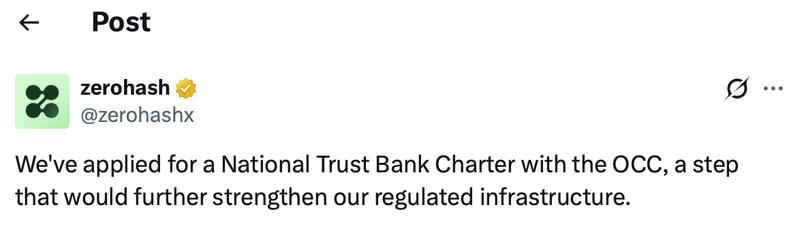
In the early part of this month, Zerohash, a company specializing in blockchain infrastructure, submitted its own application for a United States national trust bank charter with the goal of broadening its stablecoin and custody service capabilities for banking institutions, brokerages and financial technology companies.
Additional recent applicants in this space include Coinbase, which submitted its application in October and remains in a waiting period for a regulatory decision, alongside Laser Digital and Payoneer, both of which filed their respective applications during the earlier months of this year to enhance custody operations and stablecoin-related payment service capabilities.
Conventional financial institutions are also making their entrance into this domain. During February, Morgan Stanley filed for a de novo trust bank charter with the intention of supporting digital asset service offerings through an independently operated entity.
Concurrently, the OCC has maintained its pace of approving applications, granting conditional licenses during the previous month to Bridge, Stripe and Crypto.com, which followed approvals granted in December for Ripple Labs, Circle Internet Group, Fidelity Digital Assets, Paxos and BitGo.
Nevertheless, the velocity of these approvals has attracted regulatory scrutiny. During February, the American Bankers Association called upon the OCC to decelerate the approval process, referencing unresolved oversight concerns under pending United States stablecoin legislation.