
Despite Advancements, Humanoid Robots Face Years Before Workforce Integration
Despite impressive technological progress, AI-driven humanoid robots face numerous obstacles including adaptability issues, reliability concerns, safety requirements and real-world operational challenges that will delay workforce replacement for years, according to experts.

While contemporary artificial intelligence-driven robots demonstrate remarkable abilities, they remain far from being able to substitute human workers due to their inability to adjust to evolving circumstances, according to researchers in the field.
In recent weeks, robotics firm Figure demonstrated its humanoid machines executing simple operations like tidying spaces, yet a fleet of robots that continuously sorted parcels for nine consecutive days generated discussion regarding the timeline for robotic job displacement.
According to Oliver Obst, an associate professor specializing in robotics at the University of New South Wales in Australia, tasks characterized by repetition—particularly manual labor in controlled settings—face the highest likelihood of robotic replacement currently, whereas clerical duties and paperwork processing could fall victim to AI automation.
Mounting apprehension exists that artificial intelligence and robotic systems will displace human employees as technological capabilities expand. Workforce consulting organization Challenger, Gray and Christmas released findings in May revealing that approximately 49,135 workers in the United States lost their positions in 2026 as a direct result of AI implementation.
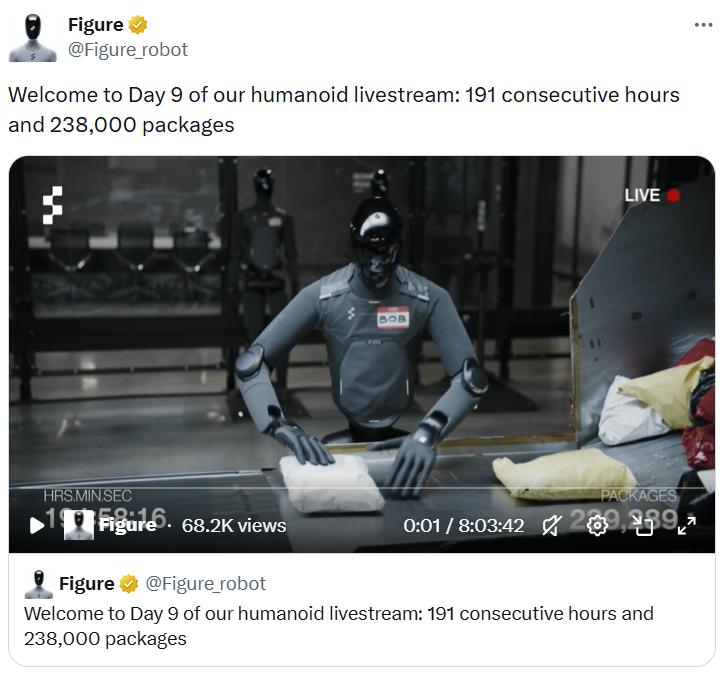
Despite this, Obst emphasized that widespread deployment of humanoid robots is improbable in the near term, as they haven't demonstrated superior efficiency or reduced error rates compared to existing automated manufacturing systems.
"Within even moderately controlled environments, these machines continue to encounter challenges related to dependability, operational velocity, worker protection, financial viability, and their capacity to bounce back from unforeseen circumstances," he explained. "The more difficult an environment becomes to regulate, the more complex the robotics challenge grows. The majority of human occupations require greater variability and decision-making capacity than what was displayed in the package-sorting showcase."
"I would not say we are at the point of mass replacement by humanoid robots. We are much closer to the selective automation of some tasks. AI software is moving faster and is already affecting some forms of information work, but physical robots still have a much harder problem to solve."
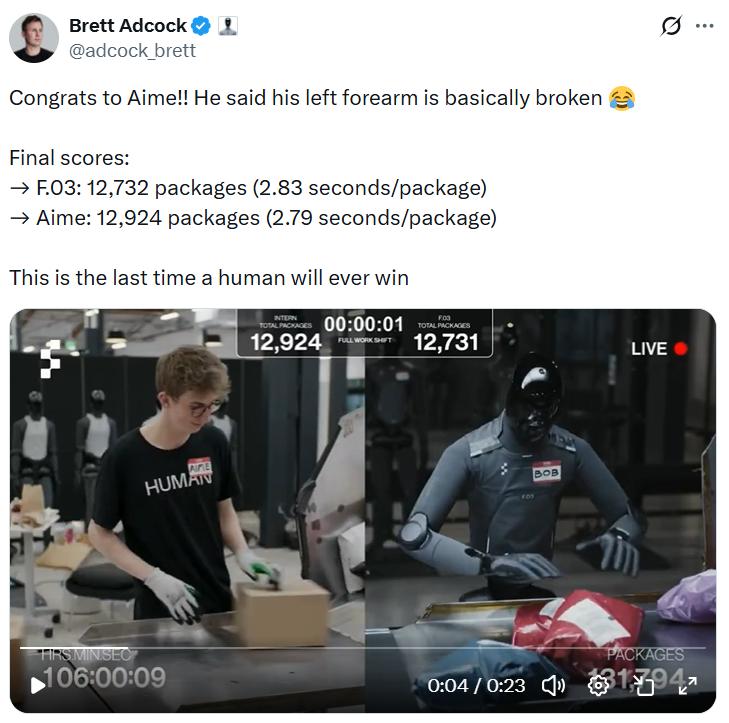
During a separate demonstration in May, a human employee successfully sorted a larger quantity of packages when compared to a team of Figure's robotic units, which required rotation for battery recharging. According to Figure CEO Brett Adock, this would mark the final occasion "a human will ever win."
Humans maintain advantages over machines in certain domains
According to Markus Levin, co-founder of decentralized data network XYO, artificial intelligence systems and automation technologies can execute repetitive operations with substantially superior consistency and stamina compared to human workers; nevertheless, robotic systems still necessitate battery charging, regular maintenance and human oversight.
The International Federation of Robotics published a report in September indicating that worldwide demand for industrial robots has experienced a twofold increase throughout the past ten years, with warehouse operations and logistics representing some of the most rapidly expanding sectors for adoption.
"My assessment is that comprehensive human replacement remains several years distant," Levin continued, "Factors including reliability, safety protocols, regulatory frameworks, infrastructure investments, and public confidence represent substantial obstacles to comprehensive deployment throughout society. The difficulty no longer centers simply on creating machines with action capabilities but rather on guaranteeing they can function safely and dependably as they assume increased autonomy."
Dr Francisco Cruz Naranjo, a senior lecturer at the University of New South Wales holding a PhD in robotics, indicated that the comparative efficiency of robots versus people is substantially dependent on the specific activity and environmental context.
"Robotic systems excel at repetitive operations without requiring continuous breaks, as demonstrated in the Figure livestream. Conversely, within highly dynamic settings, robots continue to face difficulties rapidly adapting to shifting conditions," he stated.
"Humans, in this case, are much better. This is precisely why robots at the moment are highly efficient in controlled environments, such as factories, but they have not yet succeeded widely in home settings."
According to Naranjo, repetitive occupations conducted in less stable environments face displacement risk from robotic systems, though the timeline will be determined by research progression speed and societal adaptation rates in domains such as creating robot-compatible spaces, which likely remains years into the future.
Societal benefits possible from robotic integration
Both Naranjo and Obst suggested that large-scale integration of robots throughout the workforce could yield certain advantages, including enhanced work-life equilibrium, supplementing labor pools in sectors experiencing worker shortages, and handling hazardous environments presenting excessive risk to human workers.
"The societal implications present greater complexity. Should robots reduce dangerous work in human cost terms, positive outcomes could result. However, unintended consequences may also emerge. As an illustration, removing humans from dangerous situations in military contexts might preserve lives, yet it could simultaneously reduce the perceived expense of armed conflict," Obst noted.
"Hypothetically, if we became very successful at automating almost all work, then society would need to rethink economies that are currently built around individual wages and employment."