
CryptoQuant Signals Bear Market as Bitcoin ETFs Record $240M Exodus
Following a single-day respite, Bitcoin ETF withdrawals resumed as CryptoQuant's analysis indicated Bitcoin's reentry into bearish territory.

Exchange-traded funds tracking spot Bitcoin in the United States returned to experiencing net capital withdrawals on Tuesday following a momentary halt in the exodus that began the week.
These investment vehicles witnessed approximately $240 million in net capital outflows on Tuesday, with the iShares Bitcoin Trust (IBIT) managed by BlackRock representing $210 million of that total, based on information provided by Farside Investors.
On Monday, IBIT had experienced $76.5 million in net capital inflows, bringing to a close a $2.35 billion net withdrawal streak that had extended across 11 consecutive trading sessions.
Exchange-traded funds tracking spot Ether (ETH) in the United States similarly experienced net capital outflows totaling $29 million on Tuesday, supplementing the $8.3 million in withdrawals recorded Monday. These ETH investment vehicles have witnessed net withdrawals in eight out of the previous nine trading sessions.
The resurgence of outflows from cryptocurrency ETFs occurred against the backdrop of persistent weakness in Bitcoin (BTC), which momentarily fell beneath the $63,000 threshold on Tuesday, based on data from CoinGecko.
Bitcoin has reentered a bearish market phase due to declining demand and increasing investor losses, according to CryptoQuant in a Tuesday analysis shared with Cointelegraph. The firm's Bitcoin Analyst Consensus Index revealed sentiment at its most pessimistic level since November 2025.
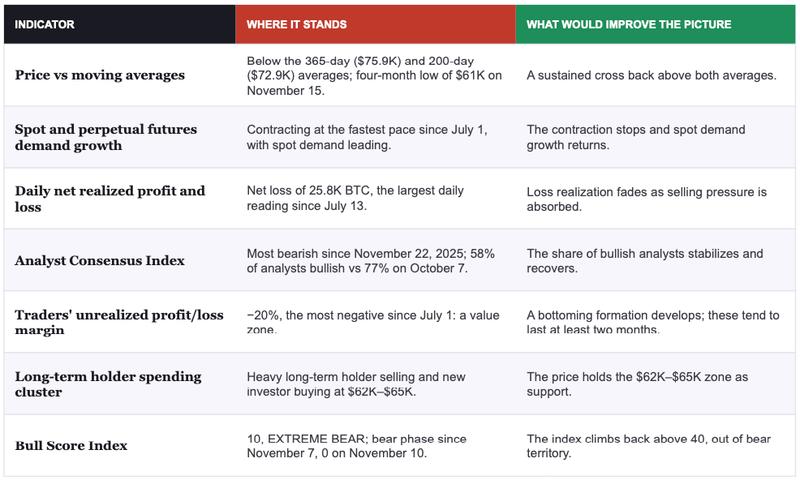
"Bitcoin needs demand growth in order to recover and rally sustainably,"CryptoQuant stated, highlighting that overall Bitcoin demand growth was declining at its most rapid rate since July 1.
Notwithstanding the pessimistic signals, CryptoQuant pinpointed potential price support within the $62,000 to $65,000 range but warned that the indicators had not yet validated a market bottom.