
Crypto Exchanges Face Mandatory Licensing Under New Australian Digital Asset Legislation
In a significant regulatory development, Australia enacts legislation mandating cryptocurrency exchanges and digital asset custodians to secure financial services licenses, establishing a comprehensive framework for the industry.

Legislative action in Australia has successfully established new regulations that will subject numerous digital asset platforms and tokenised custody service providers to the nation's existing financial services licensing requirements.
Parliamentary records confirm that the Corporations Amendment (Digital Assets Framework) Bill 2025 has successfully passed through both chambers of Australia's Parliament, representing the most significant advancement to date in the government's efforts to establish a comprehensive regulatory structure specifically designed for digital assets.
First presented to Parliament in November 2025, the legislative measure modifies the Corporations Act along with the ASIC Act to bring digital asset platforms and tokenised custody service providers under regulatory oversight, with stated objectives including enhanced consumer protection, improved market integrity and increased regulatory certainty across the sector.
Royal assent represents the final procedural requirement before the bill achieves legal status. Implementation is scheduled to commence 12 months following the granting of assent, accompanied by an additional compliance transition window allowing businesses adequate time to meet new requirements.
Under the provisions of this bill, cryptocurrency platform operators, encompassing both exchanges and custody service providers, must secure an Australian Financial Services Licence (AFSL) issued by the Australian Securities and Investments Commission (ASIC), which serves as the nation's primary financial regulatory authority.
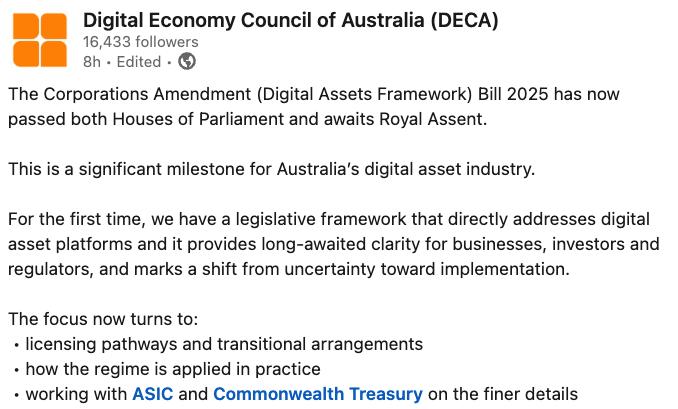
In a statement published on LinkedIn, the Digital Economy Council of Australia (DECA), an industry advocacy organization representing stakeholders in Australia's digital economy sector, welcomed the legislative progress with enthusiasm.
For the first time, we have a legislative framework that directly addresses digital asset platforms and it provides long-awaited clarity for businesses, investors and regulators, and marks a shift from uncertainty toward implementation.
DECA
Addendum clarifies treatment of MPC and crypto custody under new law
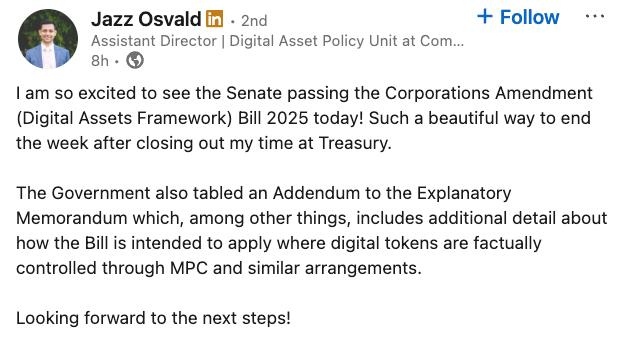
Taking to LinkedIn, Jazz Ozvald, who previously served as assistant director of digital asset policy at the Commonwealth Treasury, shared his enthusiasm regarding this significant achievement in advancing the bill through Parliament.
Ozvald highlighted that government officials simultaneously submitted an Addendum to the Explanatory Memorandum, which provides supplementary details clarifying how the legislation is designed to function in situations where digital tokens are under factual control through multi-party computation (MPC) arrangements.
Multi-party computation represents a cryptographic methodology employed in securing cryptocurrency wallets through the distribution of control among multiple participants, ensuring no individual party maintains complete authority. Transaction authorization becomes possible only when a sufficient number of parties collaborate, thereby creating enhanced security against theft or unauthorized use of funds.
According to the addendum's clarifications, the legislation's scope encompasses only those platforms that maintain actual custody of cryptocurrency assets on behalf of clients, as distinguished from entities merely providing technological infrastructure that facilitates control over assets, including scenarios involving distributed control mechanisms such as MPC configurations.