
BTC Reaches $68K as Futures and Macro Indicators Reveal Persistent Trader Pessimism
Despite Bitcoin's surge to $68,000 driven by optimism surrounding potential resolution of US and Israel-Iran tensions, futures market data indicates traders maintain a skeptical outlook.

Main highlights:
- Bitcoin surpassed the $68,000 threshold following President Trump's suggestion of pursuing an end to the Iran War regardless of whether the Strait of Hormuz achieves complete reopening.
- Derivatives market indicators for Bitcoin reveal elevated fear levels, with protective put options commanding higher prices and minimal interest in bullish leveraged positions.
On Monday, Bitcoin (BTC) experienced an upward movement to $68,000 in tandem with S&P 500 gains, triggered by US President Donald Trump's indication that his administration might explore pathways to conclude the US and Israel-Iran conflict even without fully reopening the Strait of Hormuz. Despite this rally, derivatives metrics reveal that Bitcoin traders continue maintaining a bearish perspective, suggesting minimal conviction that support at $66,000 will persist much longer.
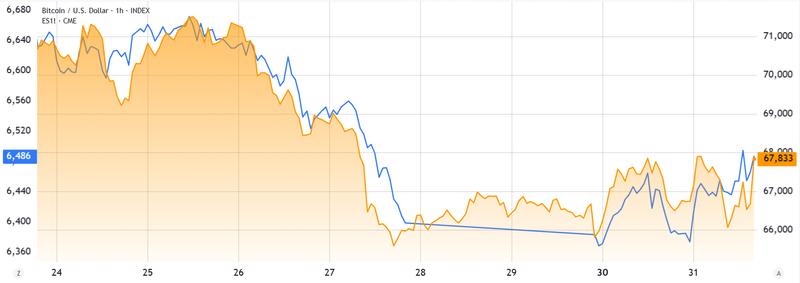
A brief decline in Bitcoin's price to $66,000 coincided with the same day when research analysts from Google published claims suggesting the elliptic curve discrete logarithm problem (ECDLP) might be vulnerable to quantum computing power that is 20 times less than previously thought. Nevertheless, savvy traders rapidly recognized that the entangled logical physical qubits required to execute such an attack remain impractical given the limitations of currently available equipment.
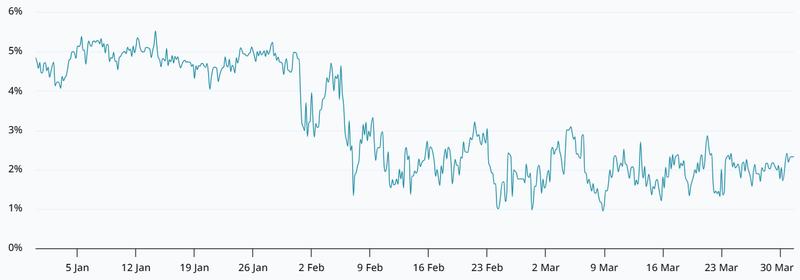
On Tuesday, the annualized premium for Bitcoin monthly futures contracts compared to conventional spot markets remained at 2%, unchanged from the previous week's levels. Readings below the 4% threshold signal insufficient appetite for bullish leverage, as short position holders (sellers) generally require a premium as compensation for extended settlement timeframes. Even more significantly, the price surge beyond $71,000 on Wednesday failed to generate bullish sentiment among investors.
Limited appetite for bullish leverage shown in Bitcoin derivatives
Bitcoin's price demonstrated resilience by maintaining levels above $66,000 throughout the past week, even as the S&P 500 dropped to its lowest point in 7 months on Monday. On Friday, crude oil prices climbed above the $100 mark, causing market participants to proceed with caution. Expectations regarding monetary policy easing in the US have declined dramatically over the past month as fuel price pressures have pushed inflation higher.
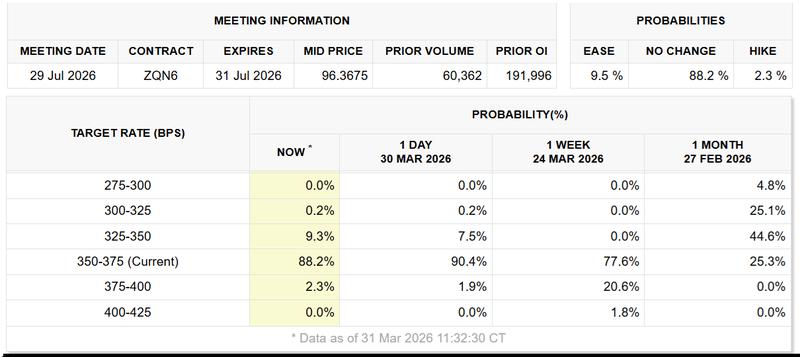
According to data from the CME FedWatch Tool, market participants now assign less than 10% probability to interest rate reductions by the US Federal Reserve by July, representing a sharp decline from the 75% probability estimated one month earlier. Elevated capital costs create advantages for fixed-income investments, constrain consumer spending patterns, and diminish incentives for corporate expansion. These conditions place additional strain on the US job market, which is already showing signs of weakness.
Examining the Bitcoin options market provides insight into whether professional traders are adopting a bearish position.
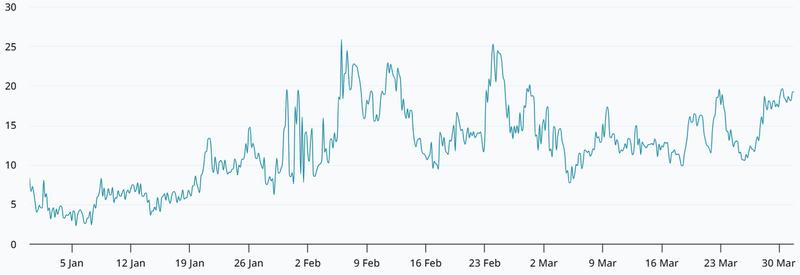
Bitcoin put (sell) options commanded a 17% premium relative to call (buy) options on Tuesday. Such elevated levels typically correspond with extreme anxiety regarding potential price declines. Balanced market conditions are characterized by a range spanning -6% to +6%, last observed in mid-January. Market makers and whales are evidently reluctant to accept downside exposure, despite Bitcoin having already experienced a 23% decline year-to-date in 2026.
The fact that Bitcoin has shown resilience around the $67,000 level indicates that quantum computing concerns were rapidly dismissed, though another factor may be responsible for the absence of bullish enthusiasm. Market participants might be anticipating economic stimulus measures as recession risks become more apparent. During initial phases, such stimulus packages typically provide greater support to stock markets compared to Bitcoin.
At present, the majority of market participants perceive Bitcoin as a risky asset class rather than a safe haven, which accounts for the pessimistic sentiment evident in Bitcoin derivatives. Consequently, the weak demand for bullish leveraged positions should not be interpreted as traders anticipating prices falling below $60,000.