
BTC Plunges Under $66,000 Amid Escalating US-Iran Military Tensions
The leading cryptocurrency experienced its steepest single-day decline since the beginning of February on Tuesday, losing over $4,500 in value within 24 hours.

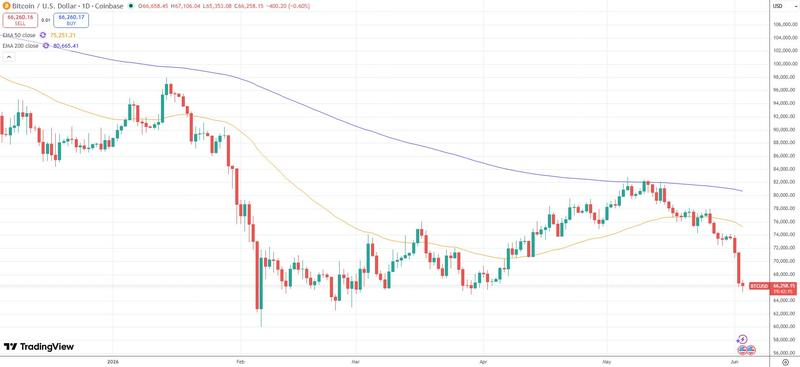
The price of Bitcoin has experienced a 7% decline throughout the day, piercing through crucial support levels to reach a nine-week low following renewed military strikes between the US and Iran as ceasefire negotiations have reached an impasse.
The price of Bitcoin (BTC) declined to $65,385 on the Coinbase exchange during the early hours of Wednesday trading, marking its lowest valuation since the latter part of March, based on data from TradingView.
This sharp decline comes on the heels of the most substantial daily decline observed since Feb. 5, during which BTC lost upwards of $4,500 throughout Tuesday's trading session.
Data provided by CoinGlass indicates that approximately 277,000 traders faced liquidation within the previous 24-hour period, resulting in total liquidations amounting to roughly $1.83 billion. Over 90% of these liquidations were attributed to long positions, with Bitcoin and Ether (ETH) accounting for the majority.
In a statement to Cointelegraph, Andri Fauzan Adziima, who serves as the research lead at Bitrue Research Institute, explained that Bitcoin's present decline is primarily driven by "leveraged liquidations, heavy ETF outflows, and technical breakdowns than pure Iran news, but it amplifies the fear."
According to Adziima, he anticipated "choppy consolidation," noting that genuine support levels exist at lower prices around $64,000 to $65,000, "with any de-escalation or strong macro rebound potentially sparking a sharp relief rally."
The exodus of $150 billion from the cryptocurrency market capitalization occurred as the US pursued its military strikes targeting what officials characterized as "aggressive Iranian behavior."
In a statement released on Tuesday, the US Central Command announced that it had successfully neutralized numerous Iranian ballistic missiles and drones, and "conducted self-defense strikes" targeting Qeshm Island as a response to attempted attacks orchestrated by Iran throughout the Middle East region.
"Iran launched several ballistic missiles toward regional neighbors; however, all failed to hit their intended targets," CENTCOM said. According to the statement, two Iranian missiles were directed at Kuwait, while three additional missiles were launched toward Bahrain.
This most recent military confrontation unfolds during an ongoing two-month ceasefire arrangement between the US and Iran, a period that has featured indirect negotiations focused on prolonging the ceasefire and removing a blockade affecting the Strait of Hormuz. Despite these efforts, the negotiations have not yet produced a formal agreement.
In a post on Truth Social on Tuesday, President Donald Trump asserted that "reports that the Islamic Republic of Iran, and the USA, stopped speaking a few days ago are false and erroneous."
"The conversations between us have been going on continuously, including four days ago, three days ago, two days ago, one day ago, and today," he said.
These remarks were issued following a report from Iran's Tasnim news agency on Tuesday stating that the country planned to halt all conversations with the US until Israel ceased attacking Lebanon.