
Bitcoin network mining difficulty drops before anticipated increase in upcoming adjustment
A decrease in Bitcoin mining difficulty was recorded on Saturday, though projections indicate another increase during the upcoming adjustment scheduled for May 1, 2026.

On Saturday, the mining difficulty for Bitcoin (BTC), which represents the relative complexity of appending fresh blocks to the Bitcoin blockchain, experienced a decline. This reduction comes at a time when publicly listed mining operations have been liquidating unprecedented volumes of BTC to finance their operational costs.
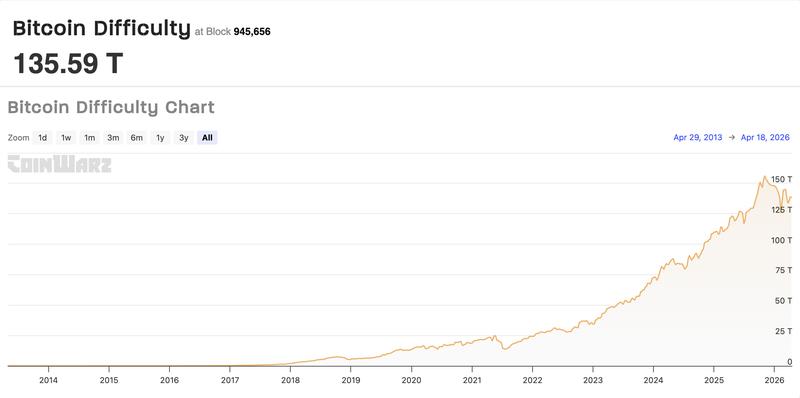
Data sourced from CoinWarz reveals that Bitcoin's mining difficulty dropped to approximately 135.5 T, representing a relatively small decline of roughly 1.1% during the preceding 24-hour period. Projections suggest that the mining difficulty will experience an uptick during the subsequent adjustment cycle. According to CoinWarz:
"The next Bitcoin difficulty adjustment is estimated to take place on May 01, 2026, 01:24:54 PM UTC, increasing the Bitcoin mining difficulty from 135.59 T to 137.43 T, which will take place in 1,865 blocks, about 12 days, 18 hours, and 41 minutes from now."
Throughout the previous year, Bitcoin mining operations have confronted an escalating array of obstacles, including diminished block rewards, climbing energy costs, a bearish cryptocurrency market environment, and geopolitical disruptions that collectively generate substantial economic pressures for mining entities.
Public mining companies sell record amounts of BTC
According to data from TheEnergyMag, publicly listed Bitcoin mining enterprises liquidated greater quantities of BTC during Q1 2026 than the aggregate total sold across all four quarters throughout 2025.
TheEnergyMag reports that mining operations including MARA, CleanSpark, Riot, Cango, Core Scientific and Bitdeer, collectively disposed of in excess of 32,000 BTC throughout the first quarter of 2026.
These combined liquidations exceeded the 20,000 BTC that was sold during Q2 2022, which coincided with the Terra-Luna ecosystem's catastrophic failure that triggered cryptocurrency's descent into a prolonged bearish cycle.
Mining operations routinely liquidate portions of their BTC holdings in order to satisfy operational expenditures, which are calculated and paid in traditional fiat currencies.
Nevertheless, as the expense associated with mining individual BTC units exceeds current spot market valuations, numerous Bitcoin mining enterprises find themselves in increasingly precarious financial positions.
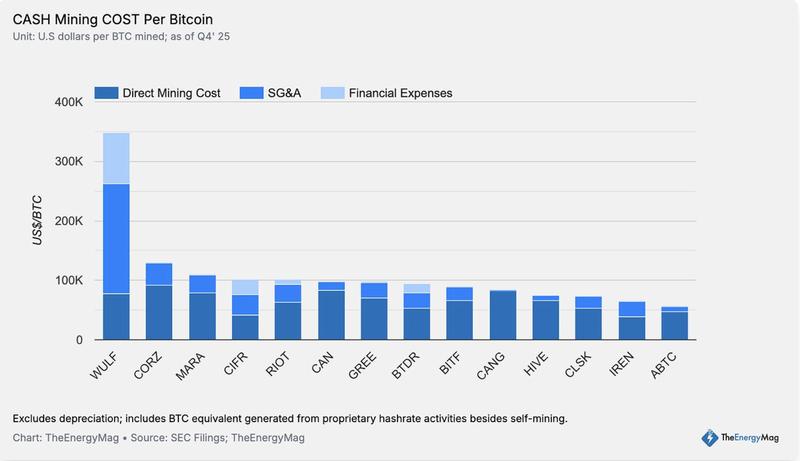
According to the Q1 2026 mining analysis published by asset management firm CoinShares, as many as 20% of Bitcoin mining operations are currently operating at a loss given prevailing economic circumstances.
The CoinShares analysis stated that "Q4 2025 marked the most challenging quarter for Bitcoin miners since the April 2024 halving."
The report's authors identified the "sharp" correction in BTC values during October 2025, which reduced Bitcoin's price from approximately $125,000 at its peak down to roughly $86,000 by December 2025, along with the increasing computational complexity required for block addition, as significant adverse factors impacting the mining sector.