
A7A5 Ruble-Pegged Stablecoin Expands Operations Under Western Sanctions Regime: CertiK Report
Despite facing Western sanctions, the Russian ruble-pegged stablecoin A7A5 has facilitated over $110 billion in transaction volume, CertiK reports.

Despite being subject to Western economic restrictions, the A7A5 stablecoin pegged to the Russian ruble has experienced sustained expansion, facilitating more than $110 billion in aggregate onchain transaction volume, data from CertiK reveals.
According to CertiK's findings, A7A5 has facilitated over $110 billion in total onchain transaction volume, secured approximately 43% of the worldwide non-US dollar stablecoin marketplace, and experienced growth in its holder base from 13,000 to 29,000 wallet addresses during the period spanning February 2025 through May 2026.
CertiK characterized A7A5 as among the most transparent examples of a stablecoin infrastructure designed to circumvent sanctions, establishing connections between the token and Russian entities involved in cross-border payment processing.
This expansion demonstrates the constraints of Western economic restrictions when applied to blockchain-based transaction networks, including the European Union's 19th sanctions package, which was enacted on Oct. 23, 2025, and banned transactions involving A7A5 effective Nov. 12. According to CertiK, the reserve architecture positions critical assets beyond the immediate reach of Western regulatory enforcement.
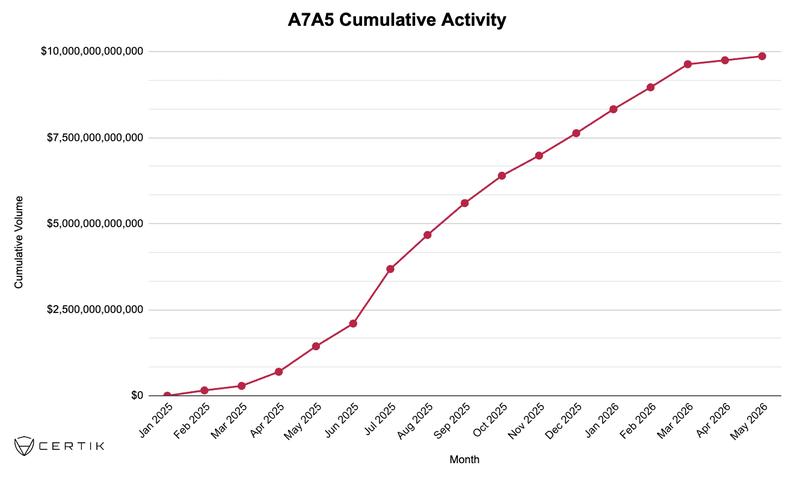
The issuance of A7A5 occurred in January 2025 through Old Vector LLC, a Kyrgyz-registered organization operating on behalf of A7 LLC, a Russian cross-border settlement company, which counts among its co-owners Moldovan-Russian business magnate Ilan Shor alongside Promsvyazbank, a state-controlled Russian financial institution serving the defense industry.
Subsequently, Russian regulatory bodies granted recognition to A7A5 within the nation's digital financial asset regulatory framework.
Transaction data shows the stablecoin achieved $11.2 billion in trading activity for A7A5/RUB pairs and an additional $6.1 billion in A7A5/USDT trading pairs, with the majority of this activity occurring on Grinex, which operates as the replacement for Garantex, the exchange that previously operated as a money laundering conduit for Conti, Black Basta, LockBit and certain illicit proceeds linked to North Korean-affiliated threat actors, including $30 million originating from the 2022 Horizon Bridge security breach that was transferred to Garantex during February 2023.
The US Secret Service executed a seizure of the Garantex domain during March 2025, concurrent with Tether implementing a freeze on roughly $28 million in USDt (USDT) stored within Garantex-operated wallet addresses.
The design intent behind A7A5 was to mirror certain aspects of USDT's stablecoin functionality while maintaining issuance operations, reserve holdings and freezing capabilities outside infrastructure under Western control.
Can Western sanctions curb A7A5's circulation?
The developers behind the ruble-pegged stablecoin have engineered it without incorporating a centralized termination mechanism, which means that the smart contract functions governing wallet and asset freezes remain under the exclusive control of its Russian and Kyrgyz development team, as explained by Jonathan Riss, OSINT and blockchain intelligence analyst at CertiK.
Additionally, the stablecoin's reserve assets are positioned within Central Asian financial networks, primarily throughout Kyrgyzstan and within Russia's banking infrastructure, placing these funds beyond the jurisdiction of Western sanctions enforcement.
Furthermore, A7A5 employs a distributed circulation strategy leveraging decentralized finance (DeFi) liquidity pools including Curve and Uniswap to avoid potential freezing actions by centralized cryptocurrency exchanges, CertiK's Riss explained to Cointelegraph, adding:
"While Western regulators cannot directly rewrite the Ethereum or Tron blockchain to erase A7A5, the EU's 19th package and parallel US/UK actions target the physical and digital choke points."
Those behind A7A5's creation engineered the stablecoin with deliberate attention to the aforementioned three "immunities" as a means to bypass sanctions that had effectively disabled their earlier evasion tactics, such as utilizing Tether's USDT, according to Riss.
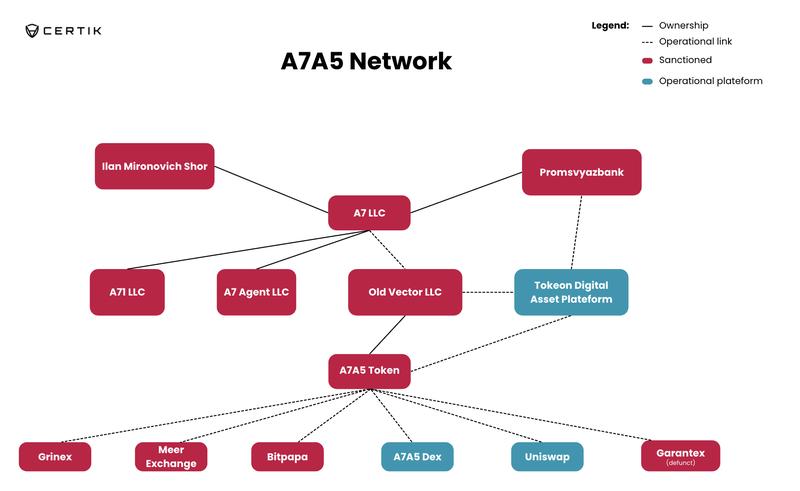
As the controlling stakeholder, Shor holds 51% ownership of A7 LLC. His political career included service as a Moldovan parliament member through 2017, at which point a Moldovan court issued a conviction against him related to a 2014 financial theft totaling approximately $1 billion from three banking institutions in Moldova. His departure from Moldova occurred in 2019, after which he secured Russian citizenship.
An in absentia sentencing to 15 years of imprisonment was handed down in 2023. His current location is Moscow.