
Why Ethereum's Journey to $2,500 Could Face More Obstacles Than Anticipated
While cryptocurrency markets pursued positive gains throughout the week, Ethereum's climb toward the $2,500 mark faces potential roadblocks. Cointelegraph breaks down the challenges ahead.

Important highlights:
Derivatives data for ETH indicates a defensive pivot as institutional traders implement hedging strategies against potential declines amid worldwide uncertainty.
Ethereum maintains its leading position among institutional players due to their preference for decentralized networks, even as network usage metrics show recent weakness.
The price of Ether (ETH) fell 6% after a short-lived climb to $2,200 on Wednesday, mirroring declines in United States stock markets while the Iranian conflict reached its sixth consecutive day. Global oil production interruptions and disrupted natural gas shipments from the Middle East sent WTI crude oil values to heights last witnessed in July 2024.
Market participants revised their economic expansion forecasts downward as tensions intensified, adopting a risk-averse strategy.
The bearish sentiment among traders intensified as the Trump administration encountered judicial resistance to its tariff policies. On Monday, a Federal court denied a Justice Department appeal to suspend proceedings for 90 days, effectively overturning the administration's reliance on emergency authority for implementing trade duties.
Ethereum finds itself trapped within these broader economic challenges, which have dampened upward movement despite recovering 22% from the $1,800 level tested on Feb. 24. Current blockchain data and derivative trading activity demonstrate substantial lack of enthusiasm from those betting on price increases.
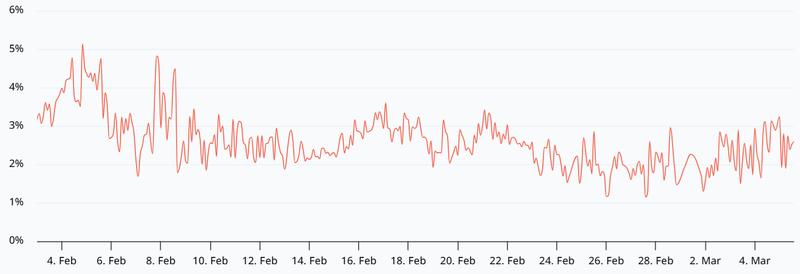
The annualized premium on 30-day ETH futures contracts remains considerably beneath the 5% neutral benchmark, indicating insufficient appetite for leveraged long positions. This measurement is influenced by ETH currently trading 58% under its August 2025 peak of $4,956. To determine whether institutional trading desks expect additional downward movement, examining the options marketplace becomes essential.
During periods when large-scale investors and market-making firms pursue downside protection, the ETH options skew (put-call) generally climbs beyond the 6% neutral threshold. During periods of extreme volatility and stress, this measurement can exceed 15%.
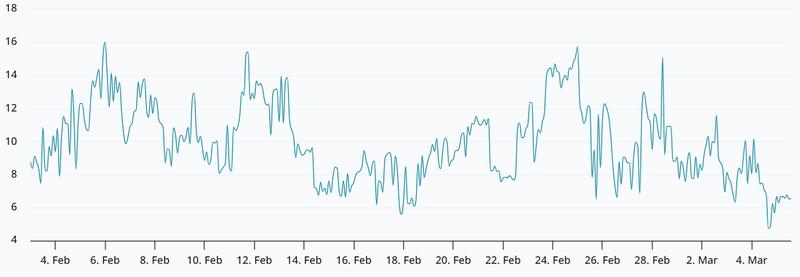
On Thursday, the ETH options skew climbed to 7% following a brief return to neutral territory just one day earlier. This ongoing skepticism within professional trading circles gives bearish market participants the ammunition needed to drive continued doubt. Apart from broader macroeconomic headwinds, such as private credit defaults in the US and increasing corporate workforce reductions, Ethereum grapples with network-specific challenges.
Ethereum is positioned to capture the pickup in DApps demand
Activity levels on the Ethereum blockchain have plateaued after experiencing a moderate surge during early February. Sustained utilization of blockchain infrastructure remains critical for maintaining healthy ETH price trends and mitigating inflationary effects. Ethereum's integrated token burn system relies on competition for validator queue entry, a dynamic usually driven by trading volume on decentralized exchanges (DEX).
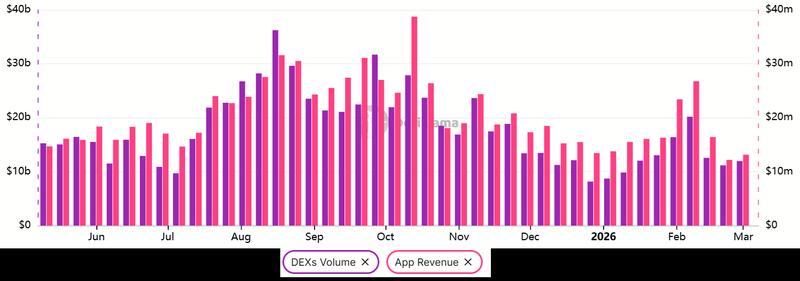
Decentralized exchange trading volume on Ethereum recently registered $12.6 billion on a weekly basis, declining from $20.2 billion measured four weeks earlier. Revenue generated by decentralized applications (DApps) fell to $14.1 million across the seven-day period, representing a 47% reduction compared to the prior month. Alternative blockchain platforms have experienced comparable patterns, with Solana's DEX trading volumes also contracting by 50% during the identical 30-day timeframe.
Notwithstanding the underwhelming blockchain usage statistics, ETH maintains a strong position to benefit from any future resurgence in DApp engagement thanks to its commanding share of total value locked (TVL). When incorporating secondary layer scaling infrastructure, the broader Ethereum network represents approximately 65% of aggregate blockchain market TVL.
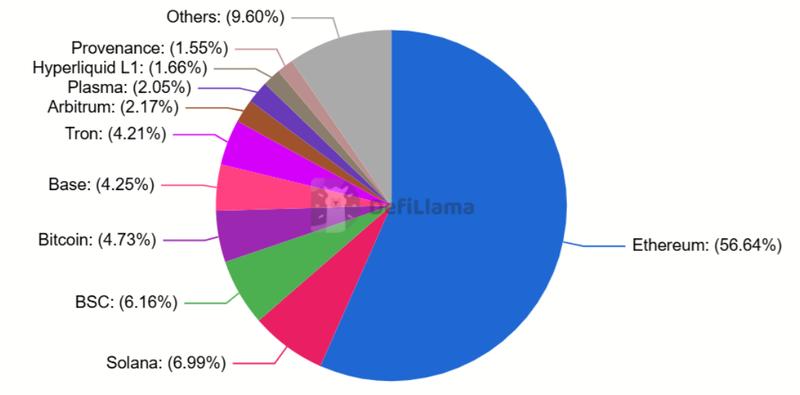
Ethereum's primary blockchain layer contains $55.4 billion in TVL, whereas its principal rival Solana, commands $6.8 billion. This substantial differential demonstrates that institutional capital allocators prioritize decentralization despite the reduced transaction costs and superior processing speeds available through alternatives such as Solana and BNB Chain.
The prevailing weakness observed in Ether derivative instruments and blockchain utilization data doesn't inherently indicate an impending price collapse. Market psychology can reverse rapidly toward sustained upward momentum should ETH successfully breach and hold above the $2,400 threshold. Currently, Ether's valuation remains tightly correlated with the prevailing risk-averse market environment, which diminishes the probability of establishing durable bullish price action.