
Traders Transfer 55,000 Bitcoin to Trading Platforms as Market Faces $1.1 Billion in Forced Closures
As Bitcoin fell beneath the $81,000 threshold, widespread cryptocurrency position liquidations occurred while traders transferred BTC to trading platforms at realized losses.
A widespread selling wave across Bitcoin (BTC) and alternative cryptocurrencies resulted in forced liquidations exceeding $1 billion within a 24-hour period, as holders who recently acquired positions transferred tens of thousands of BTC to trading platforms while incurring losses.
Key points:
- Forced cryptocurrency liquidations reached approximately $1.1 billion within 24 hours following Bitcoin's decline to $80,350.
- The downward pressure on BTC pricing increased the likelihood of a breakdown beneath critical support zones, according to analysis from Rekt Capital.
- Holders classified as short-term Bitcoin investors transferred over 55,000 BTC to trading platforms at a loss during Thursday's session.
Bitcoin's decline to $80,350 triggers $1.1 billion in forced liquidations
Information sourced from CoinGlass indicated that aggregate cryptocurrency liquidations totaled $1.09 billion during the 24-hour window ending at 10 am UTC on Friday.
This represented the most significant single-day liquidation figure since Aug. 21, during which BTC/USD climbed from $73,000 to $79,500, establishing two-month peak values and catalyzing $1.3 billion in forced closures of cryptocurrency short positions. By contrast, leveraged long positions comprised $1.05 billion of the liquidations recorded on Thursday.
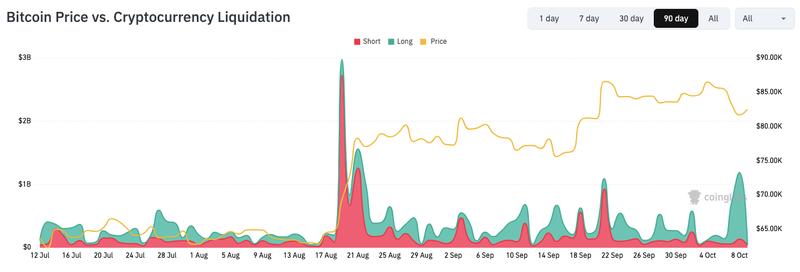
The market downturn came after news emerged regarding the US government transferring over 12,000 BTC that had been seized in prior confiscations. Movements of this nature can generate expectations of potential selling pressure.
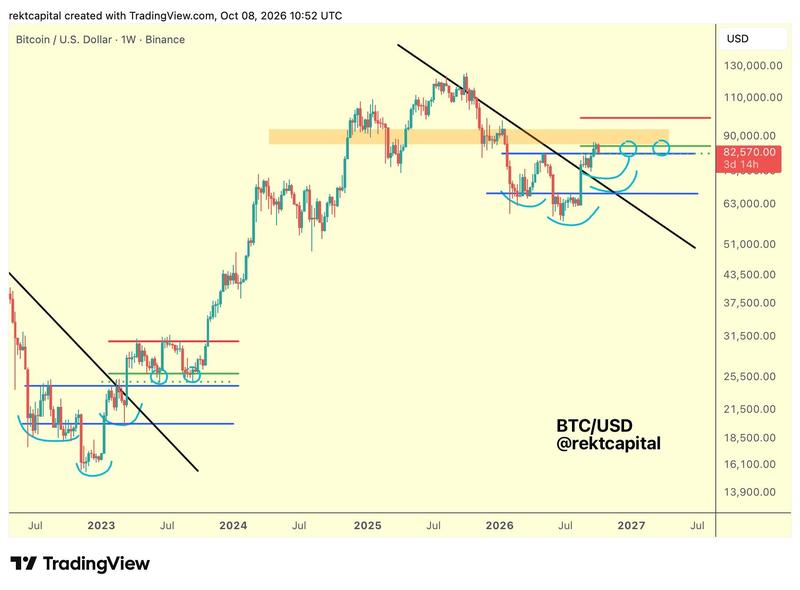
BTC/USD declined to $80,350 on the Bitstamp exchange, marking its weakest price point since Sept. 18, prior to rebounding to approximately $82,500 by Friday. This price level has maintained significance throughout Bitcoin's extended upward trend beginning in early July, representing the breakthrough threshold for an inverse head-and-shoulders chart formation. For Bitcoin to validate the bullish pattern reversal, it would need to sustain this level as a support zone.
Trading strategist and market analyst Rekt Capital, who has been monitoring the reversal formation and its parallels to Bitcoin's 2023 price recovery, currently identifies the forthcoming weekly candle closure as critically important.
"Bitcoin is currently failing its retest of ~$82500. Weekly Close below $82500 and turn it into resistance however and Bitcoin will be back in its Macro Accumulation Range,"
he said Thursday on X.
Recent Bitcoin acquirers transfer 55,600 BTC to trading platforms while realizing losses
Blockchain analysis data additionally revealed heightened pressure among more recent Bitcoin market participants as prices deteriorated.
Data contributor Amr Taha from analytics service CryptoQuant documented that short-term holders — defined as addresses holding Bitcoin for periods not exceeding six months without executing sales — moved 55,600 BTC to trading platforms at a loss throughout Thursday's trading session.
Loss-making transactions denote cryptocurrency units being deposited to exchanges at valuations lower than those recorded during their most recent blockchain movement. These activities frequently signal investors' reactive impulse to liquidate holdings at unfavorable prices, driven by concerns of additional price deterioration should they postpone their exit strategies.
According to CryptoQuant's assessment, Thursday's loss-taking volume surpassed levels observed on June 26, when Bitcoin dropped beneath $60,000 for two consecutive trading days.
"Notably, Bitcoin was trading above $81,000, compared with $59,300 in June — a price difference exceeding 36%,"
the contributor wrote, adding that exchange users may not have opted to sell the entirety of their positions, even after moving them to their accounts.
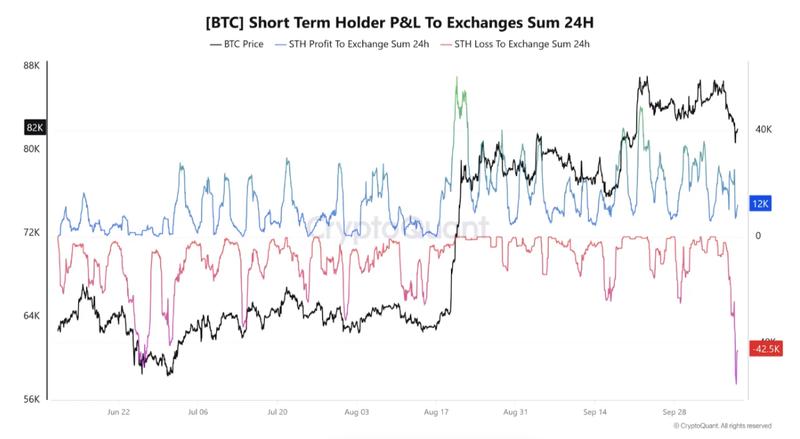
"Historically, aggressive loss-driven selling by short-term participants can coincide with short-term capitulation, potentially exhausting weaker holders and creating conditions for a subsequent price recovery,"
the report said.