
Iran's Nobitex Exchange: The Puzzle of Its Absence from US Sanctions Lists
An examination of publicly available data regarding Iran's largest cryptocurrency platform, exploring its utilization by state authorities, findings from blockchain analytics investigations, and the reasons behind its conspicuous absence from OFAC's designated entities list.
As February 2026 drew to a close, Iran experienced an almost complete internet blackout. Following coordinated military operations conducted by Israel and the United States, Iranian authorities effectively disconnected the nation from the global internet infrastructure — presumably maintaining connectivity only for a select group of government-approved users with external network privileges.
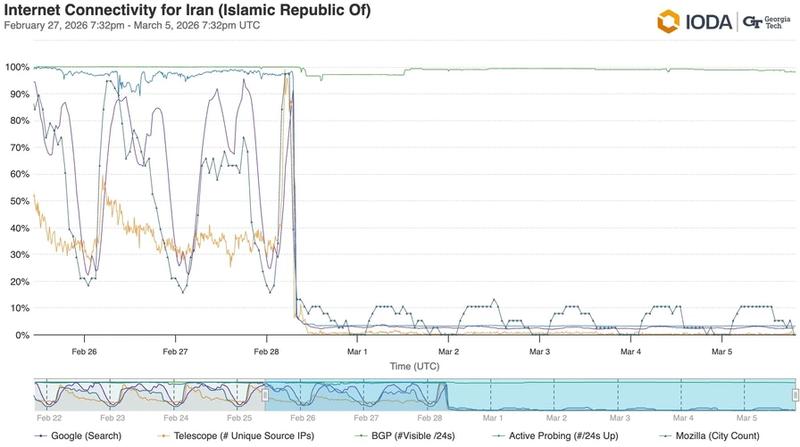
Yet amid this enforced digital isolation, a crucial financial platform maintained uninterrupted operations: Nobitex, the cryptocurrency trading venue with documented connections to Iran's governmental elite.
An examination of publicly available data regarding the platform reveals how Iranian state actors leverage it, what blockchain analytics companies have uncovered through their investigations, and the factors explaining why, notwithstanding these revelations, the exchange remains absent from OFAC's SDN List.
Understanding the magnitude of Iran's dominant crypto platform
Nobitex operates well beyond the margins of the crypto ecosystem. Although precise figures differ among sources, researchers universally acknowledge that billions of dollars in digital assets flow through the platform. TRM Labs, for example, documented observed transaction volumes approaching $5 billion spanning the period from 2025 through March 2026.
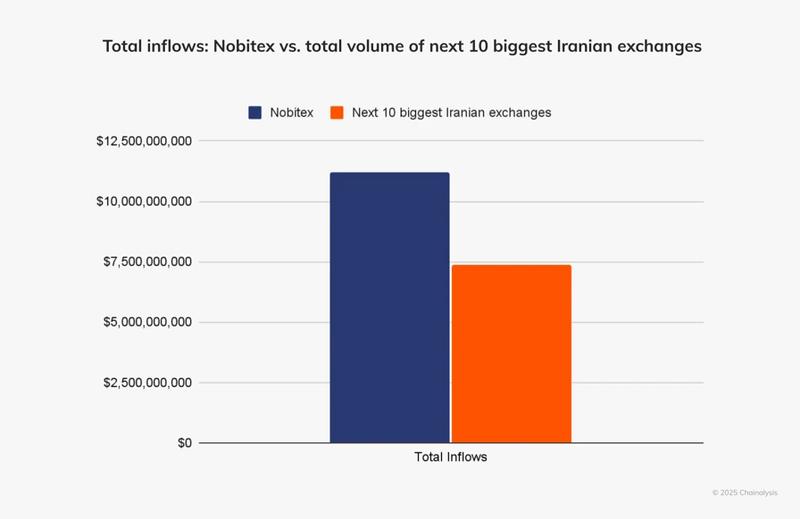
The platform maintains a substantial base of individual users. Based on statistics published by Nobitex itself, approximately 11 million Iranian citizens utilize the service — representing nearly 12% of the nation's total population.
Standard industry features comprise the exchange's service portfolio: traditional and leveraged trading options, interest-generating investment vehicles, pooled liquidity mechanisms, virtual gift certificates, and cryptocurrency-backed loan facilities.
Beyond retail services, Nobitex accommodates sophisticated traders and corporate clients. Such participants receive customized arrangements, including enhanced transaction limits and accelerated application programming interfaces.
However, the platform captured widespread scrutiny not through its consumer-facing services. Instead, attention focused on evidence indicating Nobitex operates as a sovereign currency conduit for a nation isolated from SWIFT infrastructure.
Underground financial architecture
Multiple public investigations have examined Nobitex's role in helping Iranian leadership circumvent international economic restrictions.
During January 2026, Elliptic released findings documenting organized acquisitions of USDT stablecoins conducted by Iran's monetary authority. The firm's analysis revealed transactions exceeding $507 million executed via intermediaries operating from the UAE, with the purchased digital assets transmitted "primarily" to Nobitex.
Given that these stablecoins could subsequently be exchanged for Iranian rials, the central bank was essentially executing currency market operations beyond the scope of traditional international banking channels.
State utilization of the exchange extends far beyond this single application. Recent investigative journalism by Reuters traced connections between the platform's co-founders — siblings Ali and Mohammad Kharrazi — and a prominent Iranian political and religious dynasty.
The news organization additionally identified Mohammad Baqer Nahvi, an executive with Safiran Airport Services, as among the exchange's most significant initial backers — a company that OFAC added to its SDN List during September 2022 for coordinating air transport operations supplying Iranian unmanned aerial vehicles to Russia.
Additionally, both Elliptic and Chainalysis have traced Nobitex connections to cryptocurrency wallets linked with Hamas, Yemen's Houthi Ansar Allah organization, the Gaza Now media platform, and Garantex, the sanctioned Russian cryptocurrency exchange.
Evidence suggests the exchange constructed its technical foundation specifically for sanctions-resistant operations from inception.
During June 2025, unauthorized disclosures exposed the platform's programming code alongside portions of internal procedural documents. Analysis of this leaked material revealed software components facilitating the creation of concealed addresses, transaction aggregation and fragmentation, endpoint rotation capabilities, and specialized programming designed to circumvent regulatory verification processes. Documentation labeled "Nobitex Privacy" entered the public domain as well, containing explicit descriptions of methodologies to evade FinCEN detection systems and Western blockchain surveillance tools.
Incomplete enforcement or calculated forbearance?
April 2026 brought reports that Iranian organizations were demanding cryptocurrency payments from shipping operators seeking safe transit through the Strait of Hormuz. Digital currencies have allegedly emerged as among the preferred settlement methods for these arrangements.
The apparent effectiveness of this approach suggests cryptocurrency will maintain its role in comparable operations going forward.
Within this context, designating Nobitex for the SDN List following the Garantex precedent might appear to be an obvious measure, despite such transaction flows typically bypassing consumer-focused platforms. Nevertheless, this action has not occurred.
The Treasury Department has previously imposed sanctions on Iran-associated cryptocurrency platforms, though those entities maintained UK registration. Nobitex, conversely, operates as a domestically incorporated Iranian enterprise.
Significantly, Reuters published its Nobitex investigation on the same date that OFAC issued guidance stating Iranian digital asset platforms already constitute blocked financial institutions, irrespective of individual SDN List inclusion.
For an exchange physically situated within Iran, this classification carries limited practical consequences: its fundamental business model centers on serving Iranian customers and utilizing neutral international intermediaries.
SDN designation operates through different mechanisms. It activates secondary sanctions against all non-American counterparties globally, establishes direct legal grounds for wholesale asset seizures by stablecoin issuers, and forces foreign exchanges and over-the-counter trading desks to terminate relationships or face designation themselves.
Reasons individual SDN designation might be unnecessary
Treasury Department officials have not articulated why Nobitex has not received individual SDN designation. Nevertheless, it merits observation that the department has never placed platforms incorporated domestically within Iran onto the list — despite multiple such entities existing.
OFAC's approach toward Iran's domestic cryptocurrency market emphasizes precision-targeted interventions. Three principal tactics emerge:
- Sanctions directed at particular cryptocurrency addresses.
- Designation of money service businesses — illustrated recently by additions of exchanges purportedly handling state-controlled shadow petroleum revenues.
- Designation of private individuals and over-the-counter intermediaries.
Regarding Nobitex specifically, explanations remain necessarily conjectural. The first possibility has been previously articulated: OFAC applies a distinct strategy toward domestically based Iranian platforms, positioning Nobitex within rather than outside this operational framework.
Treasury officials may alternatively regard such measures as superfluous. As noted earlier, American persons already face prohibitions against conducting business with Iranian exchanges; from the perspective of formal restrictions, individual listing provides minimal additional constraint.
A "human shield" theory also exists. In statements to Reuters, Nick Smart, serving as Chief Intelligence Officer for Crystal Intelligence, observed the platform concentrates significant activity from ordinary Iranian citizens. He proposed that distinguishing regime transactions from civilian use of the exchange proves virtually impossible, given the intermixing of their assets.
Viewed through this lens, the Garantex situation represents an inverse scenario: that platform functioned as a business-to-business conduit for illicit capital. This enabled physical server seizures without inflicting social harm upon individual users.
No direct official confirmation exists that this reasoning influences OFAC's approach.
Finally, action against Nobitex might be perceived as ineffective absent concurrent measures targeting external "exit points." Sanctions derive value not at points of origin, but where capital exits the jurisdiction: foreign trading platforms, stablecoin issuers, over-the-counter brokers, banking institutions, and comparable intermediaries.
The paradox of widespread adoption
The Nobitex situation reinforces that the mass acceptance the cryptocurrency sector envisions carries inherent contradictions.
From one perspective, the exchange provides internationally isolated Iranians meaningful financial autonomy: mechanisms to protect savings against rial devaluation and preserve some degree of dollar-denominated liquidity access. Conversely, governmental entities exploit identical infrastructure for their objectives, spanning central bank currency stabilization operations to fund transfers supporting regional allied groups.
The critical observation is that this represents an established pattern rather than an anomaly. Chainalysis categorizes Iran alongside Russia and North Korea, observing that across all three nations, "what were once experimental and opportunistic tactics have matured into institutionalized strategies embedded within national economic and security policy."
The Iranian framework — a mass-market retail platform positioned in jurisdictionally unreachable territory complemented by offshore intermediary structures — constitutes a proven operational model. Future sanctioned governments will probably examine this precedent.
This generates an inverse question — directed at regulatory authorities themselves.
What represents the acceptable collateral impact of sanctions enforcement when state funds and millions of ordinary citizens' savings physically commingle within a singular platform? Can the assets belonging to 11 million individuals be frozen to eliminate governmental financial channels — or does this represent precisely the boundary that the SDN mechanism, in its present configuration, deliberately avoids crossing?
OFAC has not offered public commentary on this matter, and the Nobitex situation intensifies this ongoing policy debate.