
Circle's USDC overtakes Tether in transfers as stablecoin volumes surge to unprecedented $1.8T
February witnessed unprecedented stablecoin activity with transaction volumes soaring to $1.8 trillion, while USDC unexpectedly dominated with 70% market share, catching industry observers off guard.

The stablecoin market has achieved unprecedented heights in monthly transfer volumes, with Circle's USDC (USDC) overtaking Tether's USDt (USDT) for the top position, according to recently released data.
Key takeaways:
- February saw stablecoin transaction volumes reach an unprecedented $1.8 trillion mark.
- Circle's USDC accounted for 70% of total stablecoin transfer activity.
- Increasing stablecoin reserves on trading platforms signal positive conditions for cryptocurrency market recovery.
USDC "consistently" flips USDt transfer volume
February witnessed stablecoin transfer volumes climb to $1.8 trillion, establishing a new monthly benchmark, based on information provided by Allium.
These digital assets are cryptocurrencies engineered to preserve a consistent value, generally anchored to traditional currencies such as the US dollar, and have the capability to operate across various blockchain networks.
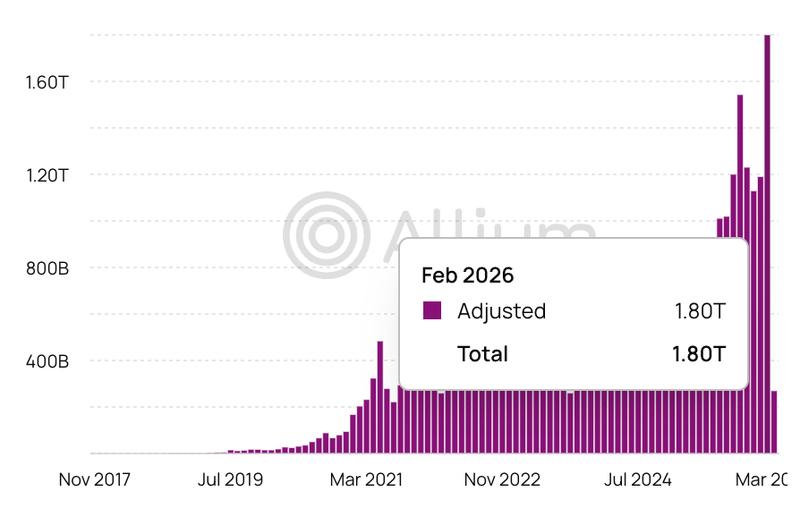
Correspondingly, USDC's transaction volume peaked at $1.26 trillion, marking a significant achievement in the widespread acceptance of the second-most valuable stablecoin by market capitalization since it first entered the market in September 2018.
This figure exceeded USDt's performance by more than twofold, as Tether's transfer volume totaled $514 billion throughout February.
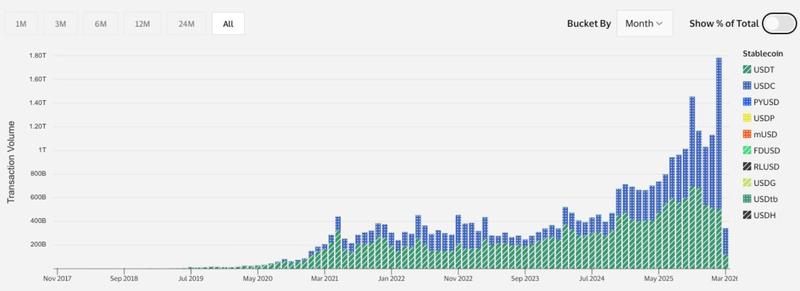
Indeed, USDC has "consistently flipped" Tether when it comes to transfer volume throughout recent months, according to Simon Dedic, founder at Moonrock Capital, in a Friday post on X.
The widespread adoption of USDC arrives as a "surprise" considering its market capitalization represents less than half of USDt's valuation, Dedic noted. With a market cap of $77.4 billion, USDC ranks as the second-largest stablecoin, while USDt commands $184 billion.
Furthermore, USDC's circulating supply has expanded more rapidly than USDt's during recent weeks. March has already seen over $3 billion in new USDC minted, based on data from market intelligence firm Arkham, while USDt's supply has shown relatively minimal change.
Circle Internet Group, the company behind USDC, disclosed robust Q4/2025 financial results, which were driven by substantial expansion in USDC's operations and broadening payment service capabilities, as Cointelegraph reported.
More stablecoin liquidity suggests "buying power"
The Stablecoin Supply Ratio (SSR), which measures the Bitcoin (BTC) market capitalization in relation to the total stablecoin market cap, is "steadily recovering after crashing" during February, according to CryptoQuant analyst Sunny Mom in a Friday Quicktake post, adding:
"This shows buying power is returning to the market."
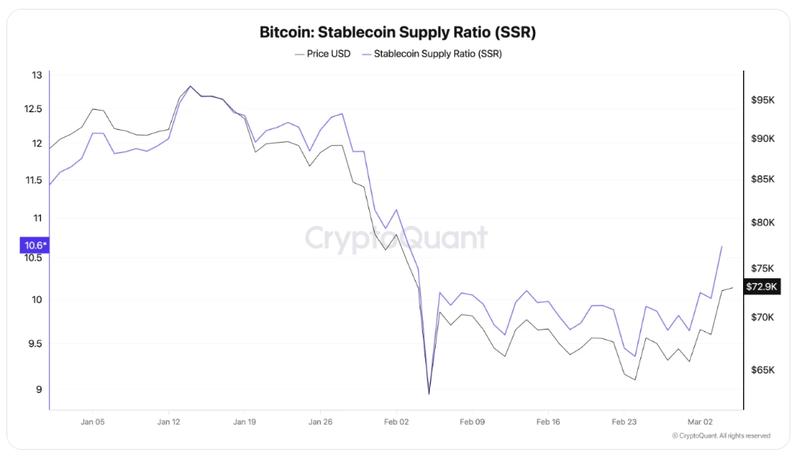
At the same time, Bitcoin's recent climb to $74,000 received support from an increase in stablecoin reserves on cryptocurrency trading platforms, which climbed to a three-week peak of $66.5 billion on Friday.
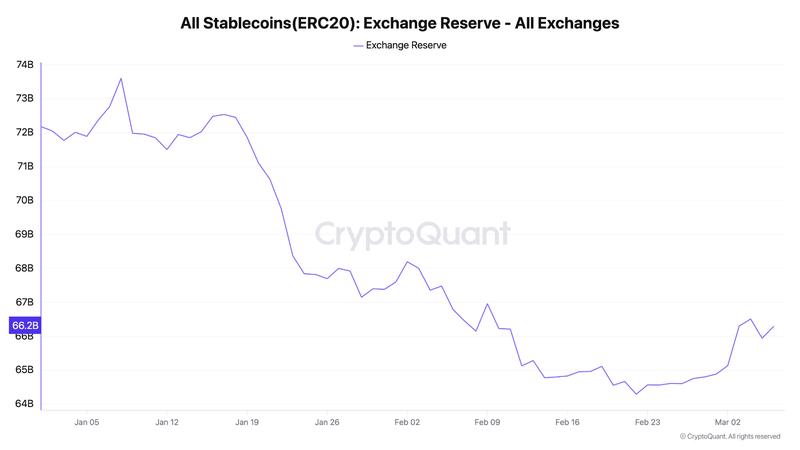
Exchange-bound stablecoin deposits have elevated the SSR in tandem with Bitcoin's (BTC) price appreciation. The aggregate value of stablecoins moved to exchanges on March 5 reached approximately $5.14 billion, a substantial increase from the $1.14 billion recorded on March 1.
Higher stablecoin balances on trading platforms translates to enhanced purchasing capacity for digital assets. Historically, the movement of capital from the sidelines back to exchanges has served as a significant trigger for the initiation of Bitcoin bull market cycles.