
Can Bitcoin Sustain Its Recovery? Additional Compromised Ledger Devices Discovered: Hodler's Digest
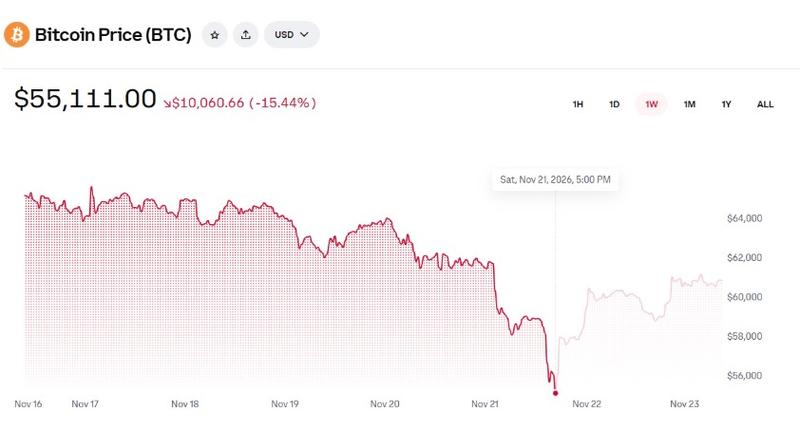
Bitcoin experienced a dramatic recovery from recent lows, but questions remain whether $55,110 marks the cycle bottom. Ledger probes fresh incidents of manipulated hardware wallets discovered in Berlin and the United Arab Emirates.

Bitcoin surges 11% as Kraken experiences $17K price anomaly despite claiming normal operations
Over the weekend, Bitcoin staged a dramatic comeback, climbing back above the $61,034 level and representing an 11% gain from the recent cycle bottom near $55,110 recorded on the Coinbase exchange.
Traditional markets also experienced significant declines as investors express growing apprehension about the viability of AI infrastructure investments funded through debt. On Friday, the technology-focused Nasdaq index dropped an additional 5.3% and is approaching bear market territory after declining nearly 20% from its peak in October. Last week saw the S&P 500 tumble 8.6%, marking it as the 12th most severe weekly decline dating back to 1952, while gold shed another 4.3% over the previous 24 hours and has fallen 21.6% since September. The precious metal is currently tracking toward its most significant three-month decline since June 2013.
During the current reporting period, Bitcoin's valuation remained stable around the $60,750 mark, though numerous analysts suggest additional downside remains likely. Historical comparisons to prior four-year market cycles indicate bottoms typically formed following US midterm elections, according to many observers.
During the earlier part of the week, seasoned market analyst Peter Brandt observed that:
"Every bull market phase in BTC's history has ended with at least a 75% correction of the previous parabolic bull trend. Could this be what's happening in Bitcoin?"
An unexpected preview of potential future price action materialized on Kraken's Canadian dollar trading pairs when Bitcoin temporarily plummeted to approximately US$17,000. Even though this represented a 71% discount compared to USD markets, Kraken maintained all systems were functioning normally, stating that every transaction executed as intended and their security personnel discovered no indications of platform breaches or account compromises. "Executed trades stand," the exchange declared.
Cryptocurrency analyst Cryptobull provided a glimmer of optimism by highlighting that Bitcoin's MVRV peak during this market cycle only reached 2.29 times above its realized price, and when extrapolating these metrics to determine the cycle bottom, it would suggest a floor around 1.03 times the cost basis of $53,700. This calculation would align almost perfectly with the $55,130 price level that Bitcoin recently touched.
Manipulated Ledger hardware wallets discovered in Dubai and Germany
Ledger has issued an alert to customers who acquired hardware wallets in Berlin beginning in January 2026, requesting they reach out to its support division as the firm examines reports of compromised devices in Germany and the United Arab Emirates.
Multiple questionable devices have been identified in Berlin, while a pair of customers in Dubai disclosed losses totaling $604,000 in digital assets.
According to Ledger, these incidents are linked to the identical distribution-channel manipulation operation initially uncovered in Southeast Asia during October. The company is additionally providing physical device examinations, including X-ray scanning, at its manufacturing facility in Vierzon, France, for customers worried their hardware wallets may have been tampered with.

Ethereum's Glamsterdam implementation potentially delayed to May 2027 due to compatibility issues
During the previous week, Ethlabs advocated for making Ethereum resistant to quantum computing and artificial intelligence threats in 2027. However, this week's All Core Developers Call indicated the network might not achieve Glamsterdam activation until May 2027.
Based on existing specifications, mainnet deployment could occur as soon as mid-January 2027. Nevertheless, if adjustments to gas pricing Ethereum Improvement Proposals are implemented and subsequently evaluated for potential contract disruptions, the activation timeline could extend to late February or early March, possibly stretching to April or May. A final determination remains pending.
The developer call also explored the potential for modifying the EIPs within the Hegota fork to emphasize post-quantum capabilities, though multiple developers contended that narrowing the upgrade's breadth would provide minimal advantages unless it simultaneously accelerated the deployment schedule.

Binance exploit-linked wallets transfer approximately $600M in ETH, utilizing THORChain and Chainflip
Addresses associated with the Binance security breach transferred close to $600 million worth of Ether across two consecutive days, with portions of the misappropriated assets channeled through decentralized cross-chain exchange protocols, based on reports from blockchain intelligence firms.
The perpetrators relocated roughly $248 million in ETH to fresh wallet addresses on Thursday, followed by an additional $346 million in ETH on Friday. According to blockchain analytics provider Onchain Lens, the attackers directed some of these funds through the cross-chain protocols THORChain and Chainflip.
THORChain experienced a surge in 24-hour trading volume, reaching $239 million on Friday, which drove the protocol's revenue to $243,000, as reported by THORChain's monitoring dashboard.
Anthropic stock purchases reach half of SpaceX's initial day net buying
Individual investors exchanged $772 million worth of Anthropic shares during its Thursday Nasdaq listing debut, though their cumulative net acquisitions amounted to merely $60 million, representing approximately half of the $118 million they invested in SpaceX during its inaugural trading day in June.
Anthropic's debut-day retail transaction volume surpassed SpaceX's $669 million figure and established the highest record for any market debut within Vanda Research's historical data, which extends back to 2012, as reported by Yahoo Finance.
Trading volume encompasses both buy and sell transactions, whereas net purchasing calculates the degree to which acquisitions exceeded liquidations.
ANT concluded its initial trading session with a 17% gain over the initial public offering price, though the equity declined to just 7% above the IPO valuation on the second day during a comprehensive market downturn.
Winners and Losers
As the week concluded, Bitcoin (BTC) experienced a 6.5% decline to settle at $60,815, Ethereum (ETH) decreased 5.9% to reach $1,713, and XRP (XRP) dropped 4.3% to $0.02. The aggregate market capitalization stands at $2.08 trillion based on CoinMarketCap statistics.
Within the top 100 cryptocurrencies by market capitalization, the week's three leading altcoin performers are Pieverse (PIEVERSE) posting a 91.2% increase, Venice Token (VVV) gaining 28.74%, and Falcon Finance (FF) advancing 4.1%.
The three worst-performing altcoins for the week are Sky (SKY) declining 22.6%, Artificial Superintelligence Alliance (FET) falling 18.4%, and Aptos (APT) dropping 16.8%.
Top Prediction of the Week
Bitcoin carry trading strategies may outperform Treasury bills during 2027, Sygnum forecasts
Bitcoin carry trade strategies could reclaim their advantage over United States Treasury bills throughout 2027 as appetite for leveraged positions recovers, according to projections from digital asset banking institution Sygnum.
Within its 2027 market outlook, the firm anticipates that the annualized premium associated with three-month Bitcoin futures contracts traded at the Chicago Mercantile Exchange will average in excess of 2% above three-month US Treasury bill returns during the coming year.
Fabian Dori, serving as chief investment officer at Sygnum, informed Cointelegraph that yields could rebound as market participants demonstrate increased risk tolerance and as fewer hedge fund operations compete for identical profit opportunities.
Top FUD of the Week
IOSCO cautions quantum-resistant upgrades may reduce blockchain speed and create vulnerabilities
The International Organization of Securities Commissions (IOSCO) has issued a warning that implementing quantum-resistant technology on blockchain networks could decelerate transaction processing speeds and elevate transaction costs.
Within a report published Thursday, IOSCO indicated that certain quantum-resistant cryptographic signatures occupy substantially more data space compared to current transaction authorization methods. Expanded signature sizes result in reduced transaction capacity per block, potentially increasing network congestion, driving up transaction fees, and demanding additional data storage capacity.
IOSCO referenced an experimental trial where a testing environment version of Solana operated approximately 90% slower when utilizing quantum-resistant signature schemes.
United States Senate progresses prediction market limitations through DEATH BETS Act
The United States Senate approved legislation on Thursday that would ban federally regulated prediction market platforms from providing contracts linked to warfare, terrorism, political assassination, and outcomes primarily determined by an individual's mortality, advancing the bill to the House of Representatives for review.
The DEATH BETS Act, originally introduced by Democratic Senator Adam Schiff in March, received approval through voice vote on Thursday following lawmakers' unanimous consent adoption of an amendment.
Sky Protocol experiences $2 billion stablecoin redemption wave, refutes allegations of illicit fund connections
Sky Protocol facilitated over $2 billion worth of stablecoin redemption requests on Thursday, coinciding with a CoinDesk investigative report that associated $518 million in transactions flowing through the protocol with potentially illicit operations.
The mass redemptions occurred amid apprehension generated by the investigation suggesting Circle might freeze USDC holdings within Sky. In a Friday statement, Sky asserted that USDS preserved its $1 peg throughout the withdrawal period and disputed the investigation's findings, referencing an independent analysis conducted by Block Analitica.
Top Magazine Features of the Week
Bitcoin reaching $1M by 2030? 'Almost certainly not,' according to Dragonfly's Qureshi
Haseeb Qureshi from Dragonfly suggests Bitcoin might achieve $400,000 by 2030 but expresses skepticism about a return to $100,000 before year-end given the ongoing decline in artificial intelligence-related equities impacting cryptocurrency markets.

Ethereum's emerging DeFi security mechanism sparks censorship debate
Phylax's infrastructure enables decentralized protocol platforms to prevent potentially malicious transactions, though it generates concerns regarding possible censorship implications and Ethereum's centralized block builder ecosystem.
Strategies for protecting wealth and maintaining fund access during national emergencies
With escalating geopolitical tensions and technological vulnerabilities, the critical consideration becomes whether individuals can safeguard their assets and maintain access to capital when traditional systems experience disruption.