
Bitcoin's path to $65K becomes more likely amid private credit turbulence and escalating conflict
BTC's gains for the week disappeared as crude oil prices climbed, conflict in Iran intensified, and concerns about US private credit market contagion frightened market participants.

Key takeaways:
- BTC encountered downward pressure as crude oil price increases and disappointing US economic indicators triggered risk-averse behavior and pushed investors toward gold.
- An increase in redemptions from private credit funds managed by BlackRock and Blackstone indicated mounting concern among retail market participants.
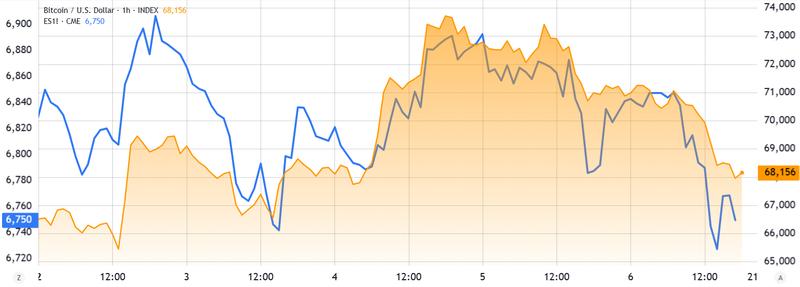
Bitcoin (BTC) experienced a 7% decline from Thursday through Friday after an unsuccessful effort to push back above the $74,000 threshold. This downward movement coincided with disappointing US macroeconomic indicators and climbing oil prices amid the seventh day of conflict involving the US and Israel-Iran. Market participants are now wondering whether Bitcoin can hold support levels above $65,000.
Under normal circumstances, weakening economic indicators create the foundation for monetary easing, which frequently provides a boost to equity markets as traders anticipate enhanced liquidity conditions. Nevertheless, during this particular cycle, the S&P 500 declined as widespread risk-averse sentiment eliminated all of the gains Bitcoin had achieved on Wednesday.
Retail sales in the US declined by 0.2% in January when measured against the prior month, while February witnessed the US economy losing 92,000 jobs. Even with the labor market showing signs of cooling, market participants remain doubtful that the Federal Reserve will implement additional interest rate reductions, given that increasing energy prices generally create inflationary pressures.
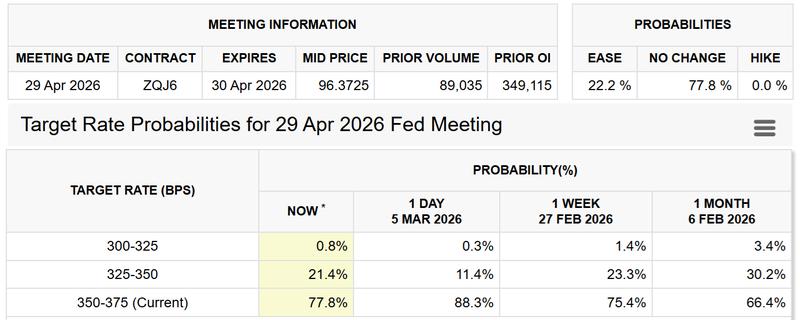
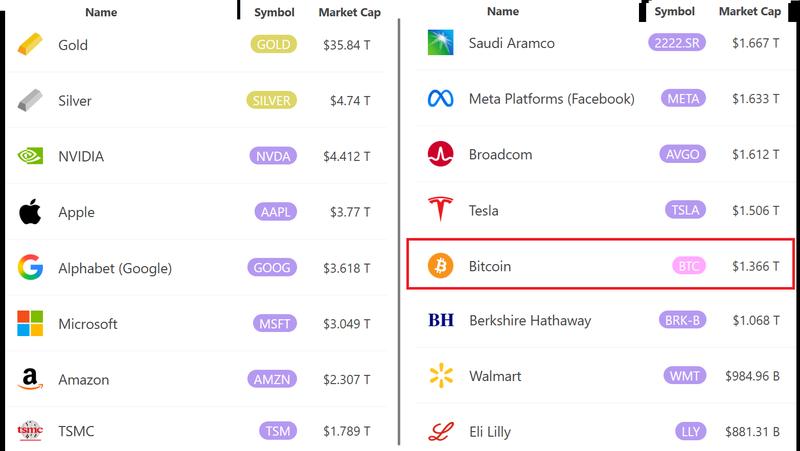
Markets for US Treasury securities are currently indicating a 78% likelihood that interest rates will hold steady in the 3.5% to 3.75% range until the end of April. A shift toward safer assets became evident as gold prices climbed while the Russell 2000 Small Capitalization index dropped to a two-month low. Bitcoin's decline beneath $85,000 in late January damaged its standing as an uncorrelated asset, particularly as silver advanced to claim the position of second most valuable asset.
Market participants are also concerned about a potential surge in corporate workforce reductions prompted by artificial intelligence automation. Kansas City Fed President Jeff Schmid observed that AI is progressively taking over positions that previously demanded manual labor. Schmid further stated that "older Americans are retiring," which is creating a structural transformation in the labor market happening in real time, according to Yahoo Finance.
War and credit strain weigh on Bitcoin's outlook
An extended conflict implies higher US government expenditures, which diminishes the fiscal room for monetary stimulus designed to drive economic growth. Market participants are becoming increasingly worried about rising logistics expenses extending beyond the commodities industry. Shipping leader Maersk declared on Friday the temporary halt of two routes linking the Middle East to Asia and Europe.
Bitcoin's attempt to retest the $68,000 threshold on Friday suggests that technical resistance points identified by market analysts might be less important than geopolitical developments affecting the oil and energy sectors and, consequently, worldwide growth expectations. The present weakness across risk assets seems to reflect limited macroeconomic clarity rather than indicating a fundamental breakdown.
A possible worsening in market participant sentiment could emerge from within the US private credit sector. BlackRock has reportedly imposed restrictions on withdrawals from one of its most significant credit funds after experiencing a surge in redemption demands, based on a Bloomberg report published on Friday. Earlier during the week, Blackstone's primary private credit fund processed requests to tender an unprecedented 7.9% of shares, demonstrating increasing retail investor nervousness.
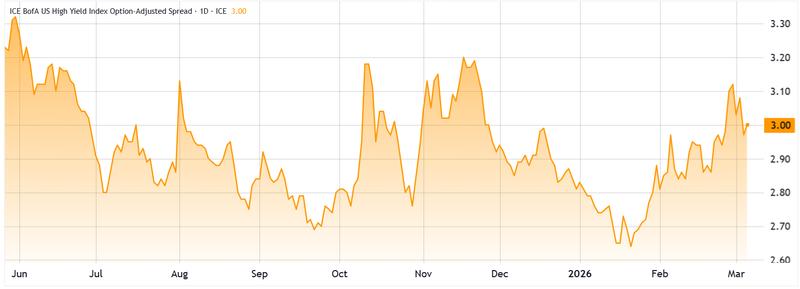
At present, the 3% option-adjusted spread applicable to higher-risk companies remains within the typical range observed during the past six months. Times of substantial economic distress generally drive this metric beyond 5.0%, a threshold last reached in March 2023. Consequently, there is no definitive indication that Bitcoin will fall beneath $65,000, despite the persistent uncertainty regarding global economic expansion.