
Bitcoin Weekly Outlook: Three Key Developments as Markets Eye Major Tech Company Results
BTC concludes the week beneath crucial support levels while equity markets attempt to claw back losses following the previous week's technology sector downturn.

The third week of October commences with Bitcoin (BTC) trading around $82,000 as both cryptocurrency and traditional equity markets initiate a cautious recovery phase.
Key points:
- South Korea's KOSPI Composite Index posted gains of almost 1.8% on Monday following the prior week's technology-sector-driven decline.
- Market participants have adjusted expectations to reflect just one additional Federal Reserve interest-rate increase in 2026, with 75% probability assigned to a single 25-basis-point increment before year-end.
- BTC recorded a weekly candle closure beneath significant local support after the Coinbase Premium Index registered -0.14, marking its weakest reading since the final days of June.
Asian markets spearhead equity recovery before major tech earnings releases
With a less crowded schedule of US macroeconomic data releases this week, investor focus will pivot toward corporate earnings reports as equities recover from the preceding week's downturn. Approximately 15% of S&P 500 constituents are scheduled to announce Q3 earnings in the days ahead, with SpaceX reporting on Tuesday and Tesla along with Meta delivering results on Wednesday.
Technology equity performance continues to attract close scrutiny following the substantial pullback observed last week, which originated in South Korean markets. The KOSPI Composite Index shed 2.8% on Oct. 12 before declining to the week's nadir of 5,455 points on Thursday, pushing week-to-date losses temporarily to 17%.
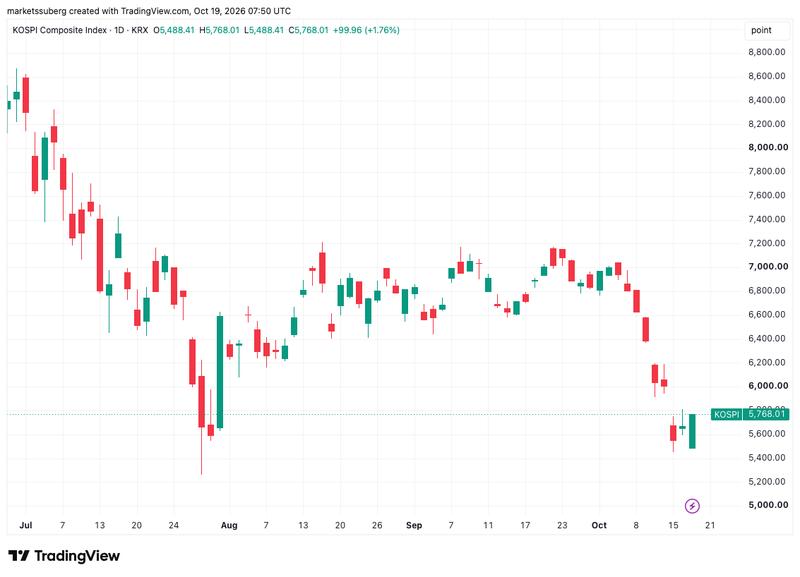
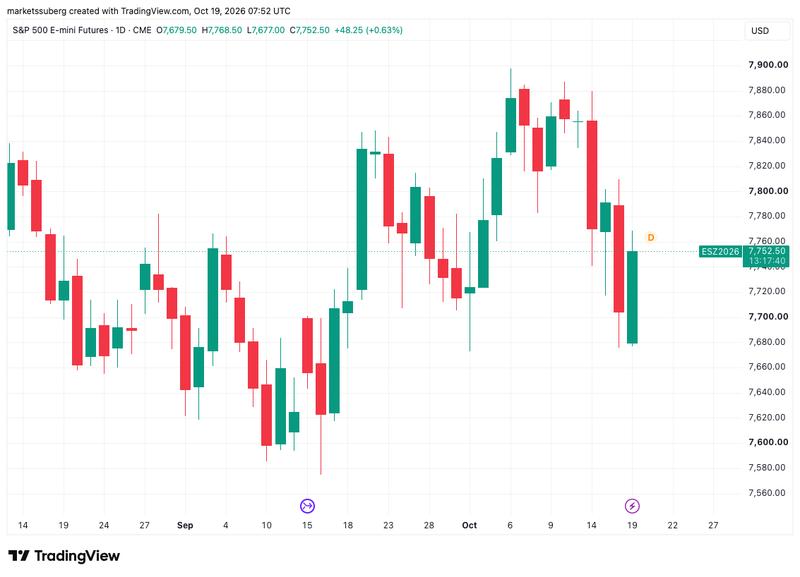
The selling pressure spread to adjacent Asian markets before weakness materialized in US equities during the latter portion of the week. The S&P 500 concluded Friday with a 2% decline for the week.
Echoing patterns observed in early August, technology stocks experienced significant selling activity amid worries regarding AI capital expenditure strategies and related debt commitments. In Korea specifically, the prospect of heightened competition in semiconductor production from China intensified the downturn.
Speculation about a potential "Black Monday" occurrence in worldwide equity markets circulated widely on social media throughout the weekend. The apprehension, which aligned with the 39th anniversary of the 1987 Black Monday collapse, proved unfounded, as KOSPI advanced 1.8% on Monday and S&P 500 futures traded 0.7% higher at the time of writing.
Addressing the disparity between public perception and actual market results, market commentator The Kobeissi Letter proposed that equities should deliver superior performance given investor appetite. Stubbornly elevated US inflation and a worldwide energy crisis have set up equities for a potential rally upon any indications of improving conditions.
"All while the AI Revolution continues to accelerate and many large-cap technology stocks become cheaper on a forward earnings basis, even as their stock prices rise. And in the background, the demand for asset ownership is historically robust,"
Kobeissi highlighted that although technology behemoths drove S&P 500 performance, 80% of index constituents are currently trading at least 10% beneath all-time highs.
Federal Reserve rate-increase expectations moderate despite inflation figures exceeding forecasts
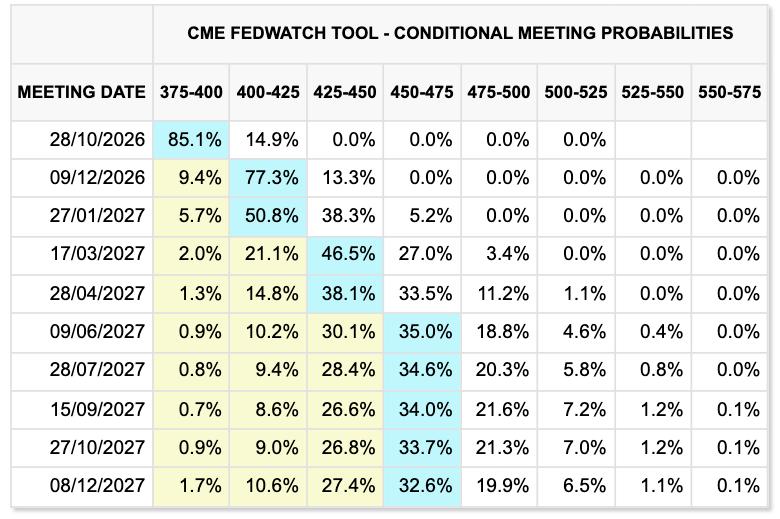
In advance of the Federal Reserve's upcoming determination on interest-rate adjustments on Oct. 28, markets have moderated their projections regarding policy tightening.
Information from CME Group's FedWatch Tool indicates 85% probability of rates remaining within their current 3.75-4% band in October. The Fed's December gathering, by contrast, carries only 11% odds of an additional pause. Rather, markets anticipate a 75% likelihood of a 25-basis-point increase, while a 50-basis-point adjustment commands 13% odds.
During a conversation with International Monetary Fund Managing Director Kristalina Georgieva last week, Fed chair Kevin Warsh refrained from providing any indications of forward guidance regarding policy, reaffirming a commitment made at the Jackson Hole economic symposium in August.
"I don't prejudge meetings. I don't believe in saying now what I might do at the meetings that we have in the balance of this year,"
Markets, nevertheless, construed the absence of concrete information as a dovish indicator, reinforcing expectations that the Fed will implement rate increases only once more prior to 2027.
Taking a more cautious stance, however, market commentator Mosaic Asset Company perceived inflation trajectories compelling the Fed to maintain its current course, preserving a headwind for crypto and risk-oriented assets.
"While investors expect the Federal Reserve to hold rates steady at its next meeting later this month, a growing inflation problem will keep favoring tighter monetary policy,"
The September release of the US Producer Price Index (PPI) published last week demonstrated the continuing influence of the Middle East crisis on energy costs. PPI registered its most substantial month-on-month advance since March 2022 at 1.7%.
"Half of the September increase in the index for final demand goods can be traced to prices for gasoline, which jumped 20.3 percent,"
Bureau of Labor Statistics
Energy costs also represented more than half of the September expansion in the Consumer Price Index (CPI), which surpassed expectations by 0.1% to reach 3.7% year-on-year.
Bitcoin price technical analysis suggests additional $80,000 support level testing ahead
Bitcoin price movement concluded with a weekly candle closure beneath a critical support area of significance spanning $82,500 to $82,800.
The weekly closing price settled at $82,000, a development that crypto trader and analyst Rekt Capital cautioned could trigger additional tests of the $80,000 threshold in coming periods.
"Such a Weekly Close would position Bitcoin for a potential bearish retest of ~$82500 into new resistance. And if that bearish retest occurs successfully then it could set price up for a drop below $80k within the next few weeks,"
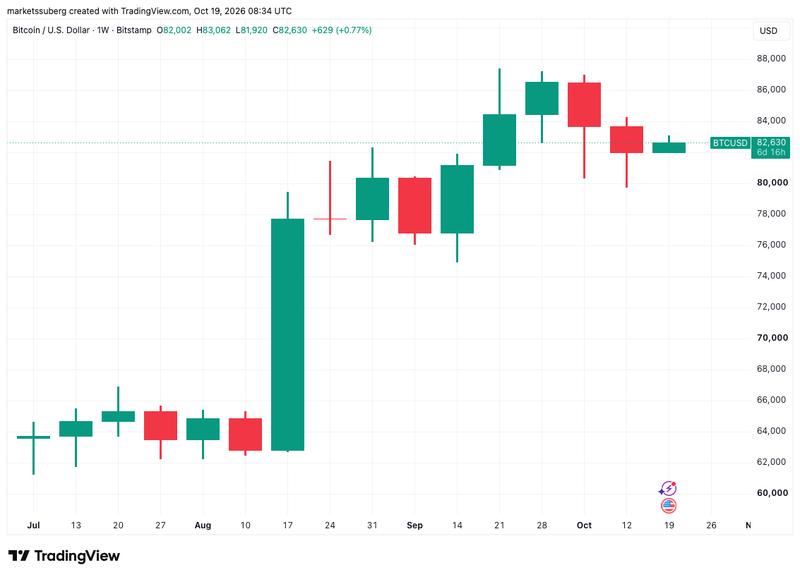
In prior coverage, Cointelegraph documented how September's local peak near $87,000 currently presents multiple resistance factors, encompassing the 2026 yearly open and its 20-month simple moving average (SMA).
Within its most recent market analysis, onchain analytics platform CryptoQuant identified diminishing US investor appetite as a resurfacing BTC price obstacle this month. The Coinbase Premium Index, which quantifies the price differential between Coinbase's and Binance's BTC/USDT pairs, descended to -0.141 on Oct. 18, representing its weakest levels since June 30.
"This reading is particularly significant. If the index remains in negative territory, it could indicate insufficient demand to absorb selling pressure, potentially increasing the likelihood of a continued price correction in the short term,"
CryptoQuant
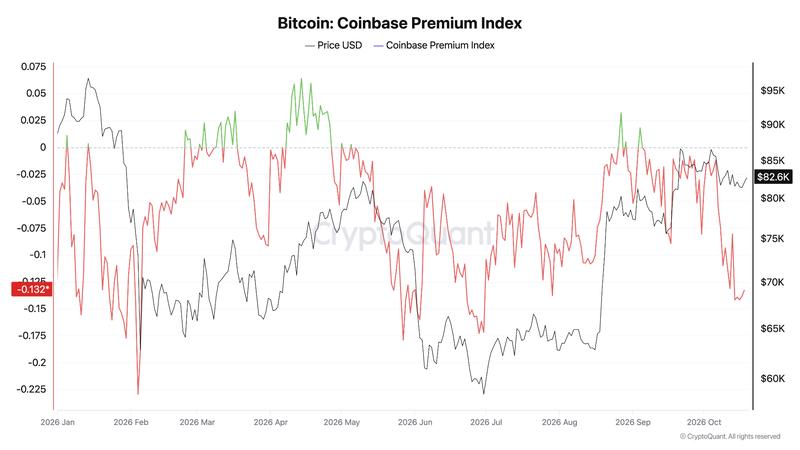
The insufficient demand stands in contrast with BTC/USD maintaining gains accumulated since the conclusion of June, having recovered from fresh multiyear lows beneath $58,000 on July 1.