
$2,000 Critical Support for ETH: Low Volatility Signals Potential Major Price Movement
Historical patterns suggest significant Ethereum price action may be imminent as realized volatility plunges to nine-week lows, with the $2,000 level emerging as crucial support.

The price of Ether (ETH) has declined by 6% throughout the past week, currently exchanging hands at $2,040 as of Tuesday. The diminishing volatility in price movements is also indicating that a more substantial correction may lie ahead.
Key takeaways
- On Binance, Ether's realized volatility has experienced a dramatic decline, reaching its lowest point since mid-January.
- To prevent additional downside pressure, ETH bulls need to successfully defend the support zone ranging from $1,800 to $2,000.
Ether price volatility hits nine-week lows
The volatility surrounding Ether has witnessed a dramatic reduction from the peaks observed in February, demonstrating a "significant decrease in price volatility and a reduction in speculative activity," based on information provided by CryptoQuant.
The concept of volatility captures the extent and speed at which Ether's price experiences fluctuations during a specified timeframe.
Data illustrated in the chart below demonstrates that the realized volatility indicator (30-day) on Binance experienced a sharp decline to 0.62 on Tuesday, down from 1.15 during mid-February. The previous instance when this metric registered at comparable levels occurred in early January, during which ETH was trading above the $3,000 mark.
At the same time, the volatility Z-Score has descended into negative territory, recording -0.43, which signals that present volatility readings are sitting beneath historical averages.
When realized volatility declines to such minimal levels, it suggests that the "market is experiencing an unusual period of calm compared to previous months," according to CryptoQuant analyst Arab Chain in a QuickTake analysis, who further stated:
"Historically, when the Z-Score falls into negative territory, it reflects a decrease in short-term risk but often precedes strong subsequent price movements."
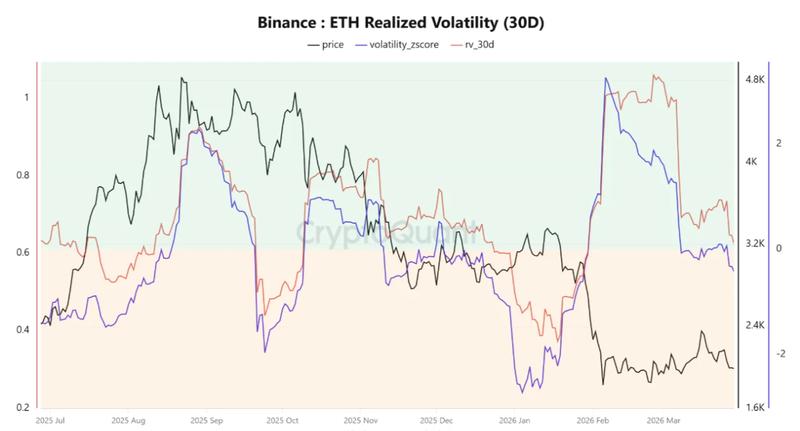
The most recent occasion when volatility experienced such a pronounced decrease occurred during August-September 2025, which coincided with an 18% drop in ETH price down to $3,800.
Following that decline, the asset surged 25% to reach $4,740 in a period of less than two weeks. A comparable volatility reduction in December 2025 came before a 20% increase in Ether's valuation. Should historical patterns repeat themselves, this potential spike in volatility may signal the conclusion of the current consolidation phase, positioning ETH for a relief rally.
Watch these ETH price levels next
The ETH/USD trading pair has remained within a range above the $2,000 mark, representing a critical support threshold that bulls need to maintain in order to ward off additional losses.
Currently, the price is retesting the middle boundary of this range, as demonstrated in the chart provided below.
"Any bounce is getting retraced quickly, which is a sign that Ethereum wants to go down," analyst Ted Pillows stated in an X post published on Tuesday, further commenting:
"If ETH loses the $2,000 level here, the dump will accelerate."
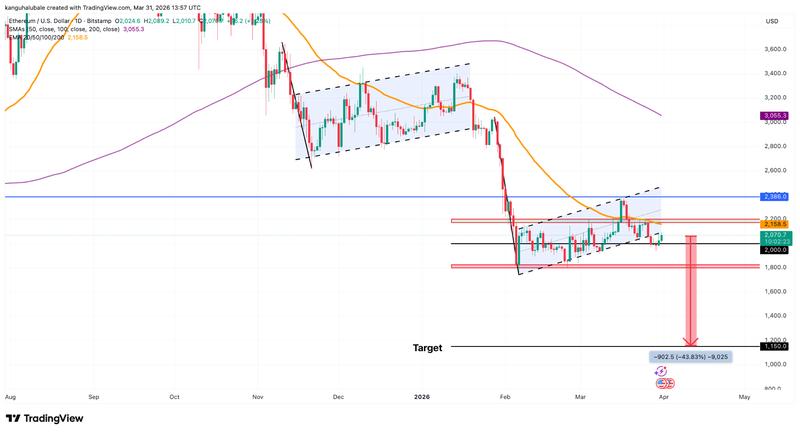
Below current levels, a significant zone of interest exists between $1,750 and $1,800, representing an area where market participants accumulated over 1.4 million ETH during the past three months, based on cost-basis distribution data from Glassnode.
Should ETH fail to hold this support level, the asset faces the risk of declining further toward $1,150, which aligns with the projected target derived from the bear flag pattern.
On the bullish side, market participants must successfully convert the $2,100-$2,200 supply zone into a support area, which is where the 50-day exponential moving average (SMA) is currently positioned. Beyond that level, the subsequent resistance point will likely emerge at the local high of $2,380 that was achieved on March 16.