
Zondacrypto chief executive disappears amid expanding Polish criminal investigation
Authorities in Poland are pursuing a criminal probe into Zondacrypto concerning alleged fraudulent activity and difficulties accessing client funds, as local news sources indicate CEO Przemysław Kral has traveled to Israel.

The situation surrounding Zondacrypto deteriorated further on Friday following a report from Polish media outlet Onet indicating that chief executive Przemysław Kral had departed for Israel while prosecutors pursue an investigation into the cryptocurrency exchange concerning allegations of fraud and significant losses suffered by investors.
The report indicates that Kral has spent approximately one week in Israel and possesses Israeli citizenship, an element that may create obstacles for any prospective extradition proceedings back to Poland. Last Friday, Polish law enforcement authorities launched an investigation into Zondacrypto regarding allegations of fraudulent conduct and financial losses experienced by investors. Cointelegraph independently verified that the email address previously utilized for correspondence with Kral has since become inaccessible.
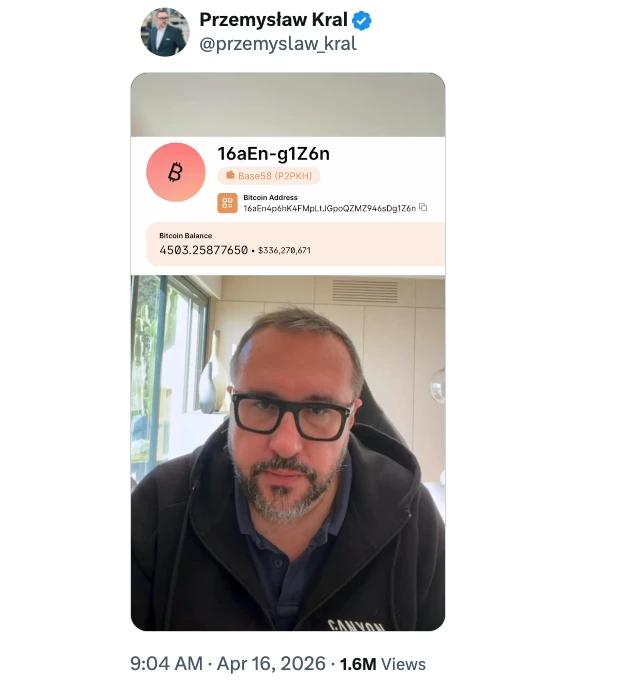
These recent developments emerge one week following Kral's acknowledgment last Thursday that the exchange's cold wallet containing 4,500 Bitcoin had become inaccessible, representing his final known public statement as of the time this report was published. According to Notes from Poland, which cited prosecutor spokesperson Michał Binkiewicz, Polish prosecutors have identified several hundred individuals who may be victims, with potential financial losses totaling at least 350 million Polish zloty (approximately $97 million).
The situation has intensified scrutiny on one of the largest cryptocurrency platforms operating in Central and Eastern Europe, despite the fact that Zondacrypto operates at a considerably smaller scale compared to international exchanges like Binance.
Supervisory board members resign from Zondacrypto, escalating concerns
The scandal intensified further during the current week following the departure of members from the supervisory board of BB Trade Estonia OÜ, which serves as the Estonian entity responsible for operating the exchange.
Through a LinkedIn posting made on Monday, Georgi Džaniašvili, a former member of the board, revealed that board members became aware of the magnitude of the Zondacrypto crisis by reading media coverage instead of receiving internal communications. He additionally highlighted "material inconsistencies" between statements made to the public and the information that had been made available to board members.
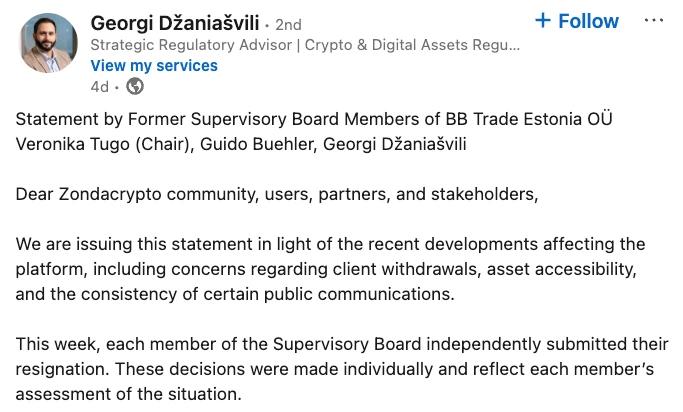
"In a governance structure where ownership and executive management are concentrated in one individual, effective oversight depends on transparency, timely communication, and mutual trust. Regrettably, that foundation has been materially undermined."
What are the reasons behind the Polish investigation into the Zondacrypto case?
Despite Zondacrypto maintaining its official registration in Estonia, the platform maintains a substantial customer base and operational footprint within Poland, especially among users who speak Polish, which prompted Polish law enforcement to initiate a criminal investigation after receiving numerous complaints from customers located in the country.
The company was originally established in Katowice in 2014 operating under the name BitBay by founder Sylwester Suszek, who has not been seen since 2022. During public statements made last week, Kral attributed the inability to access Zondacrypto's cold wallet to Suszek's actions and responsibilities.
This matter has evolved into a significant subject of debate within Polish political circles, with Prime Minister Donald Tusk asserting connections between Zondacrypto and Russian financial backing and political interference, referencing the exchange's initial history and subsequent expansion under different management.
Through an official statement released on April 17, Tusk indicated that as many as 30,000 users of Zondacrypto could potentially be impacted and drew parallels between this case and previous financial controversies that have occurred in Poland.
Tusk further stated that the absence of a thorough legal framework designed to protect investors meant that authorities had limited capability to intervene earlier, making reference to Poland's continuous postponements in enacting legislation that aligns with the European Union's Markets in Crypto-Assets Regulation (MiCA) framework.
This case may carry wider ramifications for the manner in which the European Union implements cryptocurrency supervision under the MiCA framework, as certain member states are pushing for more centralized regulatory oversight as opposed to enforcement conducted at the national level.