
Will Bitcoin Reach $250K in 2026? Market Veterans Warn 'Sell in May' May Apply
Seasoned market analyst Peter Brandt alongside fellow experts cast doubt on Bitcoin reaching $250,000, cautioning that the ongoing bearish phase could persist.

Despite showing signs of recovery, Bitcoin (BTC) continues to trade approximately 40% beneath its October 2025 all-time high that approached $126,000.
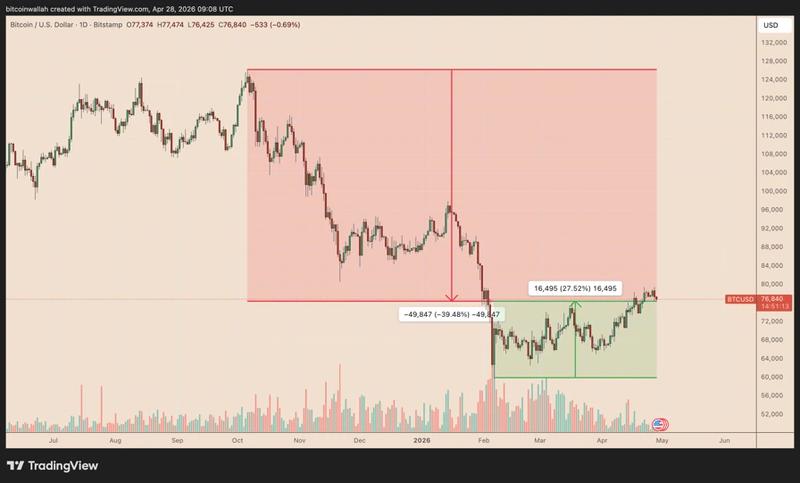
Nevertheless, prominent cryptocurrency optimists, such as billionaire Tim Draper and Tom Lee from Fundstrat, continue to maintain their year-end forecast of $250,000, a price point that would necessitate Bitcoin to surge more than three times its present value.
Does such a projection hold merit, or does Bitcoin's recent price pullback signal that the market cycle has already reached its zenith?
Key takeaways:
- A bearish continuation pattern suggests Bitcoin's downturn may continue.
- Historical patterns from halving events and midterm election years point to bearish prospects for BTC in 2026.
Seasoned Market Analyst Cautions Against Further BTC Losses
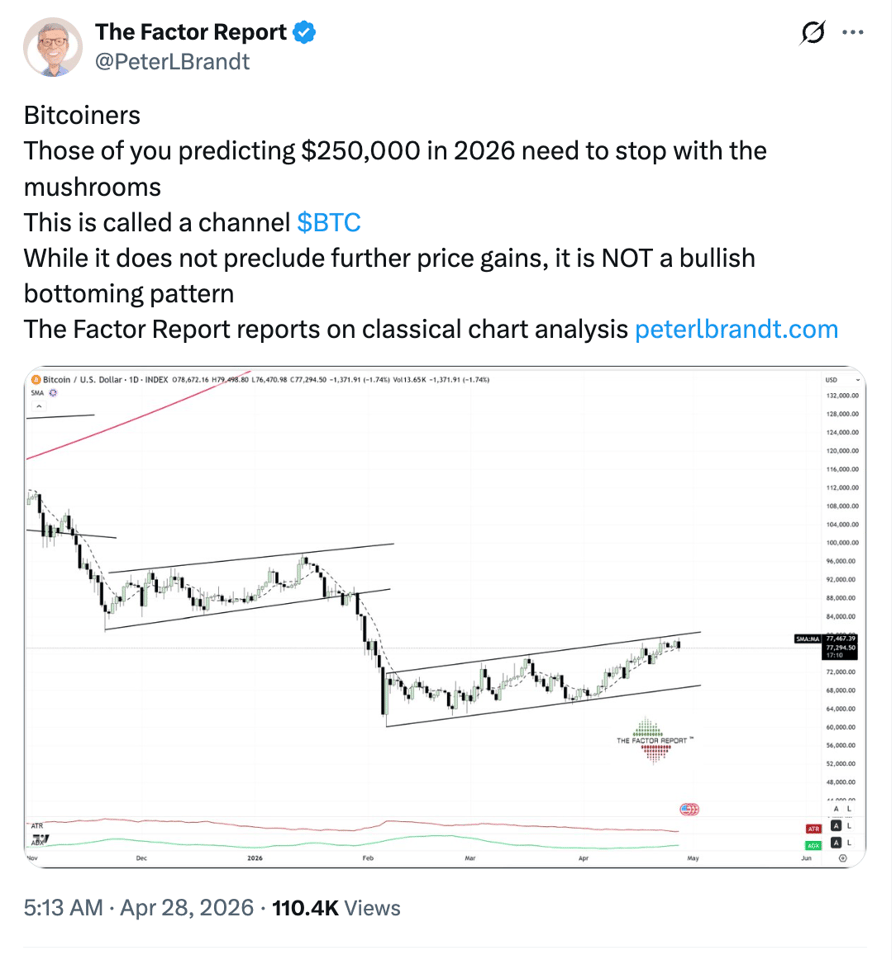
Veteran futures trader Peter Brandt has identified an evolving bear flag formation on Bitcoin's daily price chart, potentially diminishing the likelihood of BTC climbing toward $250,000 before year-end.
As of this Tuesday, Bitcoin demonstrated indicators of a reversal following its approach to the flag pattern's upper resistance level near $79,500. Should this corrective movement continue, the digital asset faces the risk of falling toward the flag's lower support boundary around $69,000 by the month of May.
Those of you predicting $250,000 in 2026 need to stop with the mushrooms
This is called a channelWhile it does not preclude further price gains, it is NOT a bullish bottoming pattern
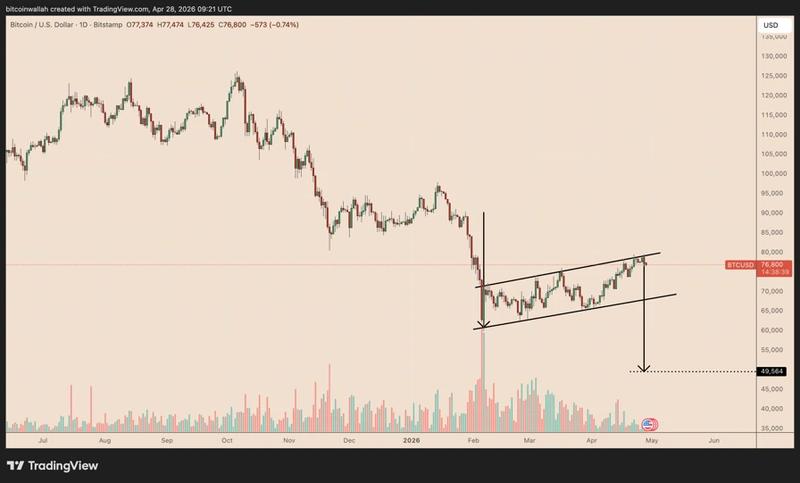
The complete resolution of a bear flag pattern occurs when prices break conclusively beneath the lower trend line boundary and descend to a distance equivalent to the preceding downtrend's vertical measurement.
Should prices breach the flag's lower support line and the technical pattern unfolds according to expectations, Bitcoin could face downward pressure toward levels below $50,000.
Historical Halving Patterns Suggest Bear Market Continuation
Throughout its history, Bitcoin's price cycles have demonstrated a predictable pattern correlating with its four-year halving schedule.
Market tops have traditionally emerged between 12 and 18 months following each halving occurrence. The 2012 cycle witnessed its peak at the 12-month mark. Following the 2016 halving, the market topped after 17 months, whereas the 2020 halving reached its highest point 18 months later.
The April 2024 halving event aligns with this established historical timeline. Bitcoin achieved its record high of $126,000 during October 2025, approximately 17–18 months following the halving.
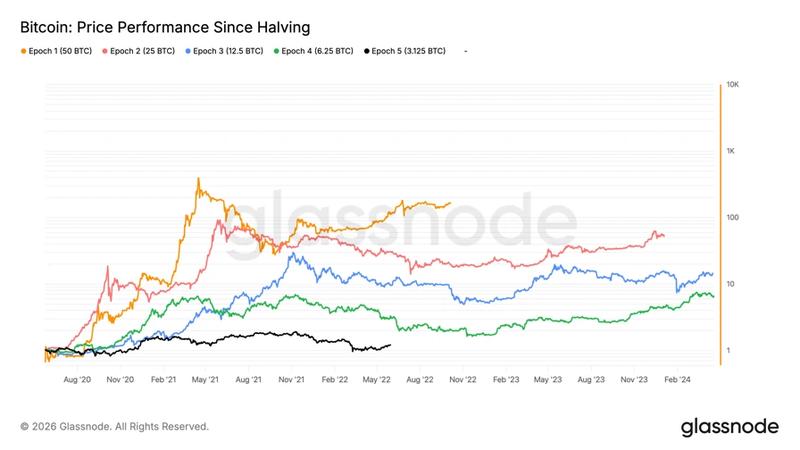
Currently, as we approach the end of April 2026 (exceeding 24 months after the halving), Bitcoin is changing hands near $77,000, representing a decline of 38%–40% from its peak valuation. This pattern correlation indicates that the 2025 high could indeed mark the cycle's top, raising significant questions about the possibility of new record highs materializing during the remaining months of 2026.
Historical Patterns Point to Potential May Decline for Bitcoin
A technical analysis chart presented by market analyst Merlijn The Trader reinforces the bearish outlook, highlighting a historical "Sell in May" phenomenon that emerges during United States mid-term election years.
Historical data shows that Bitcoin experienced a 61% decline in 2014, a 65% drop in 2018, and a 66% correction in 2022, with each of these downturns commencing around May during their respective election years.
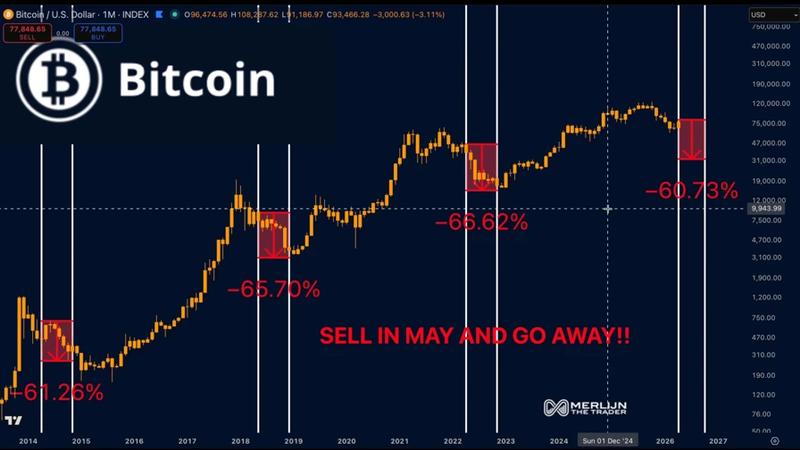
Extending this historical framework to the current year of 2026, Merlijn's analysis suggests a potential correction exceeding 60%, which would drive Bitcoin's price down to approximately $30,000.
According to a February analysis published by Capital Group, analysts Matt Miller and Chris Buchbinder noted that midterm election periods frequently generate uncertainty regarding congressional power dynamics and future policy trajectories. During the spring campaign season intensification, market participants typically reduce risk exposure, decelerate asset purchases, and prepare for increased market volatility.
This environmental context significantly undermines the argument for Bitcoin achieving the $250,000 milestone before 2026 concludes, despite the fact that multiple market analysts, including researchers from Bernstein, acknowledge potential for a more conservative recovery trajectory targeting the $100,000–$150,000 price range.