
Why the British Virgin Islands Have Quietly Become a Cryptocurrency Powerhouse
Major crypto platforms including Kraken, Bitstamp, 1inch and Bitfinex have established their legal presence in the British Virgin Islands — though arranging a face-to-face meeting with their leadership there may prove challenging.

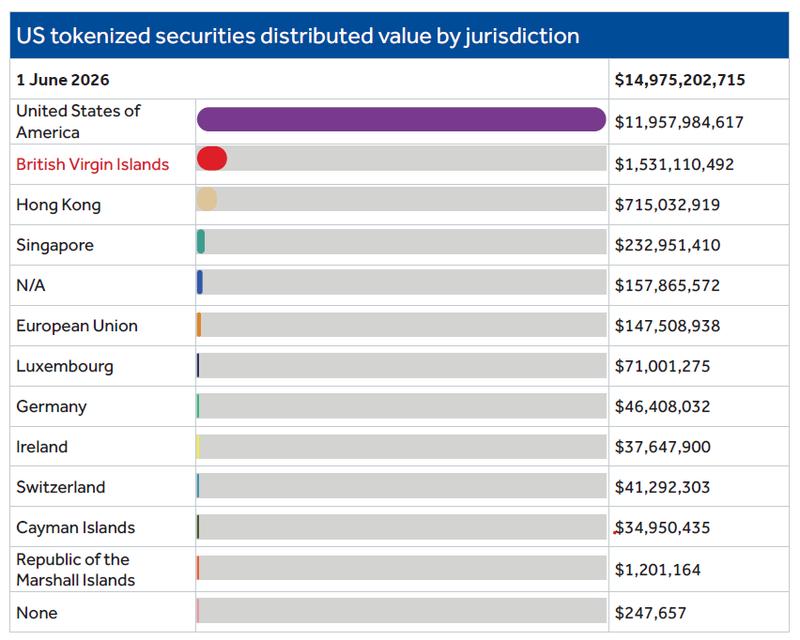
Approximately 10% of the global supply of tokenized US Treasuries originates from companies that have incorporated in the British Virgin Islands.
This positioning makes the compact Caribbean jurisdiction second only to the United States itself as a significant location for this expanding asset category, based on data from BVI Finance.
According to BVI Finance's Destination Digital report released in June, entities registered in the BVI were responsible for roughly $1.5 billion out of the total $14.98 billion worldwide market for tokenized US Treasuries recorded on June 1.
An expanding roster of cryptocurrency and digital asset companies have established their incorporation in the British Virgin Islands, with notable names including Payward (Kraken's parent entity), Bitstamp (which Robinhood recently acquired), 1inch and Bitfinex among them.
The jurisdiction features a stablecoin market capitalization of approximately $1.2 billion stored in BVI-associated addresses and maintains around 28,000 holders of stablecoin assets.
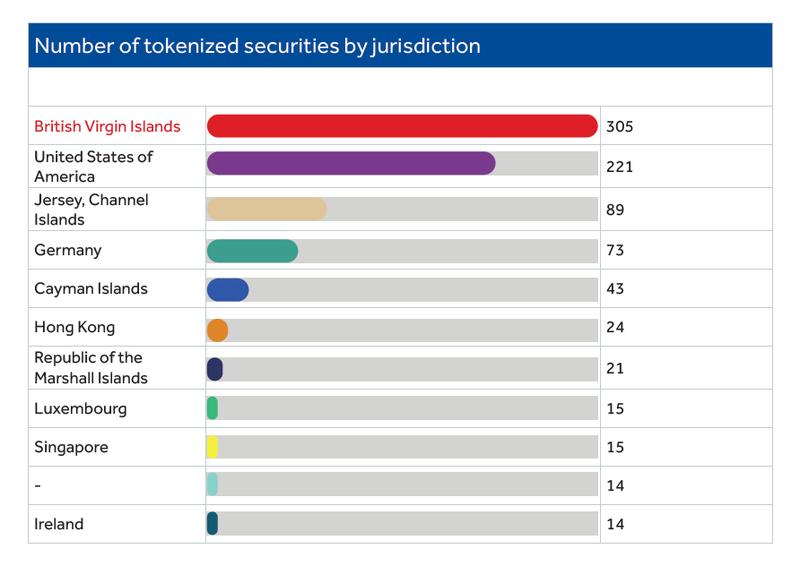
Over 25 virtual asset service providers (VASPs) have received approval under the BVI's VASP regulatory framework, and based on research from Bernstein Research, the Islands are home to 305 tokenized securities — representing the largest number for any individual jurisdiction within the RWA.xyz dataset.
These numbers indicate that the Virgin Islands has emerged as among the globe's leading cryptocurrency centers, though the actual situation contains more complexity.
By their very nature, tokenized assets are created to transcend borders, and cryptocurrency ventures frequently have the freedom to select which offshore territory they wish to establish their incorporation.
For the vast majority of instances, digital asset enterprises are not physically moving their operations to the Virgin Islands; rather, they're leveraging the jurisdiction to establish legal structures, including token issuing entities, treasury management vehicles, parent holding companies or special purpose vehicles (SPVs).
Tax advantages alone don't explain crypto firms' BVI preference
According to Andrew Jowett, a partner at Appleby (BVI) Ltd who provides counsel to digital asset enterprises on corporate structure matters, clients evaluating the BVI generally analyze multiple jurisdictions in parallel, including the Cayman Islands, United Arab Emirates, Singapore and Switzerland.
Contrary to traditional perceptions surrounding Caribbean offshore tax shelters, tax neutrality has ceased to be the main motivating factor.
"Digital asset regulation, rather than taxation, has been the predominant consideration for selecting the BVI," Jowett explained. The British overseas territory does feature appealing tax frameworks, levying neither corporate income tax nor capital gains tax on companies registered in the BVI.
However, all major cryptocurrency jurisdictions now offer advantageous crypto taxation frameworks, which means this factor no longer serves as the determining element.
The Cayman Islands levies neither corporate income tax nor capital gains tax, while the UAE maintains zero personal income tax and no federal corporate tax for entities that qualify under free zone status.
"Tax neutrality has become a baseline expectation," stated Saeed Al-Marri, chief executive of digital asset infrastructure company Ethra, which maintains its incorporation in the BVI. He emphasized that the BVI delivers legal certainty and regulatory transparency, characteristics he believes will determine which territories thrive through institutional adoption.
LTP operates as an institutional digital asset infrastructure provider running regulated entities across the BVI, Hong Kong, Australia and the UAE. Jack Yang, its founder and chief executive, shared with Cointelegraph that although beneficial taxation matters for international structures, it ranks below legal and regulatory certainty as tokenization advances deeper into institutional finance.
"A structure offering tax neutrality that fails to satisfy scrutiny from financial institutions, custodians, auditors, investment committees, or regulatory bodies holds minimal practical utility," he explained.
Orest Gavryliak, chief legal officer at the decentralized exchange aggregator 1inch, incorporated in the BVI, noted that an increasing number of decentralized finance (DeFi) protocols are selecting jurisdictions offering clear and predictable regulatory frameworks, as opposed to merely seeking the minimal tax obligations.
"The significance of jurisdiction isn't disappearing per se, but its function is evolving," Gavryliak shared with Cointelegraph. "Protocols are progressively evaluating considerations like regulatory frameworks, institutional reputation and viability over the long term."
Competition among crypto jurisdictions now centers on legal frameworks
Territories seeking to establish themselves as "cryptocurrency hubs" such as Singapore and the UAE are now competing through advantageous legal structures and licensing systems, exemplified by Singapore's Payment Services Act and Dubai's Virtual Assets Regulatory Authority (VARA) regulatory frameworks.
The BVI enacted the Virtual Assets Service Providers Act (VASP Act) during 2023, with oversight provided by the BVI Financial Services Commission (FSC).
In comparison to numerous larger financial jurisdictions, it provides a rapid processing timeline, delivering responses to VASP applications within a six-week period and targeting completion of the full review process within six months, as outlined by BVI Finance and FSC guidance materials.
Beyond advantageous tax structures, Jowett indicated that clients place priority on "simplicity of establishment" and streamlined corporate organization, aspects that have traditionally formed part of the BVI's attractiveness. Business entities can be established rapidly, the legal structure provides flexibility, and continuing reporting obligations are typically less demanding than in onshore territories.
The Virgin Islands has additionally been historically preferred due to its provision of enhanced corporate privacy compared to numerous larger financial hubs.
Although BVI companies remain subject to anti-money laundering (AML) and know-your-customer (KYC) obligations, beneficial ownership data is maintained by registered agents instead of a publicly accessible registry, resulting in reduced disclosure obligations.

Nevertheless, none of the organizations interviewed by Cointelegraph identified tax neutrality or enhanced corporate privacy as primary reasons for establishing incorporation in the BVI, instead highlighting legal certainty, regulatory transparency and corporate adaptability.
Legal incorporation rather than physical relocation to the Virgin Islands
Yang informed Cointelegraph that LTP does not maintain full-time employees "physically present" in the territory. Rather, the incorporated entity operates under its board's supervision and receives support from personnel located in other parts of the LTP organization.
This same pattern appears throughout the sector. Payward, which serves as Kraken's parent company, holds its incorporation in the BVI, yet the exchange's operational activities remain concentrated in the United States, whereas 1inch's workforce and operational functions are distributed across numerous jurisdictions.
The BVI is not succeeding in attracting prestigious headquarters facilities or substantial engineering workforces. Rather, it has established itself as the legal domicile for numerous digital asset enterprises, while the majority of operational activities occur in other locations. For territories seeking to draw this industry, this arrangement may well prove sufficient.