Wealthy Investors Expanding Cryptocurrency Holdings Despite Advisor Hesitation: New Research
High-net-worth investors are ramping up their digital currency investments, while Ric Edelman notes that financial advisors continue to lag in responding to rising client interest.

The majority of wealthy investors spanning seven major global economies currently hold digital currencies, with cryptocurrency representing approximately 10% of their investment portfolios on average, a recent CoinShares survey has revealed.
The research encompassed 2,230 investors possessing a minimum of $500,000 in investable assets throughout the US, UK, France, Germany, Italy, Sweden and Switzerland. Digital currency ownership varied from 54% in Sweden to approximately 70% in the US, UK, Germany and Switzerland.
No less than 85% of existing digital asset holders in five out of the seven nations surveyed indicated plans to expand their exposure during 2026, reaching as high as 91% in the US, UK and Germany.
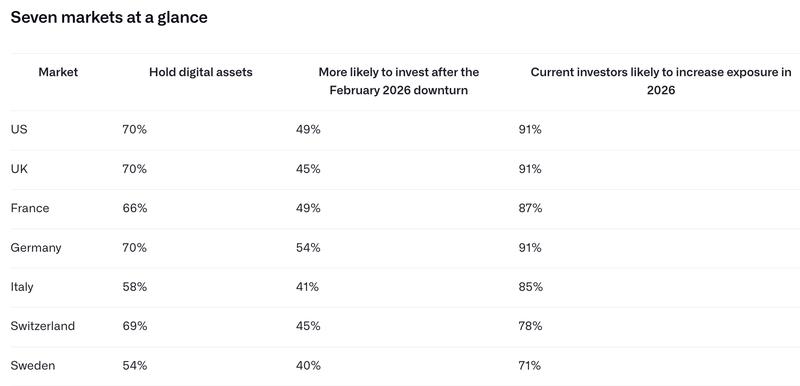
The crypto market downturn experienced in February 2026 had minimal impact on diminishing investor enthusiasm. Across all seven nations, a greater number of respondents indicated the market sell-off increased rather than decreased their likelihood to invest in digital currencies.
This resilience seems to indicate a more extended-term perspective on the asset category. Long-term value appreciation and portfolio diversification emerged as the primary motivations respondents cited for cryptocurrency investment, whereas speculation placed last. A mere 6% characterized themselves primarily as short-term traders.
Bitcoin (BTC) continued as the most commonly held digital currency, possessed by 80% of digital asset investors on average, although 89% of BTC holders also possessed other digital currencies. In the meantime, 77% of survey participants believed BTC would assume a significant position in the future international financial system, whereas 79% favored enhanced regulation of digital currency markets.
Cryptocurrency exposure proved particularly elevated among younger investors. This demographic allocated greater amounts to digital currencies compared to older investors across all seven countries and approximately double the amount in four of these nations.
Advisers lag crypto investors
The research also uncovered evidence of a gap between wealthy investors and their financial advisors. Approximately four out of 10 respondents in Switzerland, France, the US and Germany who engaged with an advisor indicated they perceived them as excessively cautious regarding digital currencies.
The survey participants' perspective on advisors was reinforced by Ric Edelman, founder of the Digital Assets Council of Financial Professionals and Edelman Financial Engines.
Edelman conveyed to Cointelegraph that financial advisors continue to be slow in adopting digital currencies, with numerous professionals lacking the expertise or motivation to gain knowledge about the asset category. He said:
Advisors are busy; they are already operating a successful practice filled with happy clients — so why bother learning something new? — and most are getting little to no encouragement from their firms.
He further noted that certain firms prevent advisors from engaging in conversations about crypto or providing crypto-related investment products to clients. Consequently, he stated advisors may remain unaware of which clients possess crypto and might be overlooking opportunities to deliver tax planning, estate-planning and philanthropic advisory services related to those assets.
How much crypto should investors hold?
Edelman disputed CoinShares' discovery that cryptocurrency allocations among affluent investors average approximately 10%, stating his personal research indicates allocations of 2% to 5% are considerably more typical.
Even while questioning the survey's number, Edelman advocates for allocations spanning from 10% to 40%, based on individual risk tolerance. He advocates 10% for conservative portfolios, 25% for moderate portfolios and 40% for aggressive portfolios.
"As the asset class matures, 10% allocations or higher will become the norm," Edelman said. "The sooner people do that, the better off they will be."
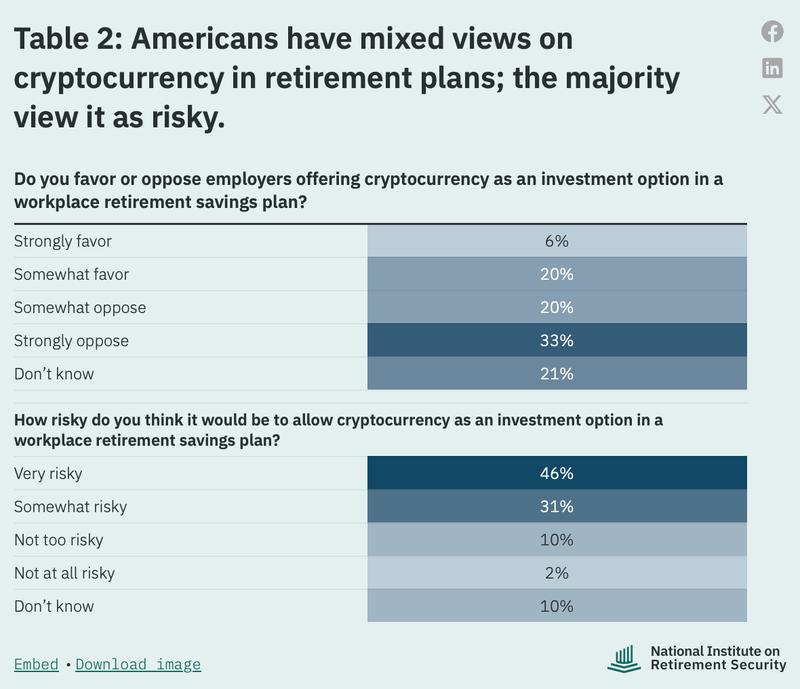
Edelman's suggested allocations contrast sharply with widespread skepticism regarding the use of cryptocurrency for retirement savings. An August survey conducted by the National Institute on Retirement Security discovered that 77% of Americans regarded cryptocurrency in workplace retirement plans as risky, including 46% who characterized it as very risky.