
Washington State Files Gambling Lawsuit Against Kalshi, Adding to Company's Legal Challenges
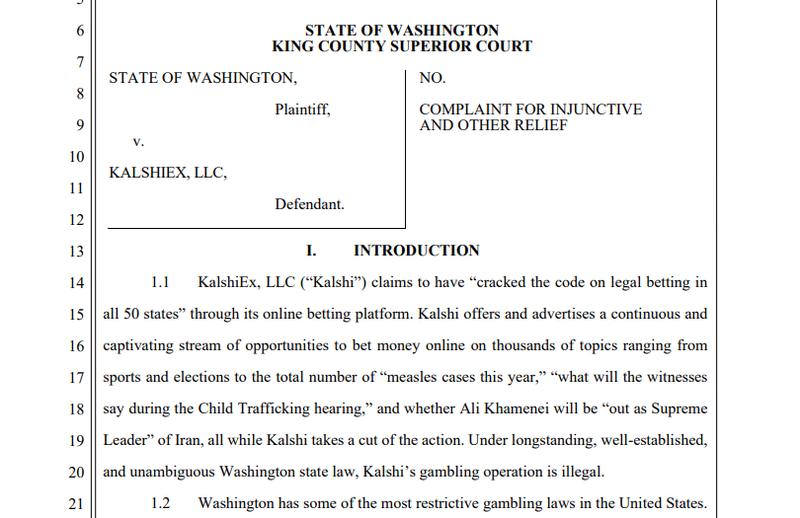
Washington's attorney general has joined other state authorities in taking legal action against Kalshi, filing a lawsuit on Friday claiming the prediction markets platform breached state gaming laws.
The prediction market operator Kalshi is now confronting yet another legal challenge at the state level, following Friday's filing by Washington state authorities alleging the company has run afoul of the state's gambling regulations through its platform offerings.
In the complaint filed by the Washington Attorney General, prosecutors cite the Pacific Northwest state's prohibition on internet-based gambling activities and its rigorous regulatory framework governing the gaming industry, asserting that Kalshi has breached the Washington Consumer Protection Act, Gambling Act, and Recovery of Money Lost at Gambling Act.
"Kalshi's website and app show consumers a range of events that they can bet on and the odds for those various events, which dictate how much the bettor will be paid out if the event occurs. This is exactly how sportsbooks and other gambling operations function. Kalshi advertises that they allow consumers to 'bet on anything' by simply calling their service a 'prediction market' rather than 'gambling.'"
Attorney General Nick Brown
According to the AG's public statement, Washington law characterizes gambling as "staking or risking something of value upon the outcome of a contest of chance or a future contingent event," and Kalshi's business operations clearly meet that legal standard. "Each Kalshi bet risks money, relies in part on chance, and promises a payout to winners."
The company wasted no time in attempting to transfer the case to federal jurisdiction, stating in its legal motion that the matters raised by Washington's complaint are currently being contested in other federal court proceedings and that Washington state had provided "no warning or dialogue" before initiating the lawsuit.
State AGs and gaming regulators mount legal fights across the country
Earlier in the month, a judge in Nevada issued a temporary order preventing Kalshi from conducting business within state boundaries, determining that state regulators have a reasonable probability of succeeding in their legal challenge regarding whether the firm's event-based contracts constitute violations of Nevada's gambling statutes.
Judge Jason Woodbury of the Carson City District Court granted a temporary restraining order on Friday, agreeing with a motion from the Nevada Gaming Control Board to prohibit Kalshi's operations in the state for a period of 14 days.
The company had maintained that its contract offerings fall under the sole regulatory authority of the US Commodity Futures Trading Commission, a federal agency that has expressed support for prediction markets that are currently defending themselves in various state courtrooms against claims of providing unlawful gambling services.
Just days before the Washington filing, Arizona Attorney General Kris Mayes revealed criminal charges against the entities operating Kalshi, claiming that the organization ran an "illegal gambling business in Arizona without a license" and provided illegal election wagering opportunities.
Although Kalshi is defending itself against multiple comparable lawsuits initiated by gaming regulatory bodies in various US states regarding allegations that the platform provides sports gambling services to state residents without proper licensing, Arizona distinguished itself as among the first states to pursue criminal prosecution.
These state-level legal proceedings are unfolding as prediction markets face increased examination by federal legislators for providing wagering opportunities on US military operations, with lawmakers expressing worries about the potential for insider information from government sources.