
Visa's stablecoin settlement reaches $7B annual rate with Polygon and Base integration
Payment giant Visa expands blockchain experimentation to nine networks total, driven by surging stablecoin transaction volumes and growing momentum for onchain payment settlement worldwide.

Payment processing behemoth Visa has broadened the scope of its stablecoin settlement experiment to encompass Polygon alongside four additional blockchain platforms, demonstrating ongoing commitment to exploring crypto-powered payment systems.
Initially rolled out by Visa in 2023, the experimental program enables business partners to complete payment settlements through stablecoins instead of conventional banking infrastructure. The recently added blockchain platforms comprise Polygon, Base, the Canton Network, Arc and Tempo. These networks complement the already integrated chains including Ethereum, Solana, Stellar and Avalanche.
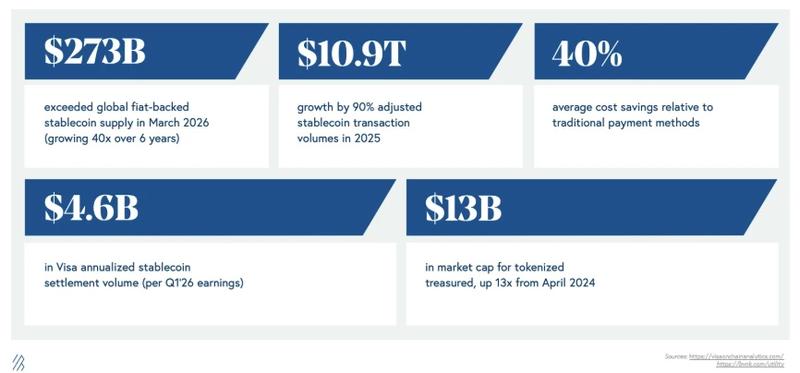
This network expansion arrives as the settlement program has achieved an annualized transaction velocity of approximately $7 billion, demonstrating quarter-over-quarter expansion of roughly 50%, based on Visa's reporting. Notwithstanding this upward trajectory, these volumes represent a fraction when measured against the corporation's primary payment processing operations.
Visa states that the program's purpose centers on assessing whether stablecoins can deliver accelerated settlement times, continuous twenty-four-hour operational capacity and enhanced operational efficiencies for international payment transfers.

The payment giant has been amplifying its commitment to stablecoin-powered settlement infrastructure. During March, Visa strengthened its collaboration with Bridge, which operates as a Stripe subsidiary, to facilitate an international card platform enabling payment capabilities connected to stablecoins.
Stablecoin payments race heats up
The intensifying emphasis on stablecoin-based settlement infrastructure emerges as rival companies including Mastercard accelerate their involvement in this space, encompassing the enablement of stablecoin-connected card transactions throughout the United States via wallet integrations such as MetaMask.
This Wednesday, payment software company Modern Treasury announced its integration with Polygon designed to assist enterprises in accelerating stablecoin payment processing, contributing to the expanding migration toward blockchain-powered settlement systems. The fintech company based in San Francisco completed its acquisition of Beam, a platform handling both stablecoin and fiat payments, during October.
Throughout the United States, market development has additionally been influenced by the enactment of the GENIUS Act, which creates more defined regulatory frameworks governing payment stablecoins.
With regulatory frameworks becoming more transparent, cryptocurrency-focused enterprises alongside traditional fintech firms are progressively vying to develop and manage the foundational infrastructure supporting stablecoin payment systems, with particular emphasis on the settlement layer responsible for transferring capital between financial institutions. Nevertheless, wider policy considerations, including the question of whether stablecoins should be permitted to generate yield, continue to face deliberation within a proposed US market structure bill, which has encountered obstacles to advancement thus far.
The aggregate market capitalization of stablecoins currently in circulation has exceeded $320 billion, representing growth of almost 150% from the beginning of 2024, as reported by DeFiLlama data.