VanEck's JitoSOL ETF Filing Marks New Chapter for Solana Liquid Staking Products
A filing has been submitted to the SEC by Nasdaq for the VanEck JitoSOL ETF, representing a proposed investment vehicle that would hold JitoSOL, a liquid staking token built on Solana, marking further development in the US staking ETP landscape.
A proposed rule change has been submitted by Nasdaq to facilitate the listing of the VanEck JitoSOL ETF, an investment vehicle structured to directly hold JitoSOL, which is a liquid staking token operating on the Solana blockchain.
The liquid staking mechanism enables token holders to participate in securing proof-of-stake blockchain networks while simultaneously obtaining a tradeable token that represents both their staked holdings and any accumulated rewards generated from the staking process.
In a statement to Cointelegraph, Jito Foundation president Brian Smith explained that should regulatory approval be granted for the fund, the staking rewards would be incorporated into the fund's net asset value rather than being distributed as separate payments to investors.
Due to JitoSOL's automatic compounding feature for rewards, every token maintained within the trust structure would correspond to the original SOL deposits combined with all staking yield that has accumulated through participation in the Solana network.
The filing was submitted to the exchange pursuant to Nasdaq Rule 5711(d), the regulation that oversees commodity-based trust shares, as Nasdaq pursues authorization to list and facilitate trading of shares in a trust structure that would maintain direct holdings of JitoSOL.
Developed by the Jito Network, JitoSOL (JTO) functions as a liquid staking token with backing from SOL that has been deposited into a dedicated staking pool operating on the Solana network. This structure enables token holders to generate staking rewards through a freely transferable token without the requirement of directly operating validators or handling onchain staking management responsibilities.
The regulatory filing references the SEC's previous approval orders for spot Bitcoin (BTC) and spot Ether (ETH) exchange-traded products, contending that the proposal meets the required standards for fraud prevention, manipulation prevention and surveillance protocols, and can receive approval through "other means" notwithstanding the fact that no regulated futures market currently exists for JitoSOL.
Based on information contained in the proposal, the trust structure would establish valuations for its shares utilizing the MarketVector JitoSol VWAP Close Index, an index that derives its calculations from pricing information provided by numerous trading platforms, while the trust would accommodate both cash-based and in-kind methods for creations and redemptions.
The submission further asserts that JitoSOL demonstrates economic comparability to SOL, presenting correlation data as supporting evidence, and maintains that a properly structured liquid staking token can be regarded as analogous to its underlying asset when applying the generic listing standards that received SEC approval in September.
According to the SEC's established review process, the regulatory agency maintains a 45-day period following Federal Register publication to either approve or disapprove the proposal, with the possibility of extending this timeframe to 90 days.
Staking exposure exists, but not liquid staking ETFs
Although the VanEck JitoSOL ETF has advanced to the SEC's exchange review phase, no liquid staking token ETF of this particular structure is presently available for trading within the United States. Nevertheless, several existing investment funds do offer regulated access to staking-related economics.
Among the first US ETFs to deliver direct staking exposure was the REX-Osprey Solana + Staking ETF (SSK), which commenced trading operations on July 2, and provides investors with a combination of spot Solana price exposure along with onchain staking rewards that are distributed directly to shareholders.
During September, the company introduced the REX-Osprey ETH + Staking ETF (ESK), delivering spot Ether exposure in conjunction with monthly distribution payments linked to staking yield generation.
Approximately one month following that launch, Grayscale broadened staking capabilities throughout its exchange-traded product lineup, incorporating staking exposure into both the Grayscale Ethereum Mini Trust ETF and Grayscale Ethereum Trust ETF (ETHE). The firm additionally activated staking functionality for the Grayscale Solana Trust (GSOL), which is currently pursuing regulatory approval to convert to an exchange-traded product.
Although the SEC's Division of Corporation Finance indicated in May that certain protocol staking activities typically do not constitute the offer or sale of securities under federal securities law, and subsequently issued comparable staff guidance during August regarding liquid staking and staking receipt tokens, these statements do not represent formal rulemaking processes and do not provide automatic approval for specific investment products.
Within the European market, 21Shares introduced a Jito-staked Solana exchange-traded product during January, delivering listed market exposure to SOL with staking functionality built into the product structure.
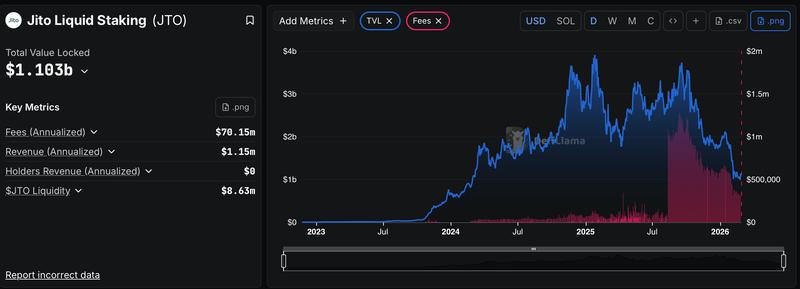
Jito's total value locked (TVL) currently sits at approximately $1.1 billion, following a peak that exceeded $3.0 billion during 2025 before experiencing a decline into the early months of 2026, based on data provided by DefiLlama.