
US Banking Industry Claims CLARITY Act's Stablecoin Rules Inadequately Safeguard Deposits
Major banking organizations in the United States have expressed dissatisfaction with the stablecoin yield provisions recently proposed in the CLARITY Act, contending that these measures inadequately safeguard traditional bank deposits.
The nation's most prominent banking organizations have voiced continued discontent with recently proposed provisions in the CLARITY Act concerning stablecoin yield, contending that the legislation does not adequately safeguard traditional bank deposits.
Through a statement released on Monday, banking representatives recognized that US Senators Thom Tillis and Angela Alsobrooks are "seeking to achieve the correct policy goal" through their efforts to ban stablecoin yield, though they emphasized that the current "proposed language" within the CLARITY Act "falls short of that goal."
"It is imperative that Congress get this right," the American Bankers Association said in a joint statement with the Bank Policy Institute, Consumer Bankers Association, Financial Services Forum and Independent Community Bankers of America.
The ongoing disagreement between traditional banking institutions and the cryptocurrency sector regarding stablecoin yield provisions has created delays for the bipartisan legislation, which successfully cleared the House of Representatives in July with a 294-134 vote. Questions persist about whether the CLARITY Act can be enacted before the US midterm elections scheduled for November 2026, a timeline that could present additional obstacles to its advancement.
Traditional banking organizations have referenced research in the past indicating that if stablecoins achieve widespread adoption, the US banking sector could experience outflows reaching into the trillions of dollars, with community banks being especially vulnerable, as they may lack sufficient balance-sheet flexibility to manage such outflows without turning to more expensive wholesale borrowing options.
In the Monday statement, the bankers also cited an article by Stanford-trained economist Andrew Nigrinis to argue that stablecoin yields driving bank deposit outflows "could reduce all consumer, small-business, and farm loans by one-fifth or more, making it essential for the prohibition to be clear and transparent."
However, White House economists reported in April that banning stablecoin yield may increase bank lending by only $2.1 billion, a marginal net increase of about 0.02%.
Bankers want "loophole" closed
Banking representatives have raised objections to the wording found in Section 404, claiming that it creates an avenue for cryptocurrency platforms to compensate users with bank-like interest or yield while operating outside of conventional regulatory frameworks.
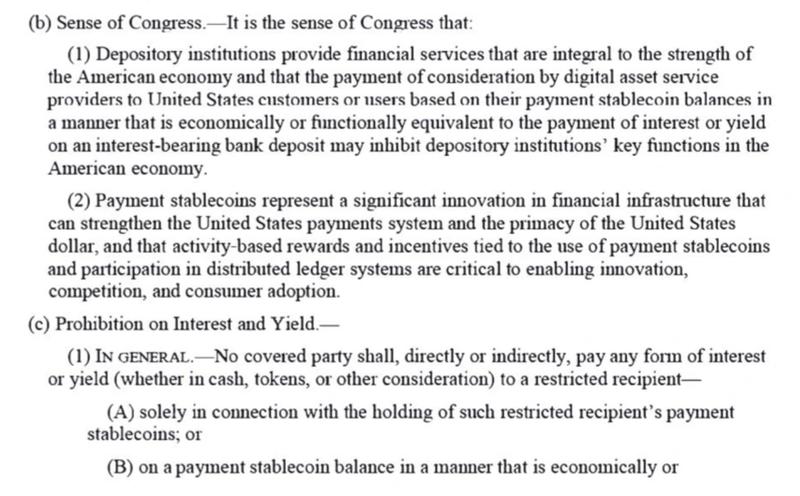
"This is a significant loophole that must be addressed," the bankers said, adding that they will be sharing "detailed suggestions for strengthening the proposed language with lawmakers in the coming days."
However, Tillis said the current text of the CLARITY Act strikes a compromise by prohibiting stablecoin rewards on idle balances while allowing crypto platforms to "offer other forms of customer rewards."
"Most importantly, it helps put us on a bipartisan path to pass the CLARITY Act, providing the regulatory certainty needed to foster innovation. Some in the banking industry may not want either of these things to happen, and we respectfully agree to disagree."
The current text of the CLARITY Act was made public on Friday, with Coinbase and other members of the crypto industry pushing for a Senate markup next week.