
Unanswered Questions After Early Bitcoin Adopter Destroys $1M in BTC
After remaining inactive for 12 years, a Bitcoin wallet transferred $1M to a cryptocurrency custodian, received nearly the full amount back, and then sent the coins to an unspendable address weeks later. The reasoning behind this remains unexplained.
This past March witnessed an unusual event: someone transferred Bitcoin valued at $1 million to a major cryptocurrency custodian. After a three-week interval, nearly the identical sum was returned. Then, remarkably, in less than two months following the return, the entire Bitcoin balance was intentionally rendered permanently inaccessible.
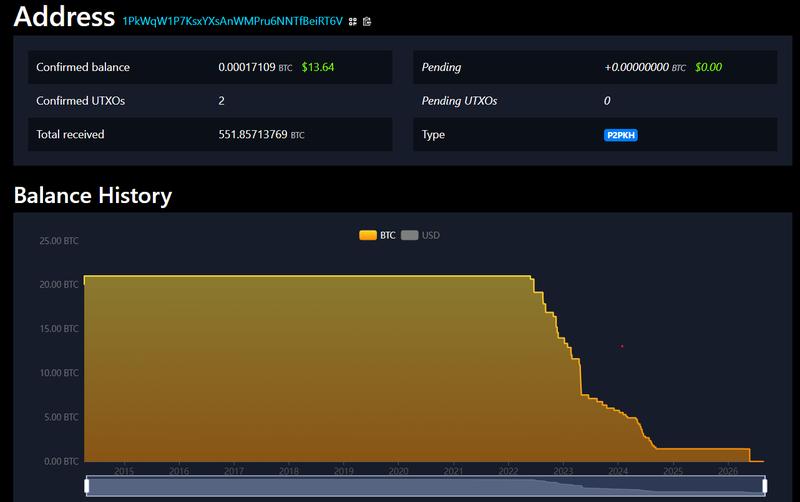
For nearly 12 years, the wallet had shown zero activity before its unexpected reactivation. Bitcoin educator Bennet observed that it transmitted 20.00010537 BTC to "a custodian of some kind" and subsequently received the funds back (with approximately $3 deducted).
"The whole balance went out to what looks like an exchange hot wallet, and almost exactly the same amount came back three weeks later. Seven weeks after that, it was burned."
This puzzling BTC transaction forms one piece of a larger puzzle involving 107 BTC that were destroyed in May, representing approximately $8.5 million in value at that moment.
Recent blockchain examination reveals that five separate wallets which ultimately destroyed their Bitcoin holdings seem to have been under the control of a single individual. This person was most likely an early adopter of Bitcoin who maintained funds on Mt. Gox, the now-defunct exchange.
The question that defies logical explanation is: what would motivate anyone to intentionally obliterate millions of dollars in Bitcoin?
The BTC wallets behind the burn
According to Chainalysis, the five addresses that eventually transmitted their Bitcoin to an address from which spending is impossible display "strong indicators of common ownership."
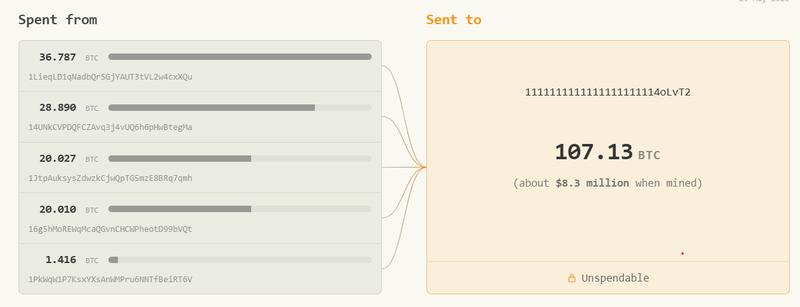
Each of the five wallets received their initial funding on the identical date in April 2014, and every one of them later transmitted nearly equivalent dollar-value amounts of BTC to an identical deposit address at a major centralized exchange.
These addresses additionally appear to have functioned in rotation: activity from one would continue sending Bitcoin to the exchange until it ceased, at which point another would assume the role with transactions showing a "similar cadence and value."
According to Chainalysis, the majority of these funds can be tracked back to Mt. Gox, "suggesting the owner was an early adopter of Bitcoin."
This doesn't automatically indicate the coins were taken directly from Mt. Gox, given that the exchange stopped operations in February 2014, while the five wallets received funding in April. Bennet says:
"It's entirely possible that the owner of these coins was one of the lucky ones who managed to get their coins off the exchange before it collapsed."
The identity of the custodian continues to be unknown. Chainalysis acknowledges it's a major centralized exchange but maintains it does not reveal publicly the names of services it identifies.
Based on Bennet's analysis, the address exhibits behavior typical of a static customer deposit address at a major custodian.
This assessment stems from the fact that the address doesn't keep a balance, and incoming deposits get swept into transactions that include dozens of additional inputs before undergoing consolidation into an omnibus wallet.
After the Bitcoin enters the custodian's infrastructure, the public blockchain loses the ability to inform us about what occurred with those coins. This makes the wallet's prior activity all the more fascinating.
The $10,400 clue
Between 2022 and 2024, one among the five addresses transmitted 19.6 BTC through 60 separate transactions to the custodian.
The quantities of Bitcoin varied considerably, spanning from approximately 0.15 BTC to 0.62 BTC. However, when calculated in dollar terms, the transactions display remarkable consistencies.
Even though Bitcoin's value increased more than fourfold throughout this timeframe, 58 out of the 60 transfers fell within 10% of roughly $10,400 at the moment they were transmitted.
Therefore, although the owner wasn't transmitting identical BTC amounts repeatedly, they were consistently transmitting nearly identical dollar values. Bennet says:
"This suggests to me a planned liquidation strategy."
Proving this hypothesis from blockchain data alone is impossible, given that the BTC became mixed with substantial quantities of other coins after arriving at the custodian, and the available data doesn't reveal whether the Bitcoin underwent sale, retention, or transfer to another location.
Notably, "while payment size was constant," Bennet says, "frequency was not — these $10k transfers came in clusters," which might align better with someone transmitting fixed-dollar sums as needed instead of adhering to an automated timetable.
The $1 million round trip
Although the $10,400 transactions provide a potential explanation for the wallet owner's previous interactions with the custodian, they fail to clarify the $1 million round trip that occurred in March.
Following approximately 12 years of inactivity, the wallet abruptly transferred its complete balance of 20.00010537 BTC and had 20.00006037 BTC returned to it, representing a discrepancy of merely 4,500 satoshis, or roughly $3.
This casts doubt on the notion that the owner was merely trading the Bitcoin, because regardless of what transpired within the custodian, nearly the exact same quantity returned.
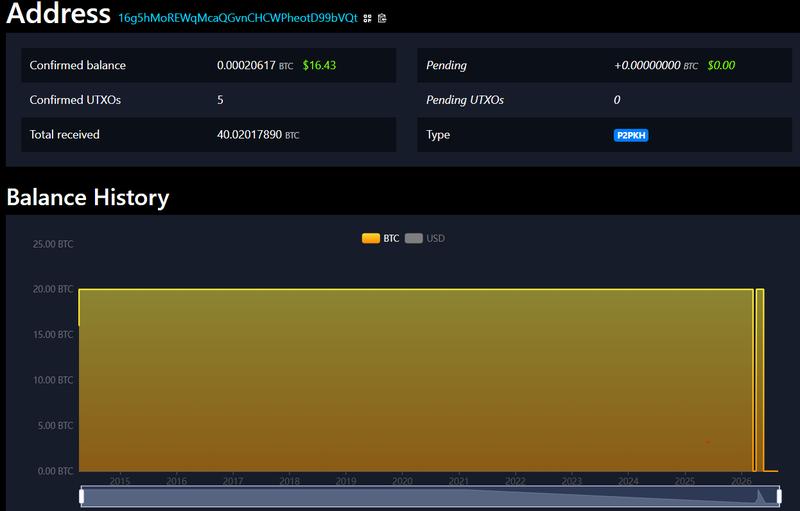
The returning Bitcoin was additionally divided into three separate transactions of 7 BTC, 7 BTC and 6.00006037 BTC, transmitted across three consecutive days.
According to Bennet, the round numbers align with a daily withdrawal limit enforced by the custodian. Significantly, the Bitcoin didn't merely arrive at a different wallet; it came back to the identical address that had originally sent it.
The transaction record also demonstrates that the identical key holder maintained control of the coins both before and after the round trip, Bennet says: transmitting the Bitcoin in March necessitated the private key, whereas burning it in May necessitated that same key once more.
This makes the entire sequence especially challenging to interpret as a standard exchange transaction.
So why did they do it?
Multiple possibilities exist, yet none accounts for the complete body of evidence. The liquidation hypothesis provides some rationale for the earlier transactions, yet it fails to explain why the owner would transmit roughly $1 million through identical infrastructure in March only to retrieve essentially all of it.
It's conceivable the owner was verifying an old wallet or custody arrangement following 12 years of dormancy, transferring the coins through a major custodian and successfully retrieving them to demonstrate that an old key and custody configuration remained functional. However, this raises the question: why subsequently destroy the Bitcoin?
Tax or compliance motivations could potentially account for why someone would move an old cache through a major custodian, yet there is no evidence connecting the transaction to a specific tax or regulatory occurrence.
A privacy-related explanation also exists. Transmitting Bitcoin through a custodian that consolidates deposits into an omnibus wallet renders the subsequent movement of those coins significantly more difficult to track onchain. While certainly plausible, this still offers no insight into their ultimate destruction.
It's possible the Bitcoin burn itself was meant as a form of statement. However, aside from a handful of blockchain investigators, the action nearly escaped notice.
The burning of Bitcoin cannot be reversed, meaning whoever controls the private keys made the choice to transmit the coins to a destination where they can never be utilized again, instead of simply leaving them inactive. Bennet says:
"There's also the possibility that a very wealthy individual without heirs decided to permanently burn their coins (thereby publicly reducing the total bitcoin supply), rather than just destroying their keys."
At present, even the organizations most qualified to examine the blockchain find themselves without answers. Chainalysis concedes:
"We don't have a clear explanation for why the owner would move a long-dormant stash through a custodian, retrieve roughly the same amount, and then deliberately burn it."
Although the blockchain provides us with an exceptionally comprehensive record of the events that transpired, it cannot reveal the motivation. At least for the time being, that continues to be the million-dollar question.