
Treasury Department Imposes Sanctions on Ethereum Wallets Connected to Sinaloa Drug Cartel
The Office of Foreign Assets Control has placed sanctions on half a dozen Ethereum wallet addresses associated with a money laundering operation linked to the Sinaloa Cartel that reportedly transformed narcotics revenue into cryptocurrency.

The Office of Foreign Assets Control (OFAC), operating under the US Department of the Treasury, has imposed sanctions on half a dozen Ethereum wallet addresses connected to a money laundering operation with ties to the Sinaloa Cartel that purportedly transformed proceeds from drug trafficking into digital currency.
On Wednesday, OFAC included these addresses in its Specially Designated Nationals list (a sanctions registry maintained by the United States that identifies individuals, organizations and assets subject to blocking measures) as part of broader sanctions targeting 11 people and two organizations associated with two financial operations connected to the Sinaloa Cartel.
According to Treasury officials, one operation, under the leadership of Armando de Jesus Ojeda Aviles, gathered large quantities of physical currency throughout the United States from fentanyl sales and other narcotics transactions before purportedly transforming these funds into digital currency for transmission to cartel members operating in Mexico.
The enforcement measure underscores the manner in which money laundering operations linked to cartels are leveraging digital currencies in conjunction with traditional cash transportation methods and shell companies, creating increased compliance obligations under sanctions regulations for cryptocurrency trading platforms and other providers of virtual asset services.
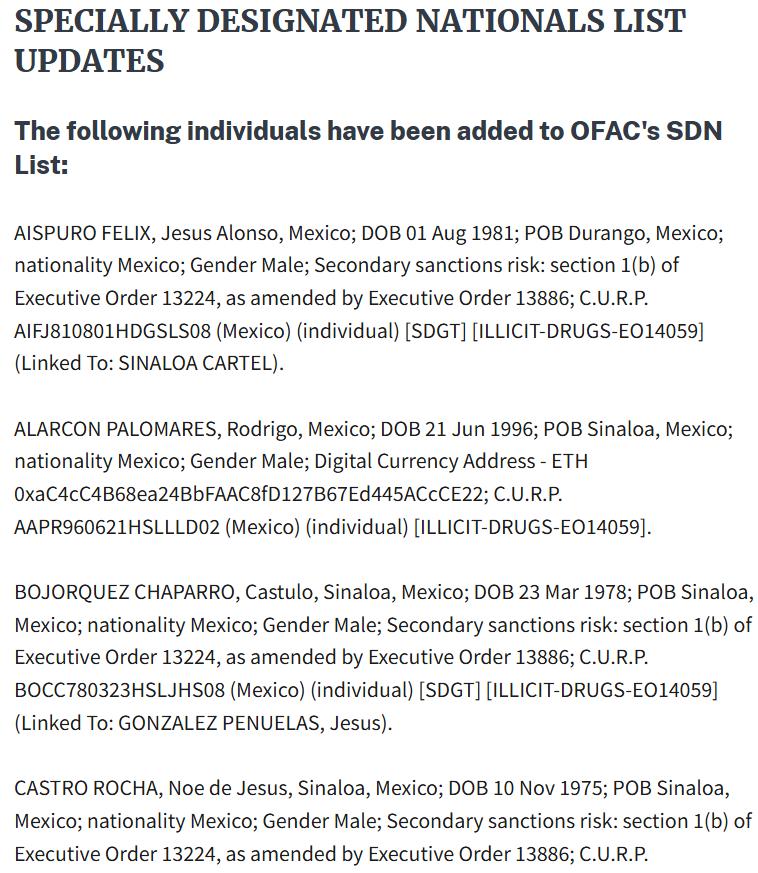
Cartel cash moved into crypto
According to OFAC's findings, the Sinaloa Cartel is purportedly leveraging distributed ledger technology to launder proceeds obtained through illegal fiat currency operations.
Cointelegraph reached out to OFAC requesting additional information regarding the money laundering activities of the Sinaloa Cartel.
The Treasury Department chose not to disclose which cryptocurrency exchanges or decentralized protocols were purportedly utilized by the criminal network. Nevertheless, the Ethereum addresses now on the sanctions list create compliance obligations for digital asset exchanges, cryptocurrency wallet services and other blockchain companies that monitor on-chain transactions for regulatory purposes.
Examining some of the largest cryptocurrency security breaches, perpetrators successfully laundered the vast majority of the $1.4 billion taken during the Bybit security incident, approximately $1.2 billion, via THORChain, converting assets from Ether to Bitcoin, based on statements from Bybit co-founder and CEO Ben Zhou.
The perpetrators responsible for the recent $293 million Kelp DAO security breach similarly relied predominantly on THORChain to convert the Ether into Bitcoin, producing approximately $910,000 in transaction fees for the decentralized protocol, as Cointelegraph documented on April 23.