
Treasury Department Calls for Public Feedback on Stablecoin State Regulation Framework
As dollar-backed stablecoins approach a $300 billion market cap, the Treasury has released its proposed rulemaking notice for public consideration.

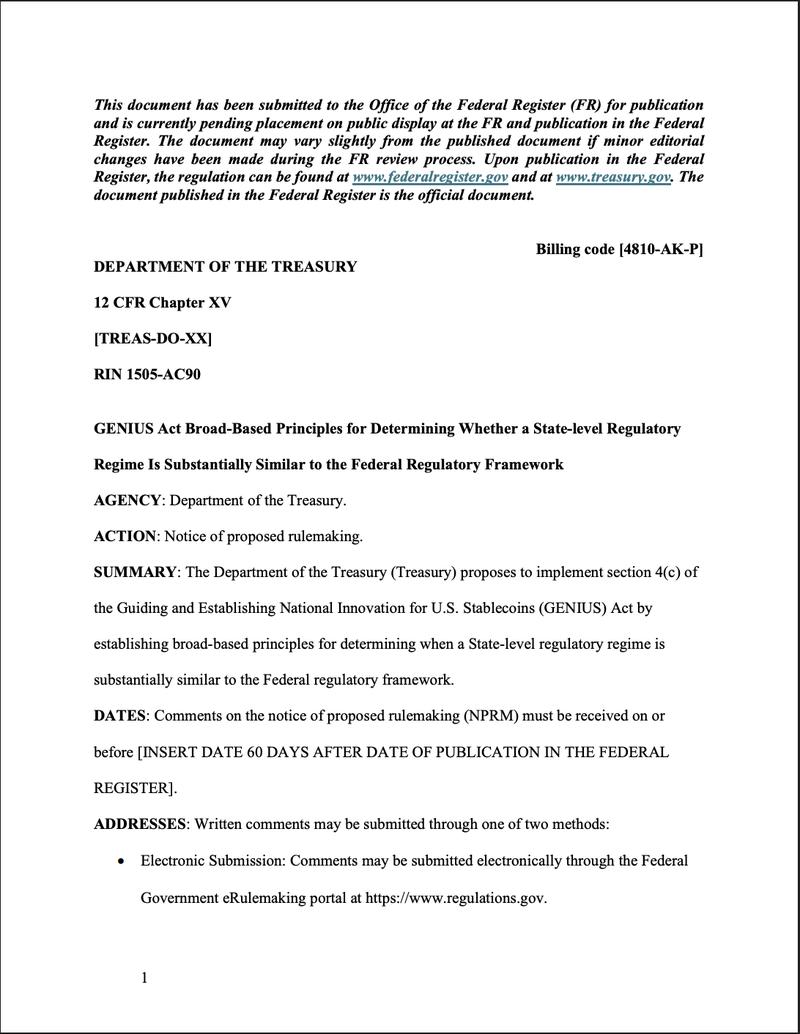
On Wednesday, the United States Department of the Treasury released a notice of proposed rulemaking (NPRM) and is requesting feedback from the public regarding proposed state-level governance frameworks for stablecoins under the GENIUS Act.
Known formally as the "Guiding and Establishing National Innovation for US Stablecoins Act," the GENIUS stablecoin regulatory framework grants states the power to oversee stablecoins that have a market capitalization below $10 billion, provided that such regulations remain closely aligned with federal policy standards.
The Treasury specified multiple mandatory stablecoin requirements that states must align with Federal regulations, including maintaining a 1:1 reserve backing through cash or high-quality cash equivalents, along with obligations for monthly reporting.
States are also required to maintain full compliance with federal anti-money laundering regulations and sanctions policies regarding stablecoins, while enforcing prohibitions on token rehypothication, which involves using identical assets to back multiple claims.
According to the proposal, states maintain the authority to establish their own liquidity requirements, reserve standards, risk management protocols, regulatory procedures, enforcement mechanisms and administrative rules, provided that such rules establish higher financial standards or are more stringent than federal regulations.
State-level regulatory regimes must lead to regulatory outcomes that are at least as stringent and protective as the Federal regulatory framework
Comments from the public must be submitted within 60 days following the NPRM announcement. When a stablecoin issuer surpasses the $10 billion threshold, it will automatically fall under federal government regulatory jurisdiction, which means the largest stablecoin issuers will be subject to exclusively federal-level regulation.
GENIUS Act becomes law, but uncertainty remains over yield-bearing stablecoins
In July, US President Donald Trump signed the GENIUS Act into law, marking what was regarded as a landmark moment for cryptocurrency regulations.
Notwithstanding the landmark regulations, questions surrounding yield-bearing stablecoins and whether issuers of stablecoins can distribute interest to token holders have created obstacles for the CLARITY crypto market structure bill in Congress.
Certain crypto companies, with Coinbase at the forefront, maintain that yield-bearing stablecoins offer savers a competitive option compared to traditional savings accounts, which generally provide interest rates well below 1%.
The banking lobby remains opposed to yield-bearing stablecoins due to concerns that these tokens will trigger deposit flight and diminish the sector's market share.