
Trading firm Jane Street moves to have Terraform insider trading lawsuit thrown out
In a legal filing, Jane Street has requested dismissal of insider trading allegations brought by Terraform, claiming publicly available market data was sufficient to justify selling its position in the failing asset.
Market-making firm Jane Street has filed a request with a United States federal court seeking dismissal of legal action initiated by the bankruptcy administrator of Terraform Labs, which alleges the trading company engaged in insider trading that contributed to accelerating the Terra ecosystem's catastrophic failure.
According to a dismissal motion submitted to a federal court in Manhattan on Thursday, Jane Street contended that Terraform's legal action represents an effort "to extract cash from Jane Street to foot the bill for a fraud that Terraform itself perpetrated on the market."
"Terraform now claims it was victimized by Jane Street's trading," it added. "The problem with this theory is that Terraform's fraud scheme — in which Jane Street had no involvement — has already been prosecuted, adjudicated, and punished."
Todd Snyder, the court-appointed administrator overseeing Terraform's bankruptcy proceedings, initiated legal action against Jane Street, its co-founder Robert Granieri, along with employees Bryce Pratt and Michael Huang in February, alleging they conducted trades involving Terra tokens following receipt of confidential information from "Terraform insiders."
The Terra ecosystem experienced a complete meltdown in May 2022 following the depegging of its algorithmic stablecoin, TerraUSD, from its dollar parity, which triggered a precipitous decline in the price of the closely linked LUNA token and eliminated $40 billion in market capitalization.
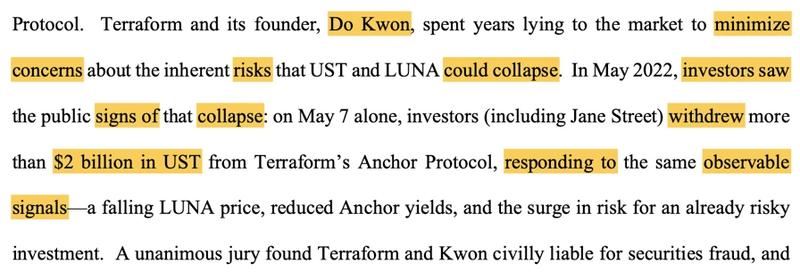
In its legal filing, Jane Street maintained that market participants "saw the public signs of that collapse," and the firm acted to "sell a deteriorating investment as the market was visibly collapsing."
The trading company asserted that the causes behind Terraform's implosion had been previously established through judicial proceedings, highlighting that Do Kwon, the project's founder, entered a guilty plea to charges of conspiracy and wire fraud, resulting in a 15-year prison sentence.
Jane Street further argued that Terraform's legal complaint contained "self-defeating" elements, pointing out that it acknowledged Jane Street's most significant TerraUSD transaction occurred 10 minutes after "supposed material nonpublic information was visible to the market."
The firm noted that Terraform failed to specify any material, confidential information that Jane Street allegedly obtained when the complaint accused the trading company of disposing of additional tokens in early May 2022 during Terraform's migration to a new liquidity pool.
"Plaintiff pleads 'on information and belief' that Jane Street learned the timing of Terraform's transition to a new liquidity pool through 'back-channel communications,' yet cannot identify a single communication disclosing that timing — despite extensive pre-suit discovery," the motion said.
Jane Street has petitioned the court for dismissal of the lawsuit with prejudice, which would prevent Terraform from filing identical legal claims against the company in the future.